
A Minnesota renter can do everything right on the bankruptcy forms and still feel one step away from losing the apartment. The lease is still live, the landlord is still watching the payment history, and the next rent date still arrives on the calendar whether the discharge comes through or not. That's why Renting During Chapter 7 In Minnesota is not really a credit-score story. It's a cash-flow story, a lease-status story, and a timing story.
The renter who treats Chapter 7 like a housing shield usually gets burned. The renter who treats it like a tool, and keeps the paperwork, rent proof, and court deadlines organized, has a much better shot at staying housed and finding the next place. For Minnesota context on relocation and neighborhood planning, ReloMaps Minnesota insights can be a useful starting point when the housing search gets serious.
A Minnesota Renter, a Chapter 7 Filing, and a Lease in Limbo
A renter in St. Paul can file Chapter 7 on a Monday and still be staring at a lease renewal, a late-rent notice, or a landlord's voicemail by Wednesday. The filing may stop some collection pressure, but it doesn't magically make the lease disappear, and it definitely doesn't make next month's rent optional. That's the trap.
The federal case and the Minnesota housing case run on two different tracks. Bankruptcy law decides what happens to the lease inside the case, while Minnesota landlord-tenant law decides what happens in the apartment. If those tracks aren't managed together, a renter can win one battle and still lose the unit.
Practical rule: Chapter 7 can protect breathing room. It does not protect a tenant who stops paying rent and stops answering notices.
The right mindset is simple. The filing creates a legal window, not a free pass. A tenant who stays current, documents everything, and responds fast to notices has options. A tenant who assumes the case itself solves the housing problem usually runs out of room fast.
For Minnesota renters, the first question is not “Will bankruptcy show up?” It's “What is the lease status right now, and how much time is left before the landlord can act?” That question controls everything that follows.
What Happens to Your Lease in the First 60 Days
Under 11 U.S.C. § 365, the Chapter 7 trustee has 60 days after the order for relief to assume or reject an unexpired residential lease, and if nothing happens by the deadline, the lease is deemed rejected unless the court extends time for cause (federal lease rule). Rejection sounds dramatic, but it doesn't automatically mean the tenant is on the curb that same day. It generally means the lease is treated as breached by the bankruptcy estate.
That distinction matters. A tenant can still remain in the home if rent keeps getting paid and Minnesota landlord-tenant law doesn't provide a separate path to removal. The trustee's deadline is a housing milestone, not an eviction order by itself.
How assumption and rejection work in real life
If a renter is current and wants to stay, assumption is the cleanest path. The debtor can also notify the landlord in writing that the lease should be assumed, and the landlord can agree, often on the condition that unpaid rent or other defaults are cured. If there are arrears, the landlord may demand cure before agreeing.
If the renter is two months behind, the case gets tighter. The trustee may still review the lease, but the arrears make assumption more difficult because someone has to deal with the default. If the landlord refuses to consent, the tenant does not get a guaranteed rescue from Chapter 7.
A rejected lease is not the same thing as an instant move-out order. It is a legal breach problem first, then a possession problem if rent and state-law obligations aren't handled.
Before filing, a renter should pull these items into one folder:
- Current rent balance, so the arrears are clear.
- Lease end date, because renewal and holdover issues matter.
- Security deposit details, including how much was paid.
- Any notices, especially late-rent or termination notices.
- Any eviction papers, even if the case seems inactive.
A good practical companion to the lease question is this guide to lease treatment in Chapter 7, because the lease issue is usually where renters lose time by guessing.
The Automatic Stay and the Stages of a Minnesota Eviction
A Minnesota renter can file Chapter 7 after receiving an unpaid-rent notice, after an eviction case begins, or even after a possession judgment. The automatic stay may pause collection and some eviction activity, but its value depends on the case's stage, the lease status, and whether rent can be kept current.
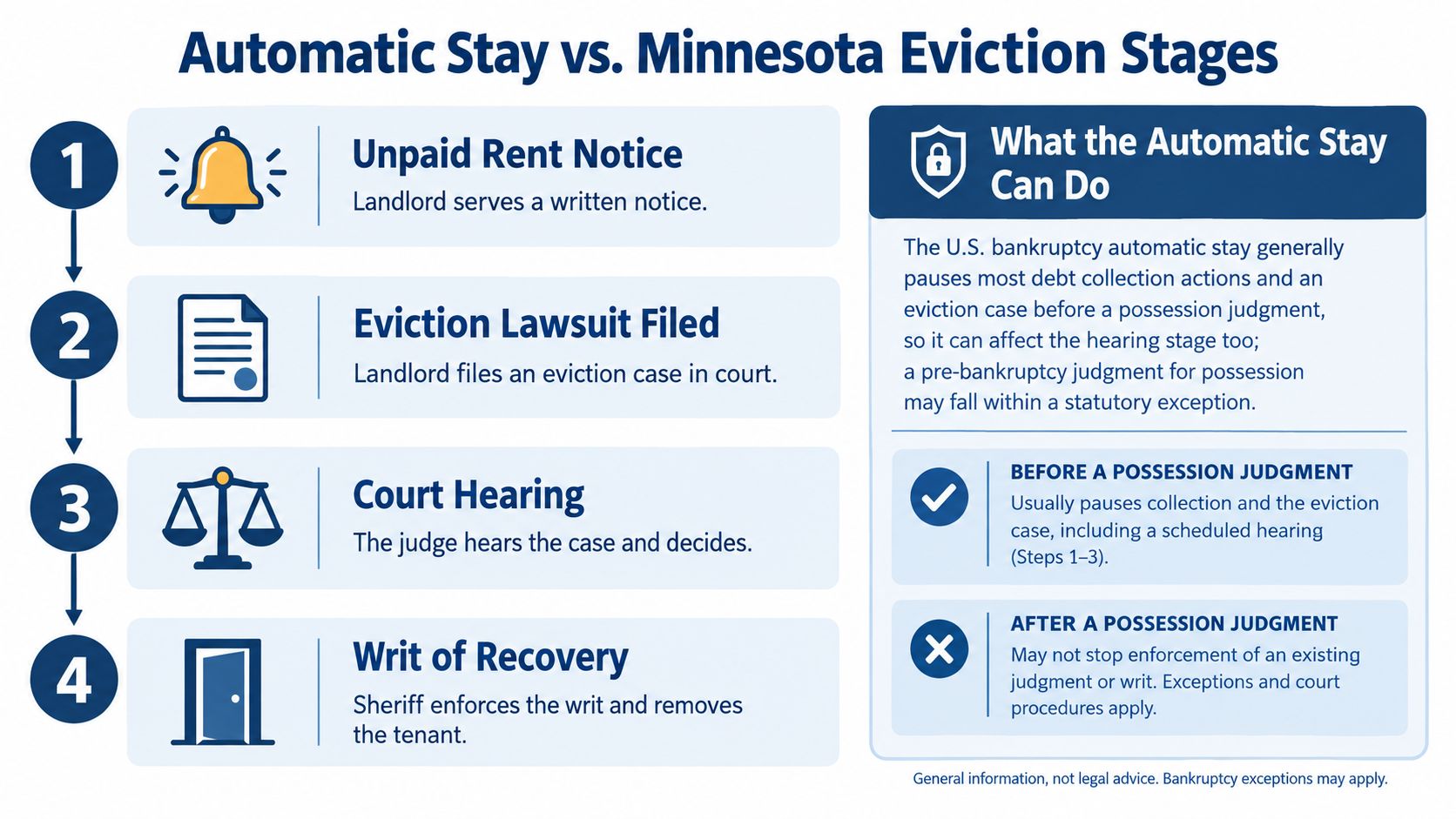
Match the bankruptcy filing to the eviction stage
Minnesota eviction cases generally follow four stages: an unpaid-rent notice, a filed eviction action, a possession judgment, and sheriff enforcement. Filing during the notice stage can create more room to address the arrears. Filing after a judgment leaves far less protection.
Minnesota's Attorney General explains that a landlord cannot lawfully remove a tenant by changing locks, shutting off utilities, or using other self-help tactics. Removal requires a court order and sheriff enforcement (Minnesota eviction procedures). The automatic stay does not prevent a landlord from using the court process when the law permits it.
The largest federal limit is an existing possession judgment. If the landlord obtained that judgment before the bankruptcy filing, the stay does not reliably erase it or restore the renter's position. Separate statutory exceptions can also apply in certain endangerment and controlled-substance cases. Those exceptions are less common in ordinary nonpayment disputes, but they can narrow the protection sharply.
The 14-day pre-filing notice window
Minnesota requires a 14-day written notice with financial and legal resource information before a landlord files a nonpayment eviction, effective January 1, 2024. Minnesota's 14-day written notice requirement, effective January 1, 2024, is described in the same Attorney General handbook cited above. The notice period gives a renter a short opportunity to pay, negotiate, seek assistance, or obtain legal advice before a case is filed.
Treat the notice date as a deadline. Confirm the balance, keep proof of every payment, and determine whether an eviction action or possession judgment already exists. For a clear explanation of how bankruptcy interacts with each stage, review this Minnesota bankruptcy and eviction overview. Chapter 7 may buy time, but it does not replace rent payments or repair a possession judgment by itself.
Tenant Screening, Credit Reports, and What Landlords Can Actually See
Bankruptcy is not the whole screening story. It is one data point inside a larger file that usually includes income, rent history, and public-record information. Minnesota renters often worry that the bankruptcy notation alone ends the conversation, but private landlords are usually looking at several pieces at once.
Federal law at 11 U.S.C. §525 prohibits government discrimination based solely on bankruptcy, while private landlords are generally not covered by that rule (bankruptcy discrimination rule). That means the screening fight is usually about documentation, not a blanket legal ban.
What a renter should ask for before paying a fee
Minnesota landlords who charge screening fees must disclose the screening provider and rental criteria before accepting payment, and the state limits denials based on certain pending or unresolved eviction records. That's why the first move is to get the rules in writing before handing over money. If the landlord won't disclose the criteria, that's a signal to slow down.
A tenant should walk into the application process with a clean, short packet:
- Written rental criteria, requested before the fee is paid.
- Proof of current income, such as pay records or benefit letters.
- On-time rent history, if available.
- A brief bankruptcy explanation, kept to a few sentences.
- A copy of the screening report, so errors can be challenged early.
Don't overexplain the bankruptcy
The strongest explanation is usually short. State what happened, say the filing was used to address debt, and point back to current income and rent performance. A long emotional story usually does more harm than good.
A useful credit reporting guide after bankruptcy can help a renter spot the difference between a clean report and one that still contains stale or inaccurate entries. For renters who need a broader application framework, a guide for renters with credit issues shows the kind of document-first approach that works even when the credit file isn't pretty.
What Chapter 7 Does and Does Not Fix for a Renter
Chapter 7 can wipe out qualifying unsecured debt, but it does not erase next month's rent, a new arrears balance, application fees, or the money needed to move. That's the part too many renters miss. The bankruptcy may reduce old financial pressure, but housing still runs on current cash.
Minnesota Housing says nearly 47% of Minnesota renters are cost-burdened, meaning they spend at least 30% of income on rent and utilities, and severely cost-burdened low-income renters reported average gross housing costs of about $1,380 per month in 2025 dollars (Minnesota Housing rental burden estimate). That's the backdrop. A discharge can help, but it doesn't make the next rent affordable by itself.

The real housing test is cash flow
The question is not whether the case looks clean on paper. The question is whether the household can cover rent, utilities, moving costs, and the deposit on a new lease without falling back behind. If the answer is no, the renter needs cash-flow triage, not just a discharge.
That's why bankruptcy advice that focuses only on approval odds misses the point. A renter can improve long-term approval prospects by clearing unsecured debt, but still be unable to pay for the actual move. The housing problem stays alive if the monthly budget is still too tight.
Bottom line: The worst housing problem is usually not the bankruptcy notation. It's an unresolved eviction, weak rent history, or a budget that still can't absorb housing costs.
One practical exception is that bankruptcy may be less damaging than a recent eviction record or unstable rent payments. Private landlords often care more about whether rent has been paid on time than about the mere existence of a Chapter 7 filing. That's why the budget problem has to be solved first.
Documents to Gather Before You Apply for a New Rental
Start gathering documents before you find an apartment. Screening decisions can move quickly, and disorganized paperwork can weaken an application even when the renter is being truthful. A complete file lets the landlord evaluate current qualifications instead of piecing together missing information.
Build the folder before the search starts
Keep one digital folder and, if possible, one paper copy. Include:
- Discharge order and case number, so the Chapter 7 filing can be verified.
- Recent proof of income, such as pay stubs or benefit award letters.
- Bank statements, showing current cash flow and available reserves.
- Landlord reference letters, if your prior housing record was stable.
- Proof of deposit funds, so the move can proceed if approved.
- Credit report summary, to identify bankruptcy or eviction errors before applying.
Prepare a short explanation letter as well. Limit it to two or three sentences. State that the Chapter 7 filing addressed past debt, confirm current income, and explain that the proposed rent fits the present budget. Keep the tone factual. Do not provide a long personal history.
Use the landlord's own criteria
Ask for the written screening rules before paying an application fee. Check the required income multiple, credit standards, rental-history requirements, co-signer rules, and any higher-deposit policy. If the criteria do not fit your documents, choose another property instead of spending money on an application likely to fail.
An eviction record may also require separate action. Minnesota courts can order expungement of some eviction records, including certain cases after three years or when justice clearly outweighs public access. That remedy belongs in state court, and bankruptcy does not erase an eviction record automatically. Gather the case information and determine whether the record is accurate before you apply.
A realistic move-in cost breakdown helps show how much cash a new lease can require before the first rent check clears. Add the deposit, first month's rent, moving expenses, utility setup, and any approved fees to your budget. A renter leaving Chapter 7 needs enough cash for the move, not merely a clean explanation of the filing.
A 90-Day Plan From Discharge to Approved Lease
A Minnesota renter can improve approval odds after discharge by treating the housing search as a records and cash-flow project. The first 30 days should focus on accurate paperwork, not rushed applications. Pull credit reports, review bankruptcy and eviction entries line by line, and dispute anything inaccurate or outdated.
Days 1 to 30, clean the paper trail
Keep the discharge order ready, check whether a possession case remains visible, and collect rent records from recent months. If an eviction entry is wrong, challenge it promptly. A short, factual explanation letter should state that Chapter 7 addressed past debt, confirm current income, and show that the proposed rent fits the present budget.
Days 31 to 60 are for building a current payment record. Pay obligations on time, keep bank balances steady, and document rent paid to a landlord, family member, or other housing arrangement. Current proof of reliable payments can matter more than the bankruptcy notation alone.
Days 61 to 90 are the application sprint. Apply only where the written criteria match your documents. Offer only supportable terms, such as a larger deposit or a co-signer, and ask for the denial reason if an application fails. Compare that reason with the landlord's stated standards.
Budget for approval and signing. The real move-in cost breakdown shows why a renter needs cash for the deposit, first rent payment, moving expenses, utility setup, and approved fees. Approval is only half the fight.
Minnesota renters should also address assistance, screening errors, and eviction-record timing. LifeBack Law Firm, P.A. offers a free 90-day Post-Bankruptcy Program with recovery support, which may provide structure during the housing search after discharge. Ensure the rental folder contains the discharge order, income proof, rent history, explanation letter, and records supporting any screening dispute before submitting applications.
Renter Questions That Only Come Up After You Have Read the Guide
A renter can usually apply before the discharge lands, but approval chances improve when the lease status is clear and the documents are ready. The safer move is to apply only when the income proof, rent history, and bankruptcy explanation are already in hand.
A spouse or co-tenant can sometimes be added to a new lease while Chapter 7 is open, but the landlord will still screen the household, and the bankruptcy's effect on the means test is separate from the rental application. The next step is to confirm how the lease will be underwritten before anyone signs.
If a tenant wants to come off an existing lease while the case is pending, the landlord and the trustee both matter, especially while the trustee is still inside the 60-day lease window. The right move is to get the lease reviewed before assuming a signature change solves the liability.
For proof of discharge, the best document is the discharge order, backed by the case number. Certified copies can be requested from the bankruptcy court, and that paperwork should be kept with the rental folder. The next step is to keep one clean copy ready for every serious application.
LifeBack Law Firm, P.A. helps Minnesota renters sort out the lease, the bankruptcy filing, and the housing paperwork that sits between them. If Chapter 7 is colliding with rent, eviction notices, or a new apartment search, visit LifeBack Law Firm, P.A. to get clear next-step guidance and a process that's built for real housing problems.