
A Chapter 7 filing can raise a credit score right away because discharged delinquent balances may no longer inflate utilization, even though the bankruptcy itself remains a major negative mark. Chapter 7 can stay on a credit report for 10 years from the filing date, while meaningful improvement may begin within 12 to 24 months when payments remain current and balances stay controlled.
A Minnesota or North Dakota filer may discover the change while checking a credit report after discharge. The number may look better than expected, yet approval for a mortgage, vehicle loan, or unsecured card can still be difficult. That apparent contradiction makes sense once score calculations and lender underwriting are treated as separate questions.
The score increase usually reflects the removal or reduction of damaging account information. It doesn't mean the bankruptcy has become harmless, and it doesn't guarantee that a lender sees the borrower as low risk. The practical task is to use the lift as a starting point, verify that every account is reported correctly, and build a stable record after discharge.
Why Your Score Jumped Right After Filing
A filer checks a credit-monitoring account after receiving a Chapter 7 discharge and sees a noticeable increase. The first reaction is often disbelief. Bankruptcy is supposed to hurt credit, so a higher score can feel like a reporting error or a temporary glitch.
The increase can be real. Before filing, the credit profile may have included severely delinquent credit cards, charged-off balances, and collection accounts. Those accounts can keep adding negative information while also making revolving utilization appear high. Once the debts are discharged and reported accurately, some of that pressure disappears from the scoring calculation.
Three changes can happen at once
The first change involves balances. Discharged unsecured accounts may show no balance, which can reduce the amount of revolving debt counted against available credit. The second involves delinquent accounts and collections. Accounts included in the bankruptcy may be updated so they no longer show an amount currently past due, although the bankruptcy notation and accurate pre-filing history can remain.
The third change is timing. The bankruptcy doesn't reach backward and erase every late payment that occurred before filing. It also doesn't necessarily create a new late payment for every month that came before the case. A score can therefore benefit from the end of active delinquency while still reflecting the serious public-record event.
A practical explanation of how included debts should appear after filing is available in LifeBack Law Firm's guidance on credit reporting after bankruptcy. A filer should compare that general framework with the actual reports from each bureau, because creditors don't always update records at the same time or with the same accuracy.
Practical rule: A higher score answers a scoring question. It doesn't answer the lender's full underwriting question.
The early lift creates an opportunity. It gives the filer a cleaner base from which to establish new payment history, but it doesn't replace the need for a budget, careful account selection, and regular report reviews. The next step isn't to borrow aggressively because the number improved. The next step is to protect the improvement.
The Mechanics Behind a Post-Chapter 7 Score Increase
A Minnesota or North Dakota filer may see a higher score soon after Chapter 7 filing or discharge and reasonably assume the credit problem is solved. The number can rise because the reported account data changed, while a lender may still view the bankruptcy as a serious underwriting concern. Those are separate questions.
Credit scoring models evaluate reported information, not the personal meaning of a bankruptcy discharge. If a profile showed large delinquent balances and then shows discharged accounts with no current balance, some risk signals may improve even though the bankruptcy remains visible.
What changes in the account data
Consider a credit card that was seriously past due before filing. Before discharge, it may show a balance, an amount past due, and missed payments. After discharge, it may show a zero balance with an included-in-bankruptcy notation. The pre-filing history does not become positive, but the account is no longer reporting the same unpaid balance as an active obligation.
Charged-off revolving accounts may also stop creating the same utilization pressure. Collection accounts included in the case should not continue reporting an unpaid balance as though the discharged debt remains collectible. If an incorrect balance remains, document the discrepancy and dispute it with both the credit bureau and the company reporting the information.
The effect can be more noticeable when high utilization and severe delinquency had already pushed the score down. Scoring models treat bankruptcy as a very negative event, but its effect depends on the full credit profile and the accounts involved. FICO's bankruptcy guidance explains why the same filing can affect two profiles differently.
How the profile may look before and after discharge
| Account type | Before discharge | After discharge | Possible scoring effect |
|---|---|---|---|
| Revolving account with delinquent balance | Balance and past-due amount may be reported | May show no balance and an included-in-bankruptcy notation | Lower reported debt can reduce utilization pressure |
| Charged-off revolving debt | Balance may continue to appear as unpaid | May be updated to show no current balance | Less active balance information may help the score |
| Collection account included in the case | Collection balance may appear outstanding | Should not show a remaining collectible balance for the discharged debt | An incorrect balance can continue harming the profile until corrected |
| Bankruptcy public record | Not yet present before filing | Appears as a major negative event | Continues to weigh on risk assessment |
The result can look contradictory. One part of the profile improves because delinquent debt is no longer reported as currently owed. Another becomes more serious because the bankruptcy public record appears.
Some severely damaged profiles can see an immediate increase when eliminating high balances has a greater effect on the calculation than the bankruptcy flag. Guidance on rebuilding after bankruptcy supports treating that increase as a scoring result, not proof that favorable loan terms are available. Equifax's rebuilding-credit guidance
For a Minnesota or North Dakota filer, the practical response is measured rebuilding, not immediate borrowing. LifeBack Law Firm's 90-day program can help organize the first stage: verify report updates, address inaccurate balances, establish manageable credit activity, and prepare for the underwriting review that a score alone cannot answer.
How Long Credit Recovery Actually Takes After Chapter 7
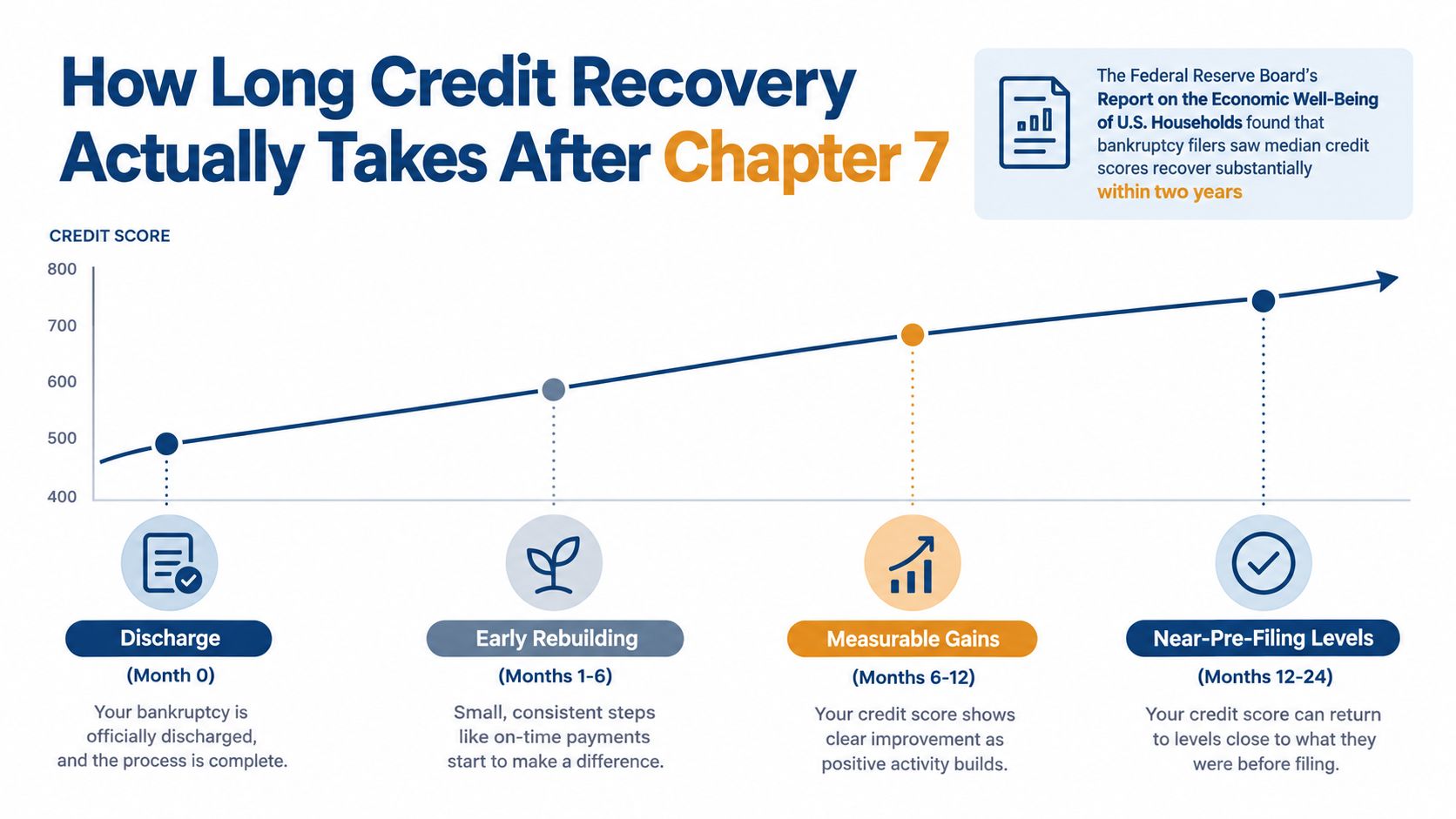
A score can rise before your financial profile feels recovered. After Chapter 7, the first change may reflect corrected account information, while the longer recovery depends on months of current payments, manageable balances, and stable finances. The first number is a snapshot, not a finish line.
Scoring models can react sharply when severe delinquency and high balances stop weighing on the calculation. The size and direction of the change depend on the entire credit profile. Consumer-credit guidance on the timing of bankruptcy reporting and recovery describes meaningful improvement as something that often begins within 12 to 24 months when a borrower maintains on-time payments and low balances.
A more realistic sequence
The first stage is the discharge and account-update period. Creditors and credit bureaus process changes at different times, so the score may move more than once as accounts are corrected. A filer should treat the first increase as an early signal, not a permanent result.
The next stage is controlled rebuilding. Each month of accurate, current payment history gives a lender newer information to review. The bankruptcy record may still appear, yet its relative importance can decline as the post-filing record grows. Reported balances and account updates can still produce temporary movement, so recovery rarely follows a perfectly straight line.
The longer stage is consistency. Avoiding new delinquencies, keeping balances manageable, and using credit within a realistic budget create a more reliable record. That record helps distinguish a short-term scoring lift from genuine underwriting recovery. A score may improve while a lender still sees limited recent history, so the practical goal is a profile that remains healthy after the initial jump.
Why the reporting period still matters
Chapter 7 remains on a credit report for 10 years from the filing date, not from the discharge date, according to the explanation of Chapter 7 credit reporting and score recovery. Learn more about how long Chapter 7 remains visible on your credit report. The reporting window does not freeze the score. It means lenders may continue to see the event while newer payment behavior supplies additional context.
For a Minnesota or North Dakota filer, LifeBack Law Firm's 90-day program can organize this early rebuilding period. The plan can focus on verifying report updates, correcting inaccurate balances, establishing manageable credit activity, and documenting progress. Measure recovery by both the score and the quality of the profile behind it.
When a Higher Score Still Means Limited Approval Odds
A score increase doesn't automatically turn a recent Chapter 7 discharge into a strong loan application. Scoring models reduce information to a number, while underwriters review the timing and circumstances behind that number.
Two borrowers can have similar scores and receive different decisions. One may have a recent discharge, little post-bankruptcy history, and a thin savings cushion. Another may have a much older discharge, a longer record of current payments, and fewer signs of financial strain. The score alone doesn't reveal those differences.
Underwriters look beyond the number
Mortgage lenders may review the discharge date, the reason for the application, the borrower's current obligations, and the rules of the loan program. A lender can also apply internal requirements that are stricter than a program's basic eligibility standards. Auto lenders may weigh the same factors differently and may respond to perceived risk through loan pricing, collateral requirements, or a larger requested down payment.
A denial after a score increase doesn't necessarily mean the score is wrong. It may mean the lender's underwriting system considers the bankruptcy too recent, the current income or debt picture insufficient, or the credit history too limited. The lender's adverse-action notice may identify the main reason, although a borrower may need to request clarification to understand how the decision was reached.
Underwriting realities after discharge
| Loan type | Minimum score | Seasoning after discharge | Typical down payment | Other requirements |
|---|---|---|---|---|
| Mortgage | Varies by program and lender | Program-specific and lender-specific | Depends on the loan and borrower | Income, assets, payment history, and report accuracy |
| Auto loan | Varies by lender | Lender-specific | Depends on the vehicle and risk assessment | Income verification, affordability, vehicle details, and credit history |
| Unsecured credit | Varies by issuer | Issuer-specific | Usually not applicable | Current obligations, recent payment history, and account risk |
| Secured credit | Product-specific | Often more accessible than unsecured credit | Security deposit may be required | Deposit, income information, and account terms |
The table is intentionally general. No single score guarantees approval, and a lender's rules can change based on the product and the applicant's complete file.
A score recovery is a credit signal, not a promise of loan approval or favorable pricing.
For Minnesota and North Dakota borrowers, the practical question is whether a proposed loan fits the household budget and whether the application will strengthen or strain the post-discharge plan. Waiting for a more stable profile may be wiser than accepting expensive credit just because an application is available.
Your First 90 Days After Discharge
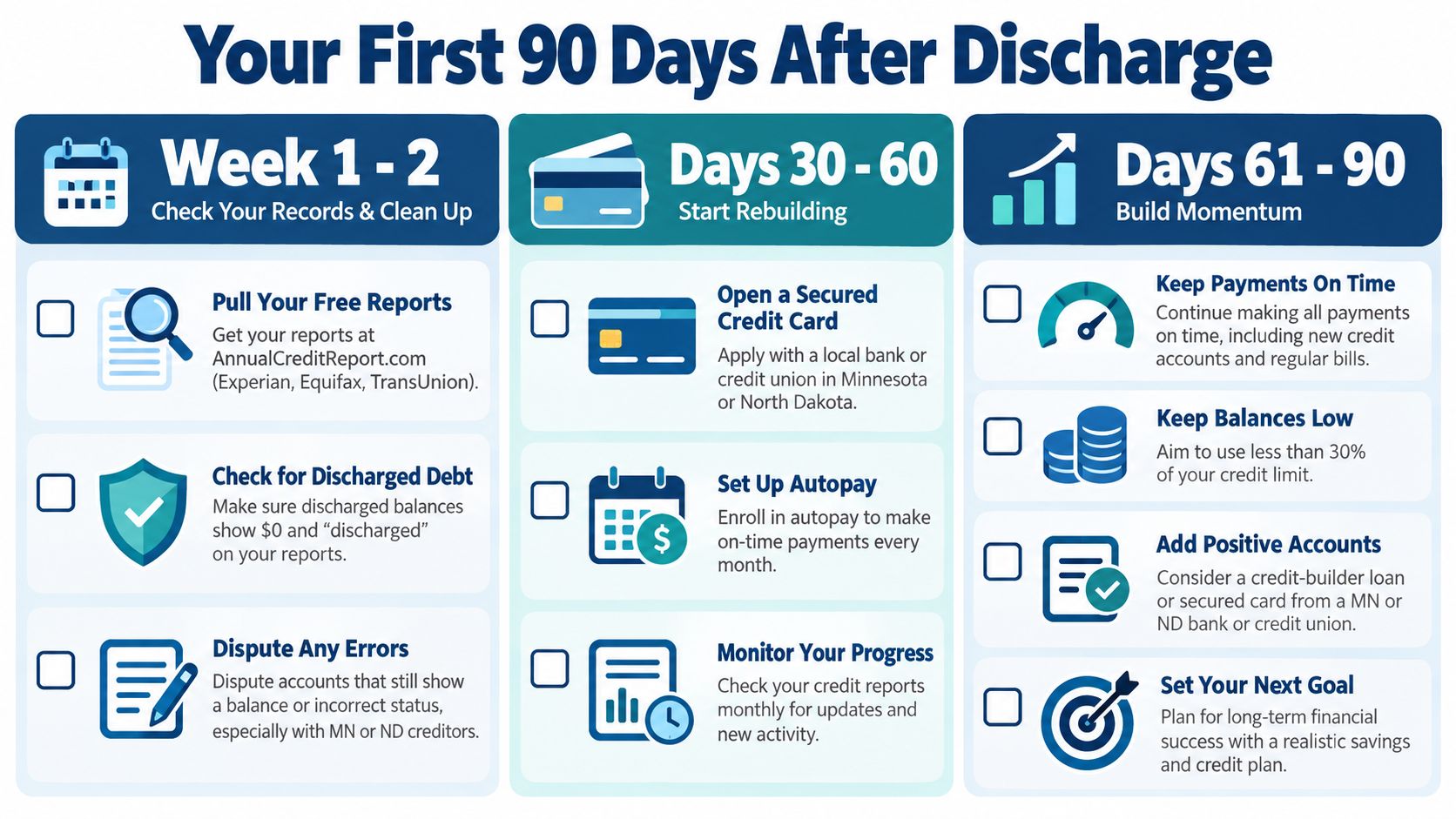
The first 90 days after discharge should be treated as a verification and stabilization period. A Minnesota or North Dakota filer can use that time to confirm that discharged accounts are updated correctly, prevent new late payments, and select only the credit products that fit the household budget.
Weeks one and two
The first task is to obtain reports from all three nationwide bureaus through the free federal report service. Each report should be reviewed separately because one creditor may update one bureau before another.
The review should check:
- Discharged balances: Included unsecured debts should not continue to appear as currently collectible balances.
- Account status: Included accounts should identify the bankruptcy accurately rather than showing a new unpaid balance.
- Dates: Filing, delinquency, charge-off, and update dates should not be altered in a way that creates inaccurate re-aging.
- Duplicate tradelines: The same discharged account shouldn't appear multiple times under slightly different descriptions.
- Remaining obligations: Reaffirmed debts and debts not discharged require separate review and continued payment under their actual terms.
A dispute should identify the account, state the exact inaccuracy, attach supporting records, and request a specific correction. A filer should save copies of the report, dispute, attachments, and response.
Days 30 through 60
A secured card can be considered if the budget can support the deposit and monthly management. The safest use is a small planned purchase followed by payment before the balance becomes difficult to control. A single manageable account is more useful than several new accounts that create extra due dates and spending opportunities.
Autopay for at least the required payment can protect the new payment history, but autopay shouldn't replace monthly review. The household budget should reserve money for housing, utilities, transportation, food, insurance, and any debts that survived discharge before discretionary credit use begins.
Days 61 through 90
The final phase is a review of what worked. The filer can compare updated reports, confirm that the secured account reports as expected, and move money into an emergency savings account when the budget permits. State housing finance agencies in Minnesota and North Dakota can also provide local education and first-time-buyer counseling for people planning a future home purchase.
The LifeBack post-bankruptcy program can add structure through a personal specialist, financing resources, and judgment-removal assistance. A filer considering that support can review the firm's guidance on the most important tip to rebuild credit after bankruptcy and then choose a plan that matches the household's actual cash flow.
Choosing the Right Rebuilding Tools After Bankruptcy
A recent Chapter 7 filer doesn't need every available credit product. The right first tool is the one that creates positive reporting without adding a payment obligation the household can't comfortably manage.
Secured credit cards
A secured card generally requires a refundable deposit and often begins with a modest credit limit. It can be useful for a filer who can make small purchases, track the statement balance, and pay on time every month.
The account should serve a budgeted expense, such as a recurring household bill. It shouldn't become a substitute for emergency cash. A filer who wants broader plain-language guidance can review this resource on how to improve your credit score, then apply only for an account whose fees and reporting practices are clear.
Credit-builder loans
A credit-builder loan is structured around regular installment payments, with the borrowed funds generally held or released under the product's terms. This option may fit someone who wants a forced savings habit and can manage another monthly payment.
The important question isn't whether an installment account sounds helpful. It's whether the payment remains affordable after rent, utilities, food, transportation, and unexpected expenses. A product that causes a late payment defeats its intended purpose.
Authorized-user status
An authorized user may benefit from a family member's well-managed account if the issuer reports that activity to the bureaus. This approach doesn't require the authorized user to control the account, but that lack of control creates risk. Late payments, high balances, or account closure by the primary cardholder can affect the result.
| Tool | Main advantage | Main risk | Suitable starting situation |
|---|---|---|---|
| Secured card | Establishes revolving-account activity | Deposit, fees, and overspending risk | A filer can manage one small monthly charge |
| Credit-builder loan | Adds installment history and may encourage saving | Creates a required monthly payment | Stable cash flow supports the payment |
| Authorized user | May add established account history | Primary user controls balances and payments | A trusted family member has disciplined account management |
A person rebuilding after bankruptcy should choose one manageable path first, monitor the reports, and add complexity only when the existing system works. The objective isn't to collect accounts. It's to create a clean record of controlled use.
Monitoring and Protecting Your Score Long Term
A post-discharge credit report should be reviewed as a living record, not treated as a one-time document. Monthly monitoring helps identify balance changes and new payment issues, while a broader quarterly review can catch inconsistencies across the three bureaus.
The bankruptcy itself may remain on the report. Accounts included in the case may remain as historical tradelines with an included-in-bankruptcy notation, but they shouldn't continue to show an inaccurate collectible balance. Reaffirmed debts should be reviewed differently because the borrower agreed to remain responsible for those obligations.
A simple review routine
- Every month: Check payment due dates, statement balances, and any new account activity.
- Every quarter: Compare reports from all three bureaus and look for duplicate tradelines, inconsistent balances, or incorrect dates.
- After every dispute: Keep the submitted evidence and confirm that the response addresses the specific error.
- Before applying for credit: Review the current reports and avoid applications that the budget or profile cannot support.
A filer should watch for re-aging, which can make an old delinquency appear newer, and for a collection account that continues to show a balance after the related debt was discharged. A duplicate account can also make the reported debt appear larger than it is. Each problem should be documented rather than handled through repeated, unsupported disputes.
How to dispute a lingering error
The written dispute should identify the bureau and furnisher, provide the account number or other identifying information, describe the inaccurate field, explain why the bankruptcy records support correction, and request deletion or amendment of the specific information. Copies of the discharge order, schedules, account statements, and prior correspondence can help establish the record.
A credit-report dispute doesn't erase accurate negative history. It asks the reporting parties to correct information that is incomplete, duplicated, outdated, or inconsistent with the bankruptcy case. If the issue remains unresolved, a bankruptcy attorney or qualified consumer-rights professional can help evaluate the next step.
Long-term protection also depends on behavior outside the report. A household should maintain a written budget, build emergency savings as cash flow allows, and avoid returning to high-balance revolving debt. The score may rise quickly after discharge, but financial stability grows from repeated decisions that keep new obligations affordable.
LifeBack Law Firm, P.A. offers bankruptcy guidance for Minnesota and North Dakota consumers, along with a structured post-bankruptcy program that supports credit-report review, financing resources, judgment-removal assistance, and rebuilding after Chapter 7. Recent filers can visit LifeBack Law Firm, P.A. to schedule a consultation and discuss a practical next step.
