
A truck payment can become the most difficult line in a Chapter 13 budget, especially when the vehicle is worth far less than the payoff balance. A Minnesota wage earner may be current on the loan yet unable to keep paying it while also funding priority claims, trustee fees, mortgage arrears, and ordinary household expenses. If repossession is threatened, filing Chapter 13 triggers the automatic stay and generally stops collection and repossession efforts immediately.
The right solution isn't always a cramdown. The 910-day vehicle exception can block that strategy, and reaffirmation, redemption, surrender, or a carefully handled replacement vehicle may make more sense. The outcome depends on the purchase date, personal-use status, vehicle value, loan documents, arrears, and the plan budget.
When a Car Payment Becomes a Chapter 13 Problem
Consider a Hennepin County wage earner earning $5,400 a month, two years into a six-year truck loan at 9.2%. The payoff is $24,000, but the truck is worth $15,800. The payment leaves too little room for $1,100 in priority claims, the Chapter 13 trustee percentage, and secured mortgage arrears.
That combination creates the classic Chapter 13 vehicle decision. The debtor may want to keep the truck, but the contract balance reflects yesterday's financing rather than today's collateral value. The first question isn't just whether the payment can be lowered. It's whether the loan qualifies for a cramdown, whether reaffirmation creates unacceptable liability, whether redemption is financially possible, or whether surrender is the responsible choice.
The stay protects the vehicle, but not the budget
The automatic stay takes effect when the petition is filed. It generally stops repossession, collection calls, lawsuits, and other creditor action while the case remains protected. The stay doesn't turn an unaffordable payment into an affordable one, however. The proposed plan still has to demonstrate that the debtor can fund required claims and maintain necessary secured obligations.
The first 30 days deserve immediate attention. Counsel needs reliable payoff information, a defensible valuation, and a decision about whether to schedule a valuation motion before confirmation. Waiting can create avoidable disputes with the lender and may force the plan to use contract treatment before the debtor has analyzed available options.
The practical choice
The three most discussed tools are cramdown, reaffirmation, and redemption, but surrender belongs in the same conversation. Each produces a different result:
- Cramdown: Splits the claim between the vehicle's value and the unsecured deficiency when the law permits it.
- Reaffirmation: Keeps the original contract in place, including its balance, rate, and personal liability.
- Redemption: Pays the lender the vehicle's value in a lump sum under 11 U.S.C. § 722.
- Surrender: Returns the vehicle, with any resulting deficiency generally treated as unsecured debt in the plan.
The analysis must also account for valuation evidence, plan drafting, servicer negotiations, confirmation language, and what happens if the truck fails during the case. Local procedure matters in both Minnesota and North Dakota, so a strategy that looks sound on paper can still fail if the motion, notice, or plan provision is incomplete.
The Four Tools for Handling a Car Loan in Chapter 13
A Chapter 13 car loan modification is a choice among competing legal and financial consequences. Cramdown may reduce the secured balance, but the 910-day rule can prevent it. Reaffirmation preserves the contract but can leave the debtor personally liable after bankruptcy. Redemption can be powerful when cash is available, while surrender may be the cleanest answer for a vehicle that no longer justifies its cost.
| Tool | Effect on Balance | Interest Rate | Typical Use Case | Post-Discharge Liability |
|---|---|---|---|---|
| Cramdown | Secured claim is limited to the vehicle's value, with the balance treated as unsecured when permitted | May be adjusted through plan treatment | Older, underwater personal-use vehicle loan | The unsecured remainder receives plan treatment and may be discharged after completion |
| Reaffirmation | Entire contract balance remains in place | Original contract rate and terms generally continue | Newer loan blocked by the 910-day rule, or a current-value loan | Debtor remains personally liable under the reaffirmed contract |
| Redemption | Lender receives the vehicle's value in a lump sum | Contract interest no longer controls the redeemed balance | Debtor has outside funds or a third-party source of payment | Liability is resolved through the lump-sum redemption |
| Surrender | Vehicle is returned and any deficiency enters unsecured treatment | No continuing vehicle-loan rate | Unaffordable, unreliable, or severely underwater vehicle | Deficiency is handled as unsecured debt under the case |
Cramdown works best for an older, underwater loan
For a vehicle purchased primarily for personal use outside the statutory waiting period, cramdown can separate the lien value from the unsecured balance. The debtor keeps the vehicle, pays the secured portion through the plan, and treats the remaining balance with other unsecured claims.
That's often the strongest fit for a long-term loan with substantial negative equity. It isn't a universal payment reduction, though. The plan must still pay the secured claim according to applicable requirements, and trustee fees, interest, insurance, maintenance, and other plan obligations can reduce the expected monthly savings.
Reaffirmation preserves certainty, but preserves risk too
Reaffirmation can be practical when the vehicle was purchased too recently for cramdown. It may also be appropriate when the payoff is close to the vehicle's value or the lender offers workable contract terms. The trade-off is significant: the debtor keeps personal liability and may face a deficiency if the vehicle is later surrendered or repossessed.
Redemption is less common because it requires a lump-sum payment. Surrender may make more sense when repairs are escalating, the payment consumes funds needed for essential claims, or the debtor can obtain reliable transportation at a lower overall cost.
Valuing the Vehicle and the 910-Day Rule
The secured portion of a vehicle claim is based on the collateral's value on the bankruptcy petition date, not automatically on the lender's payoff statement. Under § 506(a), the analysis generally asks what the vehicle is worth for the proposed use, supported by valuation evidence such as a recognized valuation printout or a comparable dealership appraisal.
A payoff statement answers a different question. It tells the court what the lender says is owed. It doesn't establish what the truck would reasonably sell for in the relevant market.
Start with petition-date value
Suppose the payoff is $24,000 and the supported vehicle value is $15,800. The proposed claim treatment would separate the debt as follows:
- Secured portion: $15,800, subject to the applicable plan treatment and interest.
- Unsecured deficiency: $8,200, treated with other unsecured debt.
- Payment result: The debtor doesn't pay the full payoff as a secured vehicle claim if the loan qualifies for cramdown.
The unsecured portion may receive only a partial distribution or be discharged after successful plan completion. The exact result depends on disposable income, required claims, trustee administration, and the confirmed plan. It isn't safe to promise a particular dividend.
For a fuller Minnesota-focused explanation of the valuation process, see this Chapter 13 cramdown guide for Minnesota filers.
Count 910 days from the correct transaction
The federal 910-day vehicle exception generally prevents cramdown when a personal-use vehicle was purchased within 910 days before filing. Because 910 days is roughly 2.5 years, a vehicle bought 36 months before filing may fall outside the restriction and qualify for cramdown, assuming the other requirements are satisfied. A vehicle bought 14 months before filing generally remains inside the restricted period, so the full loan balance usually remains secured if the debtor wants to keep it.
The rule is tied to when the debt was incurred and the nature of the vehicle use. Damage, replacement transactions, and unusual financing histories can complicate the calculation. The federal bankruptcy vehicle treatment reference describes the 910-day exception and its practical effect on Chapter 13 vehicle claims.
Expect a valuation fight when the evidence is weak
Auto servicers commonly challenge mileage, condition, prior accidents, aftermarket equipment, title history, and regional market conditions. A debtor who submits only an optimistic online estimate may lose credibility. The stronger approach pairs a dated valuation with photographs, repair records, inspection information, and a clear explanation of condition.
The so-called hanging paragraph in § 1325(a) is the statutory provision that blocks bifurcation for qualifying recent personal-use vehicle loans. It must be analyzed before a cramdown motion is drafted, not after the lender objects.
Drafting the Plan, Motion, and Confirmation Papers
A successful vehicle modification depends on consistent documents. The petition schedules, valuation motion, proposed plan, lender notice, and confirmation order must all describe the same vehicle, debt, value, and treatment. A mismatch can give the servicer an opening to object or later argue that the order doesn't control the claim.
File the valuation motion before confirmation
The usual sequence begins with a motion to determine the secured status and value of the collateral under § 506(a). The motion identifies the vehicle, lender, loan history, petition date, proposed value, and evidence supporting that value. It also explains why the 910-day restriction does or doesn't apply.
The proposed plan then classifies the auto claim as secured only to the extent of the vehicle's replacement value, with the balance treated as unsecured when permitted. The plan must show how the secured claim will be paid and how the unsecured remainder fits within the general unsecured distribution.
A separate order should resolve the valuation issue. The confirmation order should incorporate the final treatment clearly enough that the servicer can't later reopen valuation as though no decision occurred.
Make the budget match the legal treatment
The plan payment must reflect the actual vehicle treatment. That means accounting for the secured payment, interest, arrears, insurance, trustee administration, priority claims, and the debtor's ordinary living expenses. A proposed reduction that looks attractive before trustee fees and other claims may not survive feasibility review.
In the District of Minnesota, practitioners typically seek the trustee's position on plan treatment and valuation before confirmation. North Dakota practice can differ when local negative-notice procedures apply. Counsel should verify the current district procedures rather than assume a motion can be handled identically in Minneapolis, Fargo, or Bismarck.
The common Chapter 13 motions resource can help readers identify the procedural filings that often arise in a reorganization case. The important point is that filing a motion isn't the same as winning the requested treatment. Notice, evidence, objections, and the resulting order all matter.
Negotiating With the Auto Servicer for Real Savings
Negotiation usually becomes productive after the debtor has established a credible valuation and a legally supportable treatment. A servicer is more likely to stipulate when the motion includes a reliable appraisal, the 910-day analysis is complete, the proposed interest rate is explained, and the payment stream is easy to administer.
A typical stipulation addresses the secured claim amount, interest, payment timing, treatment of arrears, and the lender's lien rights. It should also state what happens to the unsecured balance and whether the agreement is subject to court approval.
Push the rate only after proving the principal
A debtor shouldn't negotiate the interest rate while ignoring the secured-value dispute. The principal classification usually creates the largest structural difference. Once that issue is narrowed, counsel can address the plan rate using the approach associated with Till v. SCS Credit Corp., including the relevant prime rate and adjustments for risk.
The plan must show a payment that the trustee can distribute and the debtor can maintain. A lower rate doesn't help if the proposed payment leaves no room for insurance, repairs, or changes in household income.
Practical rule: A servicer stipulation should resolve more than the monthly payment. It should eliminate ambiguity about value, interest, arrears, lien treatment, and the remaining unsecured claim.
Reaffirmation may be the realistic alternative
When the 910-day rule blocks cramdown, reaffirmation may be the lender's preferred solution and the debtor's only practical way to retain a newer vehicle. The contract stays intact, so the lender may refuse to reduce the balance or rate. The debtor then has to test whether the original payment fits within a feasible plan budget.
A lender may refuse to stipulate even when the valuation evidence is strong. That can lead to a contested hearing, where both sides present evidence about condition and market value. A careful valuation file often matters more than an aggressive opening demand. Readers considering whether filing can affect a vehicle payment can review this Minnesota auto-loan bankruptcy guidance.
When the Car Dies Mid-Plan
A confirmed plan does not guarantee that a vehicle will last until discharge. An engine can fail, an insurer can declare the car a total loss, or commuting needs can change after confirmation. Replacing the vehicle while keeping the existing plan payment is risky. The replacement affects the budget, secured debt treatment, insurance costs, and sometimes the plan itself.
New borrowing during Chapter 13 generally requires court approval and must fit the case's financial structure. The debtor may need a motion to incur post-petition debt under the Bankruptcy Code and local procedures. That request should show why the replacement is necessary, how much it will cost, and why the household can afford it without undermining plan payments.
Replacement choices require a new budget
The available options depend on the vehicle's condition, insurance proceeds, and the confirmed plan:
- Replace the vehicle with new financing: Disclose the proposed lender, purchase terms, interest rate, insurance expense, and monthly payment to the trustee and court.
- Modify the plan: New secured debt may require revised treatment, particularly if the replacement payment reduces funds available for creditors.
- Use available cash: Insurance proceeds or another permitted source may avoid new borrowing, but the source, amount, and use of funds must be documented.
- Surrender the old vehicle: The existing lien and any deficiency still require proper treatment in the bankruptcy case.
A totaled vehicle creates separate questions about insurance proceeds, lien payoff, and remaining equity. Surrender can create an unsecured deficiency that changes distributions. The trustee may ask how the old vehicle was valued, what happened to any equity, and whether the replacement improves or worsens feasibility.
Approval depends on necessity and affordability
Minnesota and North Dakota trustees generally expect specific evidence rather than a general request for a newer car. The filing should document the mechanical failure or total loss, transportation needs, replacement price, proposed rate, insurance, and effect on the confirmed plan.
Plan modifications occur during Chapter 13 administration. Court data report that 19,628 of 82,099 completed Chapter 13 consumer cases in 2025 had at least one plan modification before completion (2025 Chapter 13 modification data). That figure does not guarantee approval of a vehicle replacement. It does show that a confirmed plan may need adjustment when household circumstances change.
The debtor should not sign new auto financing and seek approval afterward. That sequence can create unauthorized debt, weaken plan feasibility, and place both the replacement vehicle and the bankruptcy case at risk. Obtain approval first, then complete the purchase under the terms presented to the court.
Documents, Deadlines, and Minnesota and North Dakota Notes
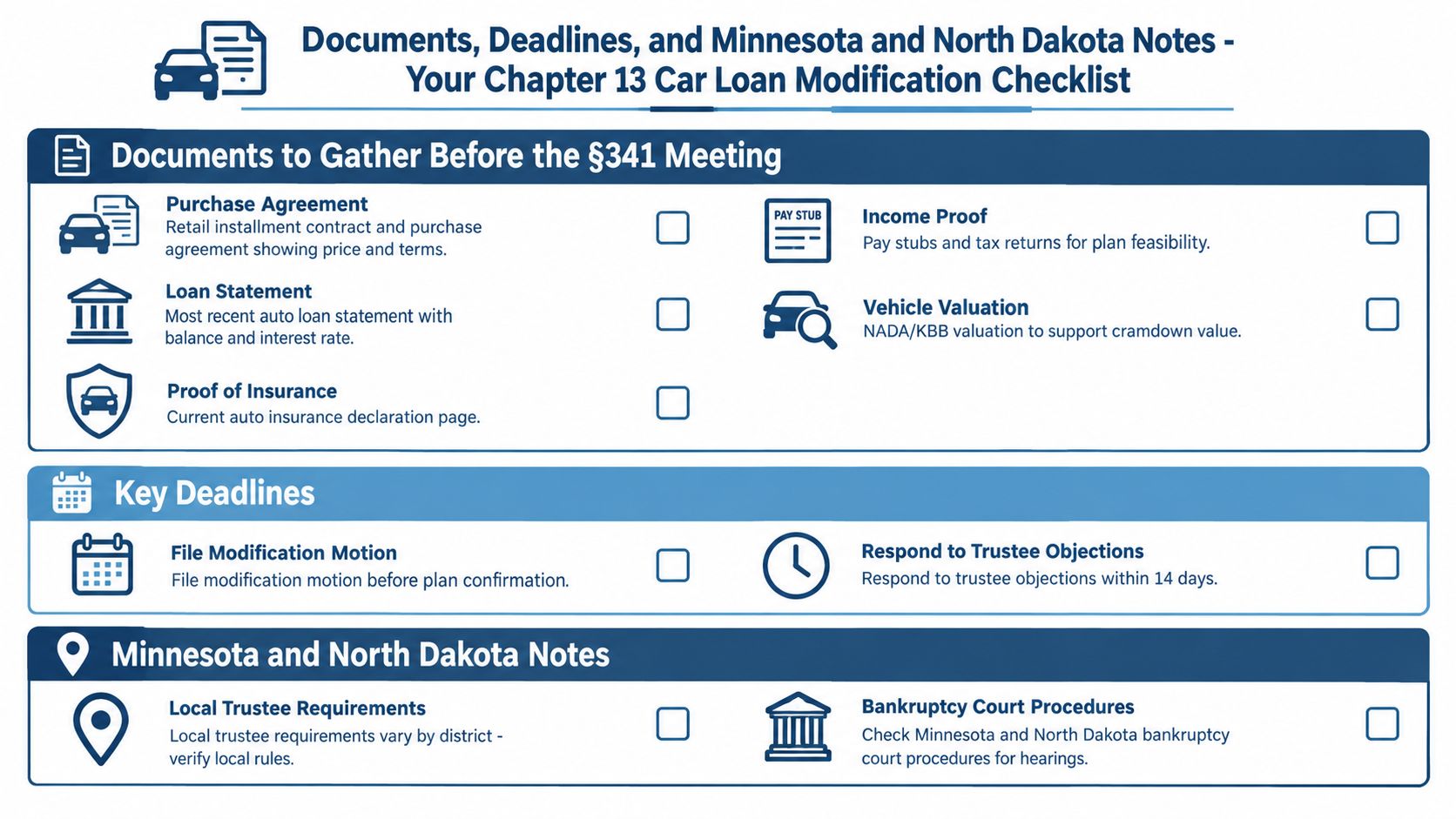
A trustee reviewing a Chapter 13 vehicle proposal will look for a file that answers practical questions: What is owed? What is the vehicle worth? When was it purchased? Is it insured? Can the household afford the proposed treatment? Gather those records before the §341 meeting.
Documents to gather
- Purchase contract: The retail installment contract and purchase agreement should show the purchase price, loan terms, and transaction date.
- Current payoff statement: Obtain a lender statement dated within 30 days. It should identify the balance, interest rate, arrears, and account information.
- Vehicle valuation: Provide dated valuation printouts. A dealership appraisal may also be needed when condition or market value is disputed.
- Ownership records: Include registration, title information, and records of prior purchases, transfers, or replacement transactions.
- Insurance proof: Provide the current declarations page showing required coverage and the lienholder.
- Income records: Pay stubs, tax returns, and household budget information must support the proposed plan treatment.
Deadlines control the strategy
Check the purchase date against the 910-day cutoff before recommending cramdown. If the rule blocks cramdown, the plan may need to rely on another treatment, such as negotiated terms, reaffirmation, or redemption. Valuation motions should be prepared early, and objections must be answered within the applicable notice period.
The plan and confirmation order should state the vehicle treatment clearly. Ambiguity can lead to disputes over ongoing payments, arrears, fees, or surrender rights after confirmation.
Local procedure also affects the filing. District of Minnesota Local Rule 3015-1 includes plan-content requirements that can affect vehicle claims. Counsel should review the standing Chapter 13 trustee addenda and filing timing in both districts. North Dakota procedures for negative-notice motions may differ from Minnesota practice, so forms from one district should not be filed in the other without checking the current rule.
What success really looks like
National court records show that Chapter 13 remains a widely used process, with many cases ending in dismissal or plan completion (2024 court data on Chapter 13 cases). That national scale does not make every vehicle strategy workable. A lower car payment helps only if the debtor can keep making plan payments after confirmation.
The final review should reconcile the purchase date, payoff, valuation, arrears, insurance, and household budget. LifeBack Law Firm, P.A. helps Minnesota and North Dakota debtors assess Chapter 13 vehicle treatment, prepare a workable repayment strategy, and address local filing requirements. Visit LifeBack Law Firm, P.A. to request a consultation about keeping, modifying, replacing, or surrendering a vehicle during Chapter 13.