
A Chapter 7 discharge doesn't mean a buyer must wait until the bankruptcy disappears from a credit report to pursue a mortgage. And a large down payment isn't the only route: in 2024, the median down payment was 9% for first-time buyers, according to the National Association of Realtors, as reported by Chase's summary of down-payment trends. The useful question is when a lender can fund the loan, and whether the buyer's full file is ready by then.
Waiting Periods From Your Discharge Date
| Program | Earliest common wait | What must be shown | How to treat it |
|---|---|---|---|
| FHA standard manual underwrite | 2 years from discharge | Good credit re-established or no new credit obligations | Ordinary FHA benchmark |
| FHA extenuating-circumstance review | At least 12 months and under 2 years | Events beyond the borrower's control plus responsible financial management | Exception only, not automatic |
| Conventional Fannie Mae standard | 4 years from discharge or dismissal | Time runs to the loan's disbursement date | Baseline for many conventional buyers |
| Conventional with extenuating circumstances | 2 years from discharge or dismissal | Documented events beyond the borrower's control | Shorter route, full underwriting still applies |
| Multiple bankruptcies within 7 years | 5 years, or 3 years with qualifying extenuating circumstances | Measured from the most recent discharge or dismissal | Stricter Fannie Mae rule |
| VA | Ask the lender to confirm the applicable date in writing | Eligibility, credit, and repayment capacity | For eligible veterans and some spouses |
| USDA | Ask the lender to confirm the applicable date in writing | Eligible property, household income, and credit | For qualifying rural-area purchases |
The clock generally starts at discharge or dismissal, not when the case was filed. For conventional financing that follows Fannie Mae's rules, the period runs from the applicable court date to the date the new loan is disbursed. That distinction matters: being able to apply or receive preapproval before the deadline doesn't mean the loan can close and fund before it.
Fannie Mae's conventional guidelines set the standard waiting periods and describe the qualifying hardship exception, including the separate rule for multiple filings. Fannie Mae's guidance on significant derogatory credit events is the place to confirm the applicable rule with a lender. For FHA manual underwriting, HUD describes the ordinary benchmark and the narrower exception for borrowers whose case involved circumstances beyond their control and who managed their finances responsibly afterward.
Practical rule: Treat the earliest date as permission to ask for approval, not proof that the loan will be approved.
A shorter path requires evidence, not just a convincing explanation. A borrower seeking an extenuating-circumstance exception should be prepared to document what happened, why it was outside their control, and how the situation changed. Lenders may also apply overlays, meaning stricter requirements than the agency minimum, such as a longer wait or tighter credit and debt-to-income standards.
Keep the discharge order and case docket together, then write down each program's earliest potential disbursement month before touring homes. Anyone who needs to confirm what a discharge order says can review this guide to how long a Chapter 7 discharge takes.
Settle Your Case Status Before You Apply
The discharge date sets the earliest possible starting point, but an unresolved case can make that date unusable. Consider a Chapter 7 borrower whose discharge is entered while the trustee's no-asset report is still pending. The lender will distinguish the court's discharge from the remaining case activity, then check whether its chosen loan channel allows underwriting to proceed. An agency waiting period is permission to apply, not a promise of approval; lender overlays and the borrower's file still matter.
For FHA, VA, USDA, or conventional financing, ask the lender how it treats the specific open-case status before relying on the earliest date. A pending trustee report is not the same as a pending discharge, but the lender may require the file to be resolved before closing. If the case involves exempt assets or a home sale, ask the bankruptcy attorney and trustee what actions are permitted before listing the property or signing a purchase contract.
Reaffirmed debts change the monthly calculation. A debt the borrower agreed to keep paying can count toward debt-to-income, even if other debts were discharged. Include the required payment when the lender reviews the application, and clarify how it will be treated rather than assuming the discharge removed it from the budget.
A co-borrower changes the review, too. Their income may help, but their debts and credit history enter the file as well. Confirm how the selected program treats that person before relying on their income. If the borrower already owns a home, the lender may also need its sale closing statement or mortgage payoff before the new loan can fund.
Which Loan Fits Your Cash and Property
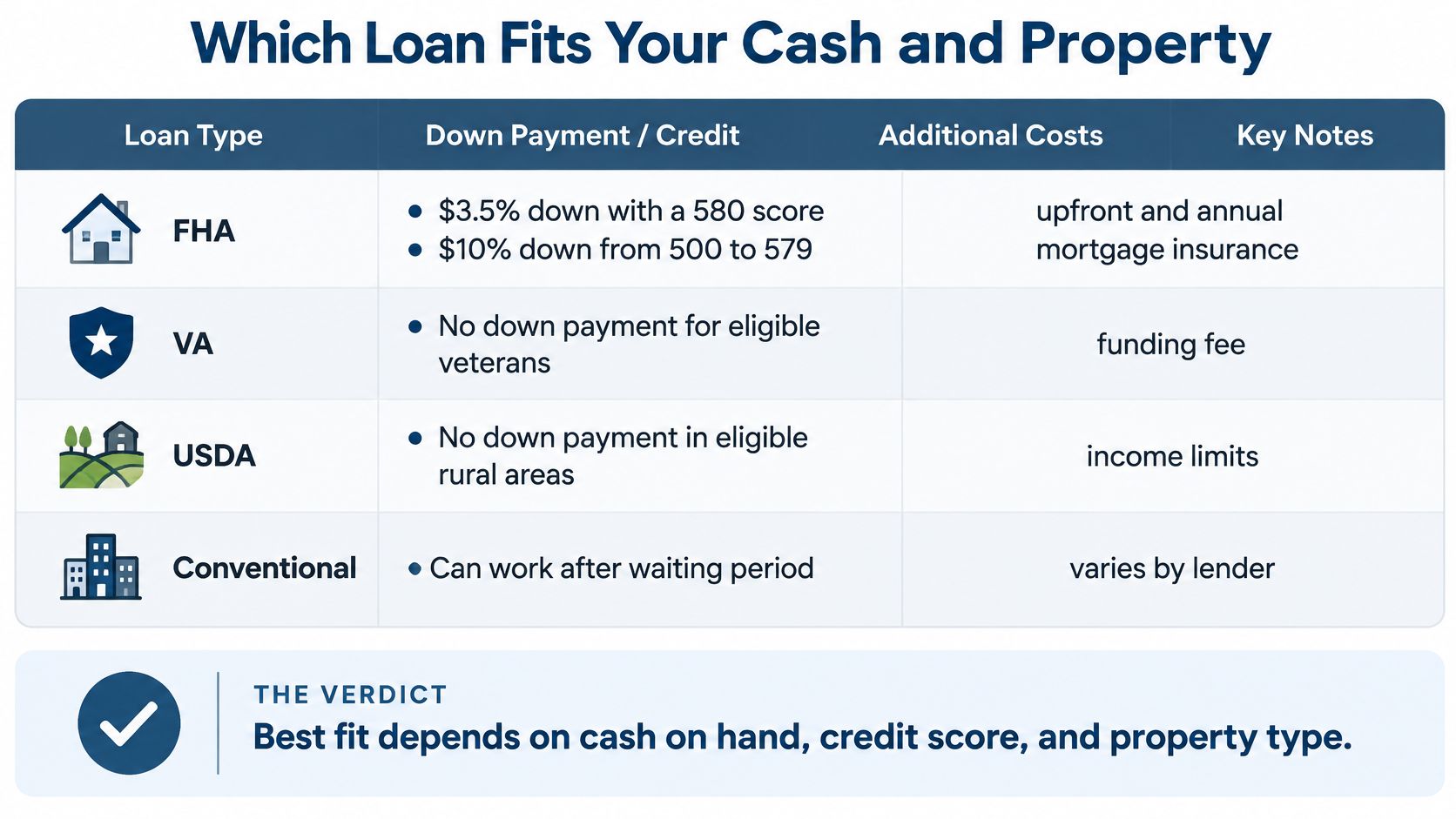
The discharge date sets the earliest point when some loan channels may let you apply, but the program, lender overlays, cash on hand, and property all shape whether that date is usable. A waiting period is permission to apply, not a promise of approval. Compare the loan's cash requirements and costs with the buyer's eligibility and the property being purchased.
| Program | Minimum down payment | Insurance or fee | Best fit |
|---|---|---|---|
| FHA | Confirm the applicable minimum with the lender | Upfront and annual mortgage insurance | Earlier agency path when the full file qualifies |
| VA | No down payment for eligible borrowers when the loan permits | Funding fee; generally no monthly mortgage insurance | Eligible veterans, active-duty service members, and qualifying spouses |
| USDA | No down payment in qualifying circumstances | Guarantee fee | Income-eligible buyers purchasing in an eligible area |
| Conventional low-down-payment options | Confirm the option and eligibility with the lender | Private mortgage insurance may apply | Buyers who meet program requirements after the applicable wait |
| Conventional standard | Set by the loan and buyer's finances | Private mortgage insurance may apply below 20% down | Buyers with stronger credit and reserves |
| Non-QM or portfolio | Often requires more cash than agency financing | Lender-specific, often at a higher rate | Buyers unable to meet agency timing or documentation rules |
Lenders assess the full application, so a 3% to 5% down payment can be a workable starting point. The cash contribution is one part of the review; the chosen program's requirements and the lender's overlays also matter.
Match the loan to the buyer's circumstances
For a borrower still within the ordinary FHA wait, ask whether an exception could apply before ruling out the program. HUD's guidance for a manually underwritten FHA loan describes the standard timing and narrower hardship review. The borrower must show either a return to good credit or a decision not to take on new credit obligations during the relevant period. Even if the agency's timing permits an application, the full file must qualify, and a lender may impose stricter overlays. HUD's FHA bankruptcy guidance explains the conditions to discuss with a lender.
For an eligible service member or veteran, compare a VA loan before assuming conventional financing is a better fit. The lender must confirm eligibility, the funding fee, and the residual-income calculation.
For a buyer considering a rural property, check USDA property and household-income eligibility before ruling out a low-cash purchase. Property location can affect whether this option fits, just as lender overlays can affect whether the earliest post-discharge date is usable.
A buyer choosing between a non-agency loan and waiting for an agency option should compare the added cost and terms with the benefit of applying sooner. A guide to getting a loan after bankruptcy can help organize questions for a lender.
Documents Underwriters Expect in the File
A lender can use the discharge date to identify when a loan channel may allow an application, but that date alone does not make the file ready. Underwriting still depends on clear records showing what happened in the bankruptcy, what the borrower earns now, and where the purchase funds came from. Organize those records so each question leads to its answer.
Assemble the file in reading order
Begin with the discharge order and petition schedules. If the borrower is seeking an exception based on circumstances beyond their control, include a concise explanation and supporting records, such as medical bills, a layoff notice, or a divorce decree. State what happened, when it happened, and what has changed since. The explanation should fit the court record rather than argue against it.
Next, gather income and employment documents. Depending on the borrower's work, these may include W-2s or full tax returns, recent pay stubs, and written employment verification. Self-employed applicants should ask early which tax returns and business records the lender needs, since their income may require more documentation.
Bank statements and records for purchase funds come next. Each large deposit needs a traceable source. For example, if a relative transfers a gift, keep the bank record showing the transfer and a signed gift letter identifying the donor, amount, and that repayment is not expected. The lender should be able to follow the money from the donor into the buyer's account. Gift funds generally cannot be an undisclosed loan.
Housing records can fill a gap for renters who lack recent mortgage history. Gather rent payment records or ask the landlord for written verification of the payment history. If the file includes a late rent payment, the landlord's records should make the dates and status clear. Before changing a collection's status or agreeing to a new payment plan, ask the lender how the obligation could affect the application's debt calculation.
Credit scores are not a document checklist item, so focus this part of the file on the borrower's own documented payment history since discharge. A guide to repairing credit after bankruptcy can help borrowers plan what to review. Buyers who are preparing to navigate the first-time home buying process can also use a separate planning guide.
Finish with a one-page cover sheet. List each derogatory item, such as a bankruptcy or late payment, and point to the record that explains it. Treat the sheet like a map: the underwriter can move from each question directly to its supporting document, including the source of any large deposit.
Minnesota and North Dakota Issues That Change the File
Chapter 7 seasoning is set by loan-program rules, not by a separate Minnesota or North Dakota homebuying ban. The local work is different: confirm the property fits the loan, and make sure the title can transfer cleanly.
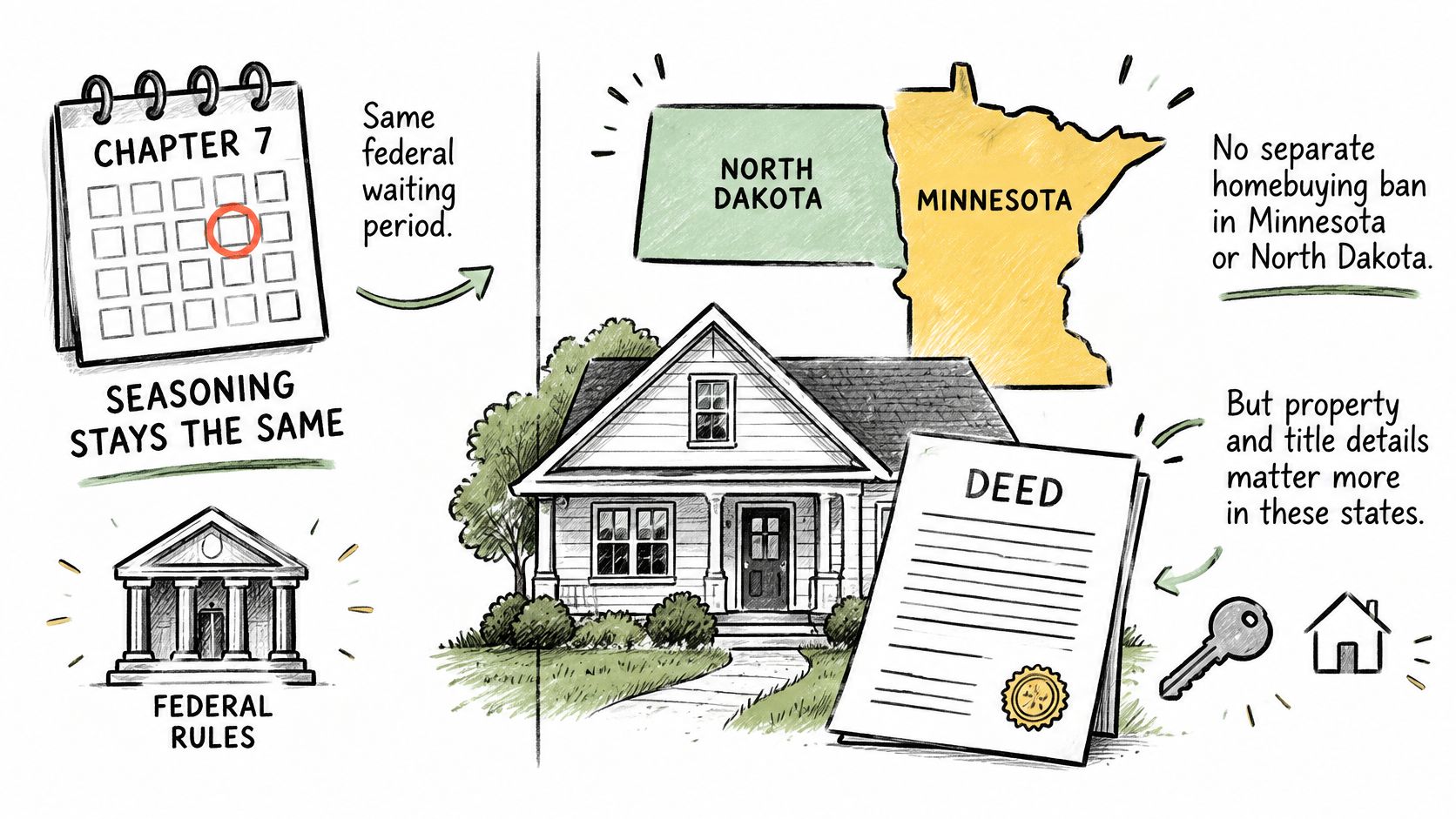
Rural and metro files can look different
Consider a buyer looking at a home outside Fargo, Duluth, or another smaller community. Before assuming a zero-down USDA loan is unavailable, ask the lender to check the property address and household eligibility. A rural address alone doesn't guarantee eligibility, and the program's income rules still need to fit the household.
A buyer looking in the Twin Cities core should plan around other loan choices unless the lender confirms that the specific property qualifies for USDA financing. Property eligibility is address-specific, so the buyer shouldn't infer approval from a town name or the edge of a map.
Winter can complicate the closing calendar. Inspection access, frozen ground, repairs, and insurance questions may need more time, so scheduling disbursement for the exact day a seasoning period ends leaves little room for a delay.
Clear the title and document the household
Ask the title company to search for judgments, tax liens, and creditor claims that could cloud ownership. A debt discharged in bankruptcy shouldn't be paid merely to reassure a seller. But if a lien attached to property, the title company may need evidence that it's released before closing can proceed.
A parent helping a buyer in Fargo or Duluth should also be reviewed early. Non-occupant co-signers and household income can be treated differently across programs, so the lender needs to know the proposed arrangement before the application is built. Local lenders may add their own overlays; ask for the seasoning rule and other requirements in writing.
A borrower with unclear discharge papers, a creditor lawsuit, or a judgment issue can consult a Minnesota and North Dakota bankruptcy attorney before the lender treats the file as incomplete. A clean federal waiting-period calculation is only one part of the transaction. The buyer also needs a clean local title.
From Discharge Order to Offer Decision
A lender's automated estimate isn't a substitute for a preapproval based on verified income, assets, debts, and housing history. A deliberate file review helps prevent the costly mistake of making an offer before the selected loan channel can fund the purchase. Fannie Mae's guidance on waiting periods and re-establishing credit supports the basic workflow: confirm the court date, calculate the applicable program date, review credit, and have the lender confirm its requirements before proceeding.
-
Download the discharge order and case docket. Mark the discharge or dismissal date shown in the court records. Keep those documents together so the lender can verify the milestone.
-
Calculate the earliest disbursement date for each loan path. Compare FHA, VA, USDA, and conventional options, then choose one target program to investigate first. A lender should confirm the date it will use for that loan channel.
-
Pull all three credit reports. List bankruptcy entries, balances, and late payments that appear inaccurate. A short written list makes it easier to identify what needs correction before underwriting.
-
Dispute errors in writing and save every response. Keep the dispute, supporting documents, and response together. The lender needs to see both the reported item and the steps taken to resolve it.
-
Use new credit sparingly and pay every bill on time. A single manageable account can support a clear repayment record, but opening several accounts at once can complicate the file. The borrower's recent behavior should be easy to verify.
-
Build purchase funds and preserve the paper trail. Track deposits, transfers, and any gift funds. The lender needs to understand where the money came from and whether it's available for the transaction.
-
Write a hardship letter only when seeking an exception. Keep it factual: identify the event, its timing, why it was beyond the borrower's control, and what changed afterward. Attach records that support the account.
-
Ask each lender to confirm its rules before authorizing a hard inquiry. Get the seasoning date and any overlays in writing. Lenders can set stricter standards than the agency minimum.
-
Request full preapproval from verified documents. The lender should review income, assets, liabilities, and housing history, not just provide an online estimate. Before an offer, confirm the program, the maximum payment, the rate-lock window, current account status, documented funds, and the lender's calculation of debt-to-income.
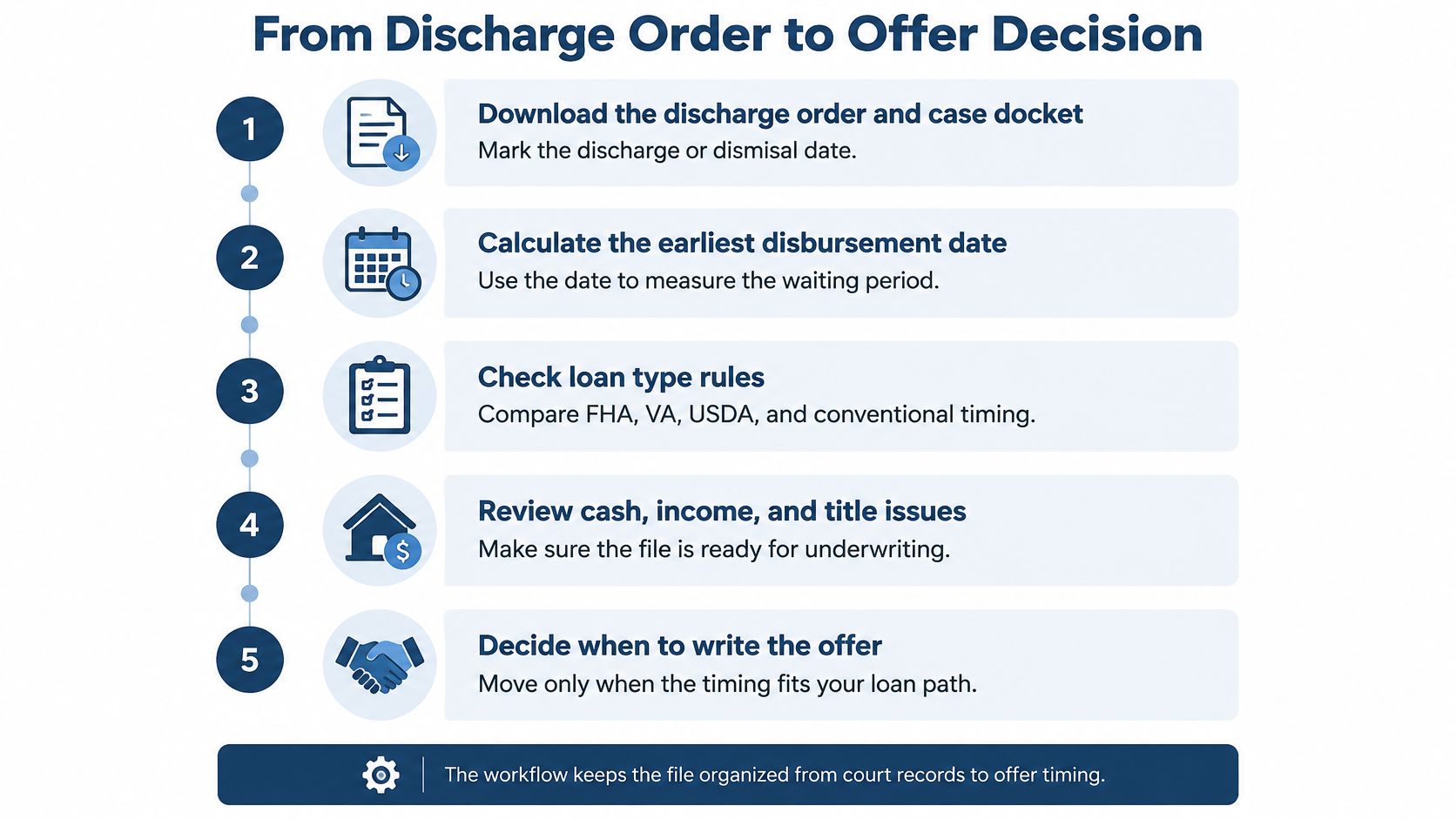
Offer decision: If a seasoning date, title issue, or required document remains unresolved, wait. If the lender has confirmed the program and maximum payment in a full preapproval, shop within that payment.
This week, place the discharge date and the lender's written eligibility date on the same page. Buyers also weighing a move beyond the region can use Puerto Rico home buying support as a resource for understanding that market's purchase process.
LifeBack Law Firm, P.A. offers bankruptcy guidance and a free 90-day Post-Bankruptcy Program with a personal specialist, Minnesota financing resources, and judgment-removal assistance. For help sorting out a Chapter 7 record or preparing for the next steps toward a mortgage, visit LifeBack Law Firm, P.A..