
“Wait until bankruptcy is over before thinking about a house” is common advice, but it can lead Minnesota buyers in the wrong direction. Some active repayment-plan borrowers have a financing path, while other buyers remain ineligible after their cases end. A homeowner facing a sheriff's sale may need to decide whether to preserve the current home before considering another purchase.
For home buyers during bankruptcy in Minnesota, the useful starting point is a coordinated review of the bankruptcy order, the proposed loan program, available equity, and any foreclosure deadline. A legal path to ownership doesn't guarantee that a lender will fund the transaction.
Waiting Periods by Loan Type and Bankruptcy Stage
Legal permission to buy during or after bankruptcy does not establish mortgage eligibility. The waiting period depends on the loan program and whether the case ended in discharge or dismissal. A Minnesota buyer also needs to compare the lender's timeline with any pending foreclosure or sheriff's sale.
| Bankruptcy status | Conventional under Fannie Mae's waiting-period guidance | FHA | VA |
|---|---|---|---|
| Chapter 7 discharged | Four years from discharge | Two years from discharge | Two years from discharge |
| Chapter 13 discharged | Two years from discharge | One year of the payout period, with court permission | One year of satisfactory plan payments, with court permission |
| Chapter 13 dismissed | Four years from dismissal, potentially reduced to two with documented extenuating circumstances | Two years from dismissal | Two years from dismissal |
| Chapter 13 still active | Not the standard post-discharge pathway; obtain a specific eligibility determination | Potential eligibility after 12 months of satisfactory plan payments and court permission, subject to underwriting | Potential eligibility after 12 months of satisfactory plan payments, with court permission |
A lender may apply stricter credit, income, or reserve requirements than the program's baseline. Get the lender's eligibility date in writing before paying for inspections or committing earnest money.
Discharge and dismissal are different outcomes. A discharge releases eligible debts; a dismissal ends the case without that discharge. A dismissal can change the mortgage waiting period, so weigh that consequence against the reason for considering it.
Read the order before calculating eligibility
The lender will ask for the discharge order, not the petition date. For a Rochester medical receptionist seeking a replacement home after Chapter 7, the order establishes the date used to assess the applicable waiting period.
The next step is a program review, not an offer. A conventional lender calculates its waiting period from the discharge order; an FHA or VA lender should confirm the program's requirements and any lender-specific conditions. A separate foreclosure history needs its own review because bankruptcy does not automatically resolve it.
Buyer-assistance eligibility is a separate question. Who qualifies as a first-time buyer may help frame that discussion, but first-time-buyer status does not override mortgage underwriting.
Before making an offer, confirm:
- Lender overlays: Whether the lender requires stricter credit, reserves, or payment history than the program baseline.
- Case status: Whether the case has been discharged and whether the bankruptcy estate remains open.
- Authorization documents: Whether the lender needs a trustee letter, court order, or other approval before proceeding.
The discharge or dismissal order starts the relevant waiting-period calculation. Meeting that date is only one gate; lender approval is another. In Minnesota, make sure both fit the property's foreclosure timeline before committing funds.
Chapter 7 Versus Chapter 13 for a Home Purchase
| Factor | Chapter 7 | Chapter 13 |
|---|---|---|
| Typical length | A liquidation case whose completion must be confirmed from the docket | A court-supervised repayment plan whose term appears in the confirmed plan |
| Mortgage arrears | Requires a workable arrangement with the mortgage creditor; reaffirmation alone doesn't cure default | Can provide a structure for addressing arrears while maintaining required ongoing payments |
| Nonexempt home equity | May expose the property to a trustee sale | Can increase what unsecured creditors must receive |
| New mortgage during the case | A purchase before discharge generally requires court or trustee review of the new obligation; after discharge, the lender's waiting period is the remaining gate | New debt typically requires a motion to incur it, with the trustee reviewing the purchase contract and proposed loan terms; court permission and lender approval are separate gates |
| When the waiting clock starts | The relevant discharge or dismissal order | The relevant discharge or dismissal order |
| Best fit for a buyer | A debtor seeking discharge who has limited exposed assets and no need for a repayment structure | A debtor with sustainable income who needs a plan to address debts and protect property |
The U.S. Bankruptcy Court for the District of Minnesota tracks Chapter 7 and Chapter 13 separately. Buyers should treat them the same way: two different strategies with different consequences for a purchase.
Chapter 7 primarily addresses eligible debts through liquidation of nonexempt assets and discharge. Chapter 13 uses a repayment structure. Keeping a home is possible under either chapter, but retention turns on equity, payment status, and the debtor's ability to fund ongoing housing costs.
Match the chapter to the housing problem
A Brainerd warehouse worker with dependable wages, mortgage arrears, and a strong reason to stay near work fits the Chapter 13 profile. The plan only works if the budget covers both the ongoing housing expenses and the plan obligation. A plan that looks affordable only because maintenance or insurance has been left out won't solve the underlying problem.
A Minneapolis renter with recent income loss presents a different question. There may be no current house to preserve, and immediate mortgage qualification may be unrealistic as well. Counsel should evaluate debt relief and eligibility first, without treating a future purchase as a reason to choose an otherwise unsuitable chapter.
The chapter choice carries the most weight when a sheriff's-sale or redemption deadline is already on the calendar. A debtor with no pending sale has more room to weigh the chapters on long-term affordability rather than urgency. In either posture, the key distinction is between protecting an existing housing position and qualifying for new secured debt, since a chapter that serves one goal can delay the other.
Reaffirmation deserves careful handling. It isn't a universal prerequisite to keeping a home, doesn't eliminate arrears, and can preserve personal liability that would otherwise be discharged. The decision belongs in an individualized review of the loan, payment status, and consequences.
Chapter selection should account for purchase timing, but speed alone is a poor deciding factor. A short case that leaves an unaffordable housing obligation unresolved isn't a useful homeownership strategy.
Check Your Protected Equity Before You Offer
An equity review answers a different question from mortgage preapproval: what value could bankruptcy expose, and how would the proposed transaction change that exposure before a sheriff's-sale or redemption date forces the keep-or-surrender decision? The answer requires defensible valuations and a complete lien picture, because legal permission to buy and lender approval remain separate gates.

Minnesota's homestead statute permits up to $510,000 of homestead value, or $1,275,000 when the land is used primarily for agriculture, subject to statutory limitations and a 160-acre cap. Treat those figures as ceilings. Occupancy, federal limitations, exemption elections, and the bankruptcy estate analysis determine how much of that ceiling shields a specific property in practice.
Build an equity worksheet
- Estimate market value. Use recent comparable sales or an appraisal appropriate to the property. An assessed value may lag what a buyer would pay.
- Obtain the mortgage payoff. A statement balance can omit accrued interest, advances, escrow shortages, or other charges included in the payoff.
- Identify attached liens. Review judgment liens, tax liens, and other title exceptions with counsel. A discharged personal debt and an enforceable property lien are separate issues.
- Estimate selling expenses. Use transaction-specific figures for commission, title, county fees, and payoff timing rather than applying one assumption to every property.
Duluth bungalow worked check: market value minus mortgage payoff minus judgment lien minus 6% selling costs equals equity available to the estate. The modest mortgage balance looked safe until the title commitment added a judgment lien and the payoff added charges; the sale-cost line then reduced the protected margin further. Run the same subtraction with an outdated assessment and the error reverses: understated value can conceal exposed equity before anyone prices the risk.
Test the exemption, not just the arithmetic
The home generally must be the owner's actual dwelling. Extended absences, a recent move, or an intended occupancy arrangement should be reviewed before assuming homestead protection applies.
The guide to Minnesota bankruptcy exemptions provides context for that discussion. Counsel should also review any recent homestead sale, proposed title transfer, and the source of purchase funds before documents are signed.
The working file should contain a title commitment, payoff letter, lien search, valuation support, and a list of every arrearage. Proposed financing and post-closing ownership should match the bankruptcy disclosures and any required plan changes. If the offer depends on new debt, the same file should separate the court's permission from the underwriter's waiting-period and credit tests.
Equity warning: Borrowed down-payment funds don't become protected merely because the borrower intends to put them into a home. Counsel must evaluate the borrowing, acquisition, and resulting equity together.
Foreclosure Dates and the Keep or Surrender Decision
Bankruptcy can sometimes preserve housing stability rather than prevent homeownership. For an owner facing foreclosure, protecting the current home may be more practical than surrendering it and trying to finance a replacement immediately.
The American Default Management Association's Minnesota overview describes a state that permits both foreclosure by advertisement and judicial foreclosure. Foreclosure by advertisement can reach a sheriff's sale without a foreclosure lawsuit, so waiting for a lawsuit to arrive is a dangerous planning assumption.
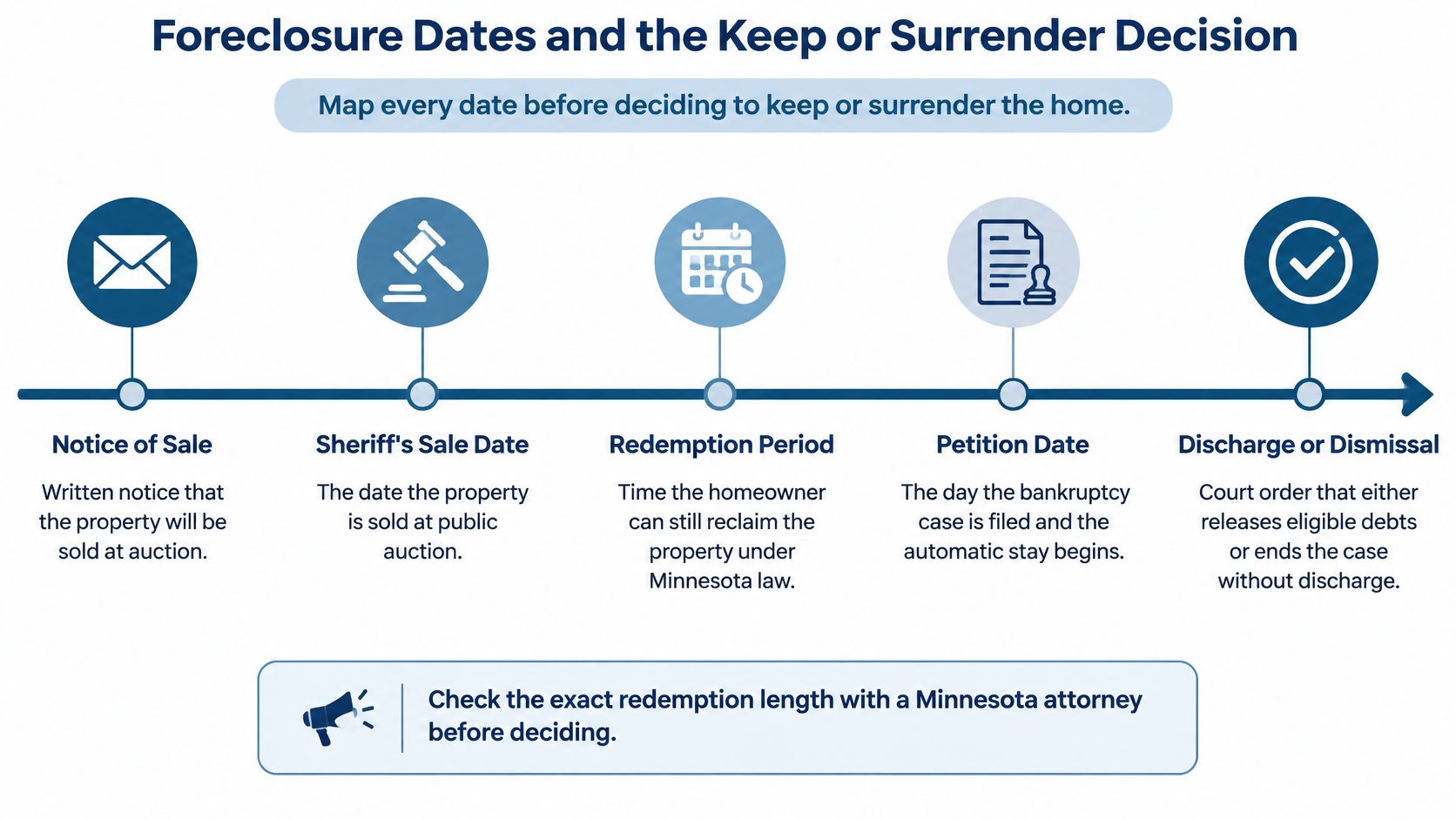
Put actual dates on the calendar
The useful timeline contains the notice of sale, scheduled sheriff's sale, applicable redemption deadline, contemplated petition date, and eventual case outcome. Those entries aren't necessarily a fixed sequence: a petition may be filed before a sale, and its timing can materially affect the available options.
Counsel needs the actual notice and sale documents, not just the homeowner's estimate of how far behind the loan has fallen. A postponement, prior bankruptcy, or completed sale can change the analysis.
The explanation of whether filing bankruptcy will stop foreclosure can help homeowners prepare for that conversation. Filing after a sale is not equivalent to filing before it, and a homeowner shouldn't assume that bankruptcy automatically reverses completed foreclosure steps.
Compare the available housing paths
- Keep the home: A sustainable Chapter 13 strategy may address arrears while the owner maintains required ongoing payments. This works only if the household can support the complete obligation.
- Surrender the home: Surrender may end an unaffordable housing strategy, but it doesn't promise immediate mortgage eligibility. Replacement housing, moving costs, and lender treatment of the foreclosure need separate planning.
- Sell or evaluate reaffirmation: A sale may preserve value, subject to estate administration and required approvals. Reaffirmation requires its own affordability and liability analysis; it isn't a substitute for resolving a default.
A homeowner with meaningful equity should not treat surrender as merely handing back the keys. Counsel should compare the potential value of an authorized sale with the costs and risks of trying to retain the property.
Likewise, an owner with little equity shouldn't assume keeping the house is automatically worthwhile. Repair needs, commuting costs, insurance, and future income stability may make continued ownership impractical even when a legal retention strategy exists.
The redemption deadline deserves written confirmation from Minnesota counsel before a filing choice is made. A credit-rebuilding plan can wait for a complete review; an approaching property deadline may not.
Documents Underwriters Want and How to Rebuild Credit
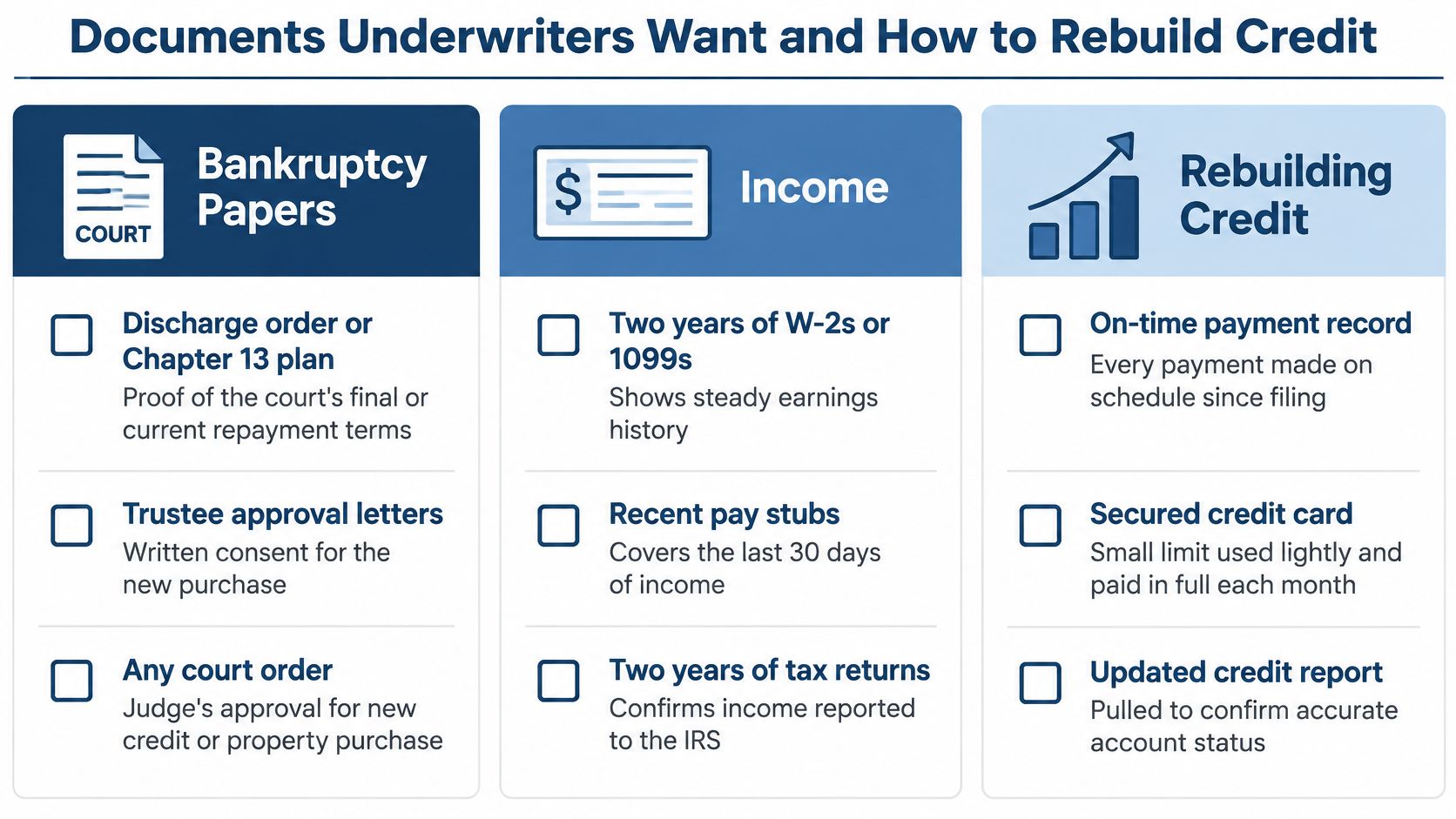
A clean discharge can still fail underwriting if the file stops at the order and never explains the money. Ask for the lender's written document request, then sort records by Minnesota timing: what must be proven before a sheriff's-sale redemption deadline, and what only becomes available after a discharge order or plan payment history exists.
- Before a redemption deadline: written confirmation of the sale and redemption dates from Minnesota counsel, trustee correspondence, housing-payment records, and source-of-funds records for any money used to cure, move, or reserve replacement housing.
- Bankruptcy papers: the discharge order or current repayment plan, relevant schedules, trustee correspondence, and any applicable purchase or borrowing order.
- Income records: recent pay statements and the employment, tax, or business records the lender requires to support qualifying income.
- Asset documentation: complete account statements and a clear trail for down-payment funds, gifts, transfers, and significant deposits.
- Explanation letter: a concise account of what caused the filing, what changed, and how the current budget supports the proposed mortgage.
- Housing payment evidence: records supporting rent or mortgage payments when requested, especially when the credit report doesn't tell the full story.
Build a dated payment record
Credit rebuilding starts with accurate reports and predictable payments. Buyers should obtain their consumer credit reports, identify errors, dispute inaccuracies in writing, and retain supporting records.
If a secured card fits the budget and any bankruptcy restrictions, run one small recurring charge through it, keep the statement balance low relative to the limit, pay it in full, and save a dated 90-day log of due dates, autopay confirmations, and posted payments. A larger carried balance adds cost without adding proof.
Rent and utility records should also remain organized, although buyers shouldn't assume every payment appears on a credit report. Automatic payments can reduce missed due dates, provided the household keeps enough money in the account to avoid returned payments.
Keep the application stable
A new auto loan, unexplained cash deposit, job change, or missed payment can require underwriting to revisit the file. Buyers should discuss material financial changes with the lender before making them, and with bankruptcy counsel when an active case is involved.
Royal LePage Brookside Realty's explanation of why buyers need mortgage pre-approval offers useful general context for reviewing financing before making an offer. Minnesota bankruptcy buyers still need a lender review that fits their specific case and loan program.
A court order may permit borrowing; underwriting clears only when income, payment record, liabilities, and closing funds verify without unresolved contradictions. Before choosing an assistance program, the buyer should ask the lender which down-payment programs it accepts for applicants with the same bankruptcy status. Program availability and lender acceptance are separate questions.
Trustee Approval and Order of Steps Before an Offer
An active Chapter 13 purchase is a controlled-credit transaction, not an ordinary mortgage closing. The U.S. Courts' Chapter 13 guidance explains the automatic stay's role in stopping foreclosure proceedings, but that protection doesn't itself authorize new secured borrowing or a purchase.
Before approaching a seller, the buyer should complete the equity review and arrange a consultation with bankruptcy counsel. Counsel can identify the district's procedures, the trustee's requirements, and whether the proposal needs changes to disclosures or the plan.
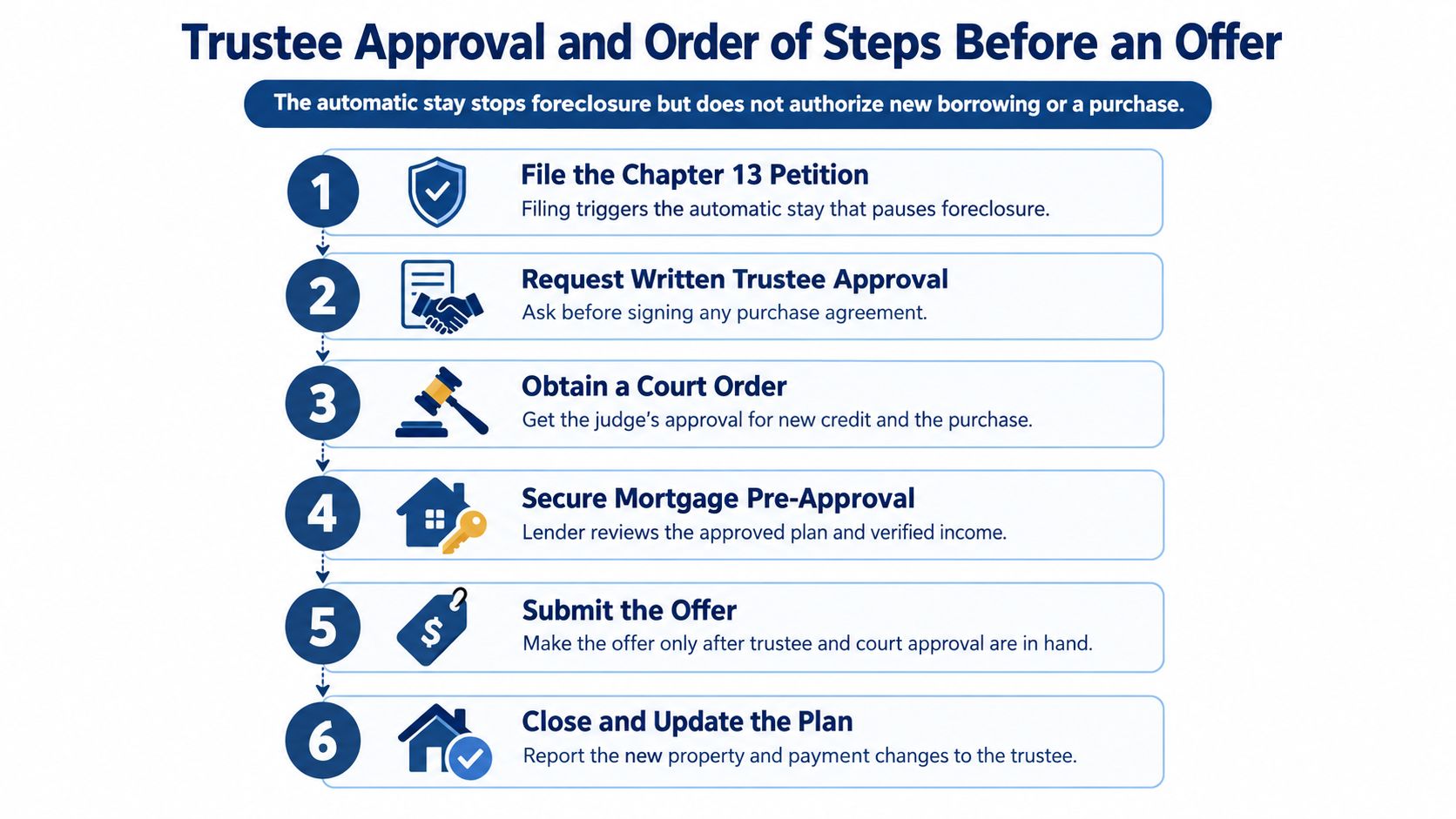
Follow the approval procedure in order
The written sequence below governs preparation for a borrower already in an active case. A general process graphic shouldn't replace the case-specific instructions counsel provides.
-
Notify bankruptcy counsel and the trustee. The proposed purchase, financing source, down payment, and reason for moving should be disclosed before an offer or money transfer creates avoidable complications.
-
Obtain lender preapproval with the pending case disclosed. The lender should review the actual bankruptcy status rather than issue a routine prequalification based only on income and a credit score. Any conditions tied to bankruptcy authorization should appear in writing.
-
Prepare the complete housing budget. Include principal, interest, property taxes, insurance, maintenance, and any continuing mortgage arrears or obligations associated with the existing home. Moving expenses, association charges, and overlapping housing payments also need attention when applicable.
-
Demonstrate continued plan feasibility. The file should show current plan performance and explain how the household will continue meeting required obligations after closing. A purchase justified only by optimistic overtime or uncertain future income deserves closer scrutiny.
-
Request required authorization and wait for it in writing. Counsel should determine whether trustee consent, a court order, or both are needed, and obtain the applicable authorization before binding purchase or loan documents are signed. Any proposed contract conditions should be reviewed before execution, not added after a dispute develops.
-
Deliver the authorization to the lender and closing agent. The transaction described in the approval must match the transaction being closed. Material changes in price, financing, payment, or ownership should return to counsel for review rather than being treated as routine closing adjustments.
Evaluate the combined obligation
Payment shock isn't limited to the difference between rent and the proposed mortgage. The trustee and lender must consider the new housing obligation alongside the existing plan payment and the rest of the household budget.
For example, a borrower may afford the proposed mortgage when viewing it alone but fall short after adding the plan obligation, insurance, and necessary repairs. A lower purchase price may help; omitting expenses from the worksheet won't.
The explanation of what the Chapter 13 trustee does helps clarify the trustee's role in reviewing plan administration and the debtor's obligations. Trustee silence isn't written consent, and an agent's assurance cannot replace required bankruptcy authorization.
No reliable universal approval rate applies to these purchases. The practical benchmark is documented affordability, continued plan performance, complete disclosure, and a lender prepared to underwrite the actual transaction.
Counsel should also coordinate any required amended schedules or plan treatment. A completed closing doesn't excuse an undisclosed change in property ownership or household expenses.
Legal permission and lender approval are separate gates. Both must open before the parties commit to a closing date.
LifeBack Law Firm, P.A. offers phone, video, and in-person bankruptcy consultations for Minnesota buyers evaluating homestead equity, foreclosure deadlines, and a proposed purchase during repayment. Visit LifeBack Law Firm, P.A. to arrange a review of the bankruptcy issues that need resolution before mortgage commitments are made.