
An EIDL is generally treated as an ordinary dischargeable business debt, but the SBA's lien on business collateral, any personal guaranty, and fraud or misuse of proceeds can survive bankruptcy. Whether the balance disappears depends on who borrowed, who guaranteed the loan, what property was pledged, and how the funds were used.
A Minnesota sole proprietor may be facing that question after a repayment deferral ended, business revenue failed to recover, and an SBA notice arrived in the mail. The owner may have no realistic way to pay the balance, yet still need the equipment, inventory, accounts receivable, or home that could be affected by collection.
The right question isn't "Can you file bankruptcy on an EIDL loan?" It's three separate questions:
- Who borrowed? Was the borrower an individual, sole proprietorship, LLC, or corporation?
- Who guaranteed? Did the owner sign a personal guaranty?
- What was pledged? Does the SBA hold a lien on business property?
A fourth issue can change the entire analysis: whether the application was accurate and the proceeds were used for eligible business purposes. Honest business failure generally calls for a different analysis than materially false financial information, unexplained transfers, or personal use of loan funds.
Where EIDL Borrowers Actually Stand Today
A borrower staring at an SBA demand letter usually wants a yes-or-no answer. Bankruptcy law rarely provides one without reviewing the documents first. An EIDL is generally handled as a government-backed business debt, not as a debt that automatically survives just because the SBA issued it.
The first task is to identify the legal borrower. A Minnesota sole proprietor and an LLC owner may have used the same bank account and operated the same business, but bankruptcy treats their obligations differently. A sole proprietor may be personally liable for the business debt. An LLC is a separate legal entity, so the company's filing and the owner's personal liability must be analyzed separately.
The three questions that control the result
Who borrowed? The note and loan authorization identify the borrower. If the individual signed as the borrower, the EIDL is already a personal obligation. If the LLC or corporation borrowed, the owner needs to determine whether a separate guaranty creates personal liability.
Who guaranteed? A personal guaranty gives the SBA a separate claim against the signer. Filing bankruptcy personally may address that liability, but a business filing alone doesn't automatically protect the individual guarantor.
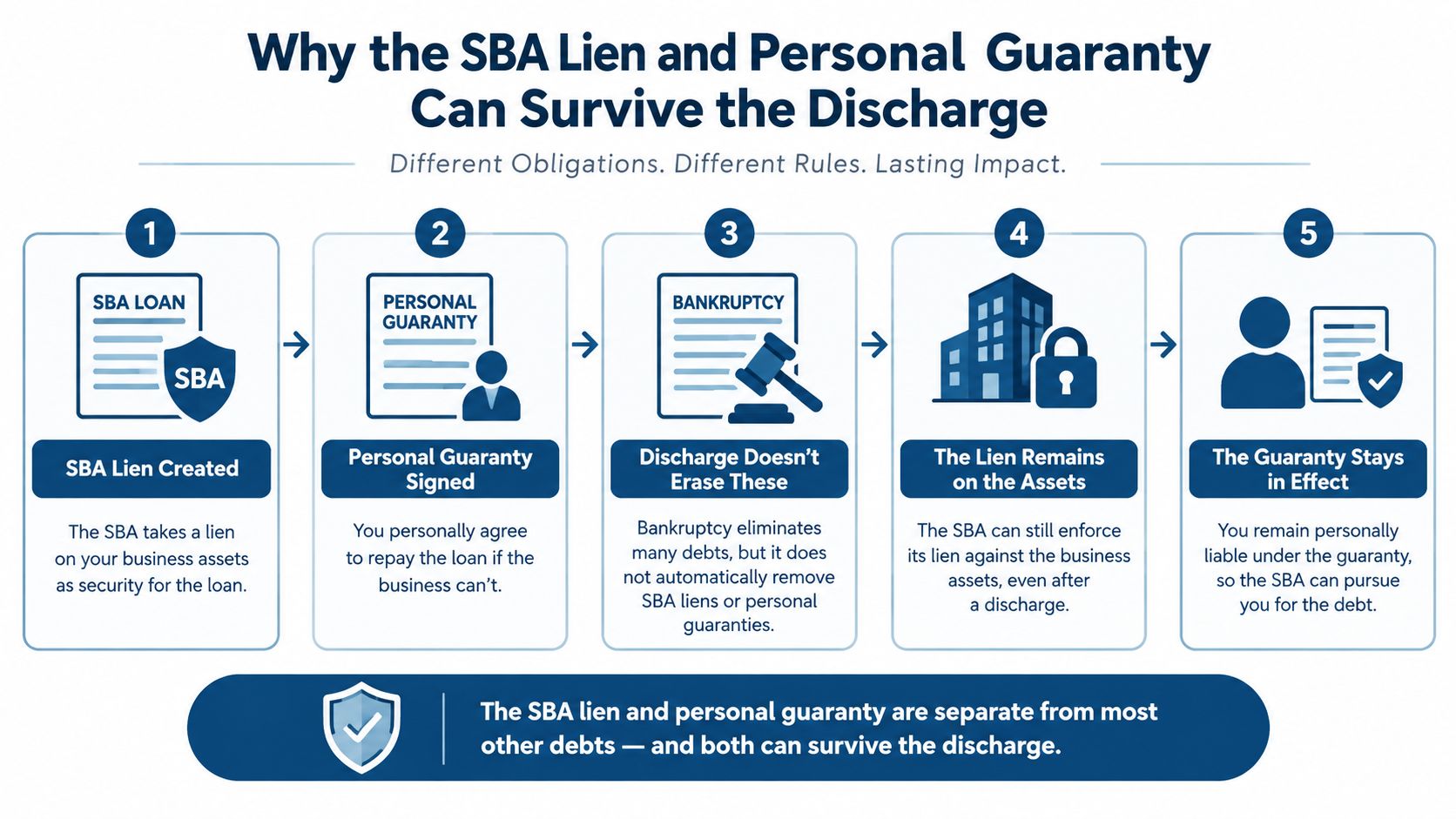
What was pledged? The loan documents may grant the SBA rights in business assets. A discharge can eliminate personal liability while leaving a properly perfected lien attached to collateral. That means the owner may no longer owe the debt personally but still face a dispute over equipment, inventory, receivables, or other pledged property.
Conduct matters before the petition is filed
The borrower's use of proceeds also matters. Eligible working-capital expenses supported by invoices, payroll records, rent records, and bank statements present a different problem from personal purchases, gifts, transfers to insiders, or records that cannot explain where the money went.
That framework gives a distressed owner something more useful than a flat answer. The analysis should separate personal liability, collateral rights, and conduct-based discharge exceptions before anyone chooses Chapter 7, Chapter 13, or a business reorganization.
How Bankruptcy Treats Government-Backed Business Debt
Bankruptcy works in two related but different ways. A discharge functions like closing a personal account permanently, while a repayment case creates a court-supervised method for addressing covered obligations over time. The discharge removes personal liability for debts covered by the applicable chapter, but 11 U.S.C. § 523 preserves specific categories of debt.
An EIDL isn't automatically excluded from discharge because it came from the federal government. The U.S. Courts' explanation of bankruptcy discharge rules makes clear that discharge depends on the chapter and that some debts are excepted. The SBA's identity as creditor doesn't replace the statutory analysis.
The CARES Act, enacted on March 27, 2020, temporarily expanded eligibility for certain small-business reorganizations under Subchapter V of Chapter 11. That change helped eligible businesses address pandemic-related debt, but it didn't turn every EIDL into a special category of nondischargeable obligation.
What the discharge does and doesn't do
The discharge addresses the debtor's personal obligation. It doesn't necessarily erase a creditor's rights in property securing the debt. It also doesn't protect a debtor who obtained money through fraud, submitted materially false financial information, concealed assets, or failed to provide the records needed for the court to evaluate the case.
That distinction is why a petition must identify the correct debtor and describe the obligation accurately. A filing that treats an LLC debt as only an individual debt, overlooks a guaranty, or ignores a lien can create problems long before the discharge order is entered.
Borrowers preparing a petition should also avoid basic filing errors, incomplete schedules, and unexplained transactions. A practical guide to avoiding common bankruptcy mistakes can help identify preparation issues, while a focused discussion of bankruptcy treatment of debt owed to the government helps place EIDL obligations in the broader federal-debt framework.
Practical rule: Federal origin alone doesn't decide dischargeability. The borrower, guaranty, collateral, documents, and conduct do.
Chapter 7 Versus Chapter 13 for an EIDL
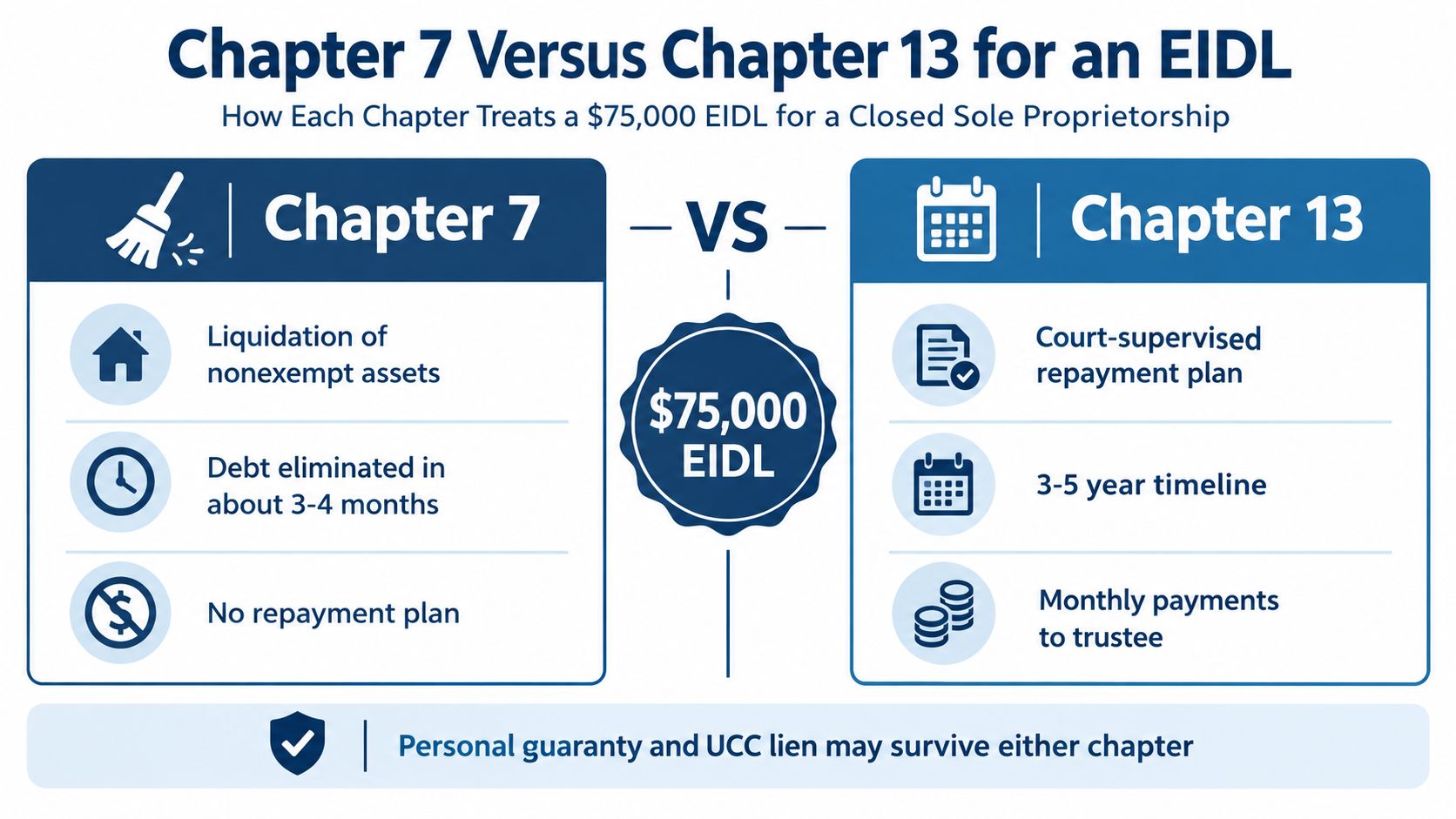
For a closed sole proprietorship, Chapter 7 and Chapter 13 can produce very different practical results even when both address the same EIDL. Chapter 7 is usually the faster path for an eligible individual with primarily dischargeable debt. Chapter 13 is a structured repayment case for an individual with regular income who needs time or asset protection.
Chapter 7
In Chapter 7, a qualifying individual may receive a discharge of personal liability for an EIDL that doesn't fall within a statutory exception. The SBA may no longer demand personal payment on the discharged obligation, but a valid lien on business assets isn't automatically erased.
That matters if the closed business still owns ovens, vehicles, equipment, inventory, or accounts receivable. The trustee also examines the debtor's nonexempt assets, so Chapter 7 isn't a guarantee that every business asset remains untouched. The correct result depends on the asset's value, applicable exemptions, ownership, and lien status.
Chapter 7 often fits a borrower who has stopped operating, has limited nonexempt property, and needs a direct discharge of personal debt. It works less cleanly when the owner has valuable collateral to protect or when records reveal unresolved transfers.
Chapter 13
Chapter 13 gives an individual with regular income a court-supervised repayment plan lasting three to five years, as described in the available EIDL bankruptcy guidance. An EIDL claim may be treated with other unsecured claims to the extent it isn't secured by collateral, and the amount paid depends on the debtor's income, expenses, plan requirements, and applicable value rules.
Chapter 13 can be useful when the owner wants to retain property that might be exposed in Chapter 7. It also creates time to address a secured claim, cure certain obligations, and complete a plan rather than facing an immediate liquidation analysis.
| Chapter | Main benefit | Main trade-off |
|---|---|---|
| Chapter 7 | Faster path toward eliminating personal liability for eligible debt | A lien and nonexempt assets may remain at risk |
| Chapter 13 | Time to protect assets through a court-approved plan | Requires sustained payments and completion of plan duties |
A detailed comparison of Chapter 7 and Chapter 13 bankruptcy can help frame the broader choice. Neither chapter automatically resolves the three questions identified above. Each still requires review of the borrower, guaranty, collateral, and conduct.
Why the SBA Lien and Personal Guaranty Can Survive the Discharge
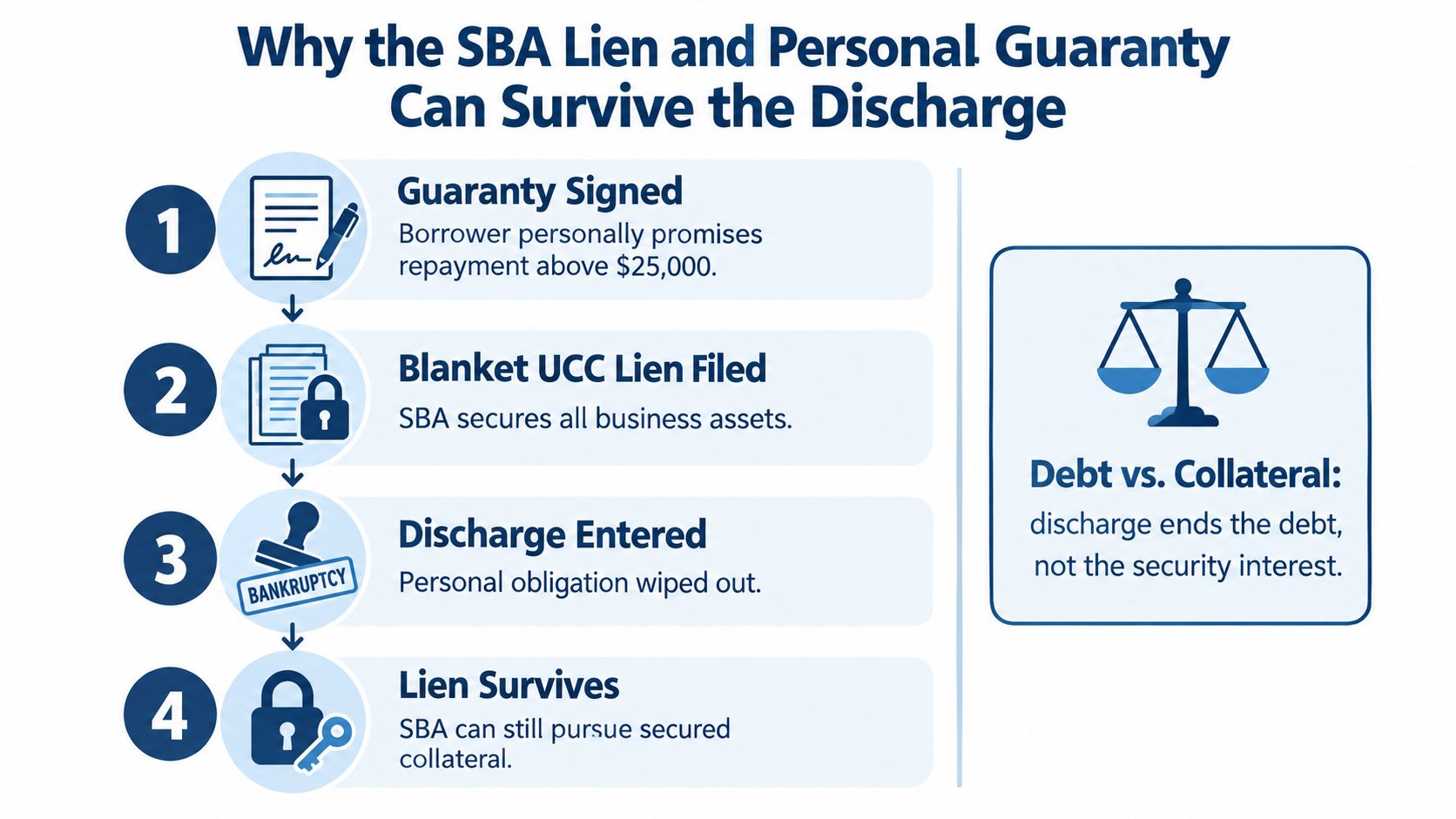
A discharge ends personal liability. It doesn't automatically invalidate a creditor's interest in collateral. That distinction is the reason an owner can receive meaningful relief and still need a plan for business property.
Available EIDL guidance generally identifies loans above $25,000 as involving a blanket lien on business assets and loans above $200,000 as involving a personal guarantee. Those thresholds should prompt a document review, not a conclusion, because the signed note, guaranty, collateral agreement, and filing history control the actual rights.
The collateral problem
Suppose a bakery borrowed through an entity and used the funds for working capital. The business later closes, but its ovens and walk-in cooler still have value. If the SBA has a valid lien, a personal discharge doesn't necessarily give the owner free and clear title to those assets. The SBA may retain rights against the collateral even if the owner can't be pursued personally for the discharged balance.
The same issue can arise with inventory, equipment, and accounts receivable. A bankruptcy attorney must identify what the lien covers, who owns the property, whether the lien was properly perfected, and whether the property has meaningful value.
The guaranty problem
An LLC filing addresses the LLC's obligations. It doesn't automatically discharge the owner's separate personal guaranty if the owner doesn't also file personally. A company can be insolvent while its owner remains exposed.
This is also why a partner or co-owner who signed the same guaranty may remain liable after another person files. Bankruptcy protection is generally personal to the debtor who receives the discharge. Owners reviewing personal guaranty liability should read the exact guaranty rather than rely on the label used in a collection letter.
The practical distinction: A discharge answers, “Can the SBA collect from this person personally?” A lien analysis answers, “Can the SBA enforce rights against this property?”
A sole proprietor's situation can be more integrated because the individual and business aren't separate legal persons. An LLC or corporation requires two separate maps, one for the entity and one for each individual who signed personally. The filing strategy must account for both.
Fraud, Misuse, and When an EIDL Becomes Nondischargeable
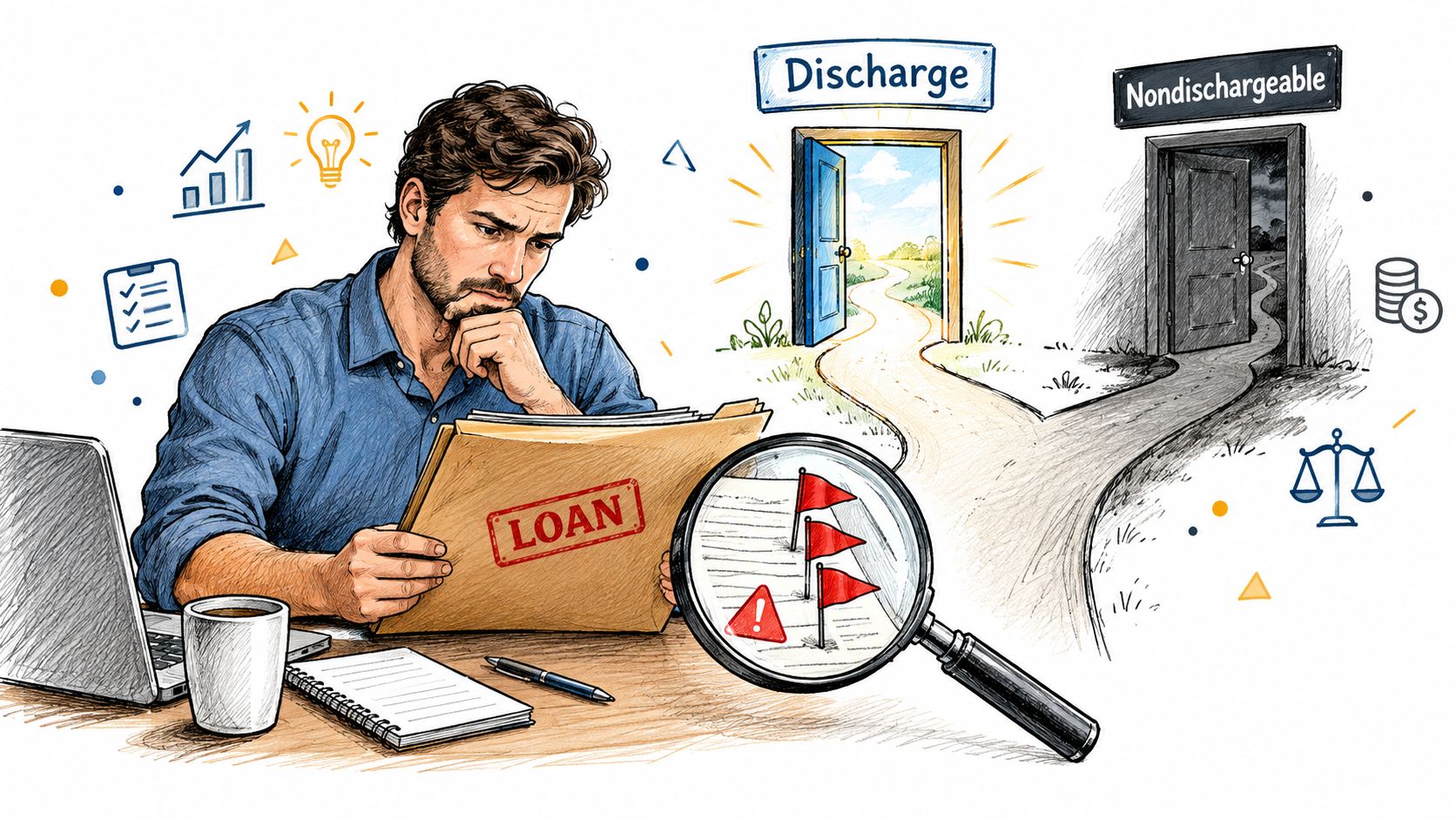
Honest business failure isn't the same as fraud. A business can close because revenue declined, costs increased, or the owner couldn't recover from the pandemic. The analysis changes when the application contained materially false financial information or the proceeds were knowingly misapplied.
Section 523 preserves debts involving fraud and materially false representations. Section 727 can deny the debtor's entire discharge for serious concealment, false oaths, or failure to explain financial records. Those provisions create two different risks: the EIDL itself may survive, or the debtor may lose the broader discharge.
Red flags that require investigation
- Application discrepancies: Revenue, liabilities, ownership information, or other financial details don't match the records available at filing.
- Personal spending: EIDL funds moved into personal accounts or used for purchases unrelated to business working capital.
- Insider transfers: Money or property transferred to relatives, friends, owners, or other insiders without a clear business purpose.
- Missing records: The debtor cannot reconstruct the path of the funds through bank statements, invoices, payroll, rent, utilities, inventory, or other operating expenses.
A federal appellate bankruptcy decision upheld nondischargeable treatment of an EIDL-related debt where the borrower submitted materially false financial information and misapplied proceeds. The SBA's statutory remedy for wrongful misapplication can equal 1.5 times the original principal under 15 U.S.C. § 636(b), as described in the appellate bankruptcy decision.
Build the file before filing
The borrower should prepare a transaction-level reconciliation before signing bankruptcy schedules. Each disbursement should connect to a business expense or have a documented explanation. If an irregularity exists, hiding it makes the problem worse. Disclosure and professional review give counsel a chance to evaluate whether the issue affects the EIDL claim, the entire discharge, or both.
A plain-language review of nondischargeable debts in bankruptcy can help explain the statutory categories, but an EIDL borrower still needs advice tied to the signed documents and actual transactions.
A Real-World EIDL Misuse Case Walked Through Step by Step
A published federal court example shows how quickly an ordinary loan problem can become a discharge-denial case. The debtor transferred $300,000 to a personal account, used $107,000 to purchase a residence, and gave roughly $100,000 to relatives and friends. After a U.S. Trustee complaint under §§ 727(a)(4) and 727(a)(3), the debtor ultimately agreed to denial of discharge, according to the published court account of the EIDL case.
The important point isn't only the amount transferred. It's the movement from business funds to personal use, followed by the recordkeeping and disclosure questions that bankruptcy trustees ask. A debtor who can't explain the transfers may face allegations involving false oaths, concealment, or failure to preserve and produce financial records.
How the problem develops
- Funds leave the business account. A transfer to a personal account creates an immediate tracing issue.
- Personal purchases follow. Using proceeds for a residence makes the business-purpose explanation harder to establish.
- Gifts or insider payments appear. Transfers to relatives and friends require careful examination and documentation.
- The petition must disclose the history. Omitting the transfers can create a separate false-oath problem.
- The trustee requests records. Missing statements, invoices, and accounting files can prevent the debtor from explaining the transactions.
The preventive response is practical. Gather every EIDL disbursement record, bank statement, accounting file, invoice, payroll record, rent record, utility bill, inventory record, and communication that explains the use of funds. Then create a ledger that follows the money from receipt to final expense.
Clean records don't guarantee a discharge, but unexplained transfers can make an otherwise ordinary debt much harder to defend.
A borrower who identifies a questionable payment before filing can discuss it with counsel and determine whether correction, disclosure, repayment, or a different strategy is appropriate. Waiting until the trustee discovers the transaction removes options and damages credibility.
Your Next Steps in Minnesota and North Dakota
An EIDL review should begin with documents, not a collection call. The borrower needs the original note, loan authorization, any guaranty, collateral agreements, current statements, and notices from the SBA or a collection agency. The file should also include tax returns, bank statements, business records, and a complete list of creditors.
Prepare the core bankruptcy file
- Loan documents: Locate the note, authorization, guaranty, collateral language, and amendments.
- Asset information: List equipment, vehicles, inventory, receivables, real estate, and ownership interests.
- Financial history: Gather tax returns, profit-and-loss statements, balance sheets, and bank records.
- Transaction support: Reconcile EIDL proceeds with payroll, rent, utilities, inventory, and other working-capital expenses.
- Collection papers: Preserve demand letters, account statements, lawsuits, judgments, and notices of referral.
Minnesota and North Dakota owners should also identify whether the business is a sole proprietorship or separate entity and whether property is held personally or by the company. That classification affects schedules, exemptions, lien analysis, and whether a personal filing is needed in addition to any business case.
Choose the chapter around the assets and income
Chapter 7 may fit a closed business with limited nonexempt property and a primarily dischargeable personal obligation. Chapter 13 may be more practical when regular income supports a plan or when the owner needs time to protect assets and address a secured claim. An operating LLC with meaningful debt may require a separate business reorganization analysis rather than an individual consumer case.
A borrower shouldn't take a new personal loan just to delay an EIDL decision without reviewing the consequences. General information about finding personal loans in Minnesota may be useful for comparison, but new borrowing can increase personal obligations and won't resolve an SBA lien, guaranty, or discharge exception.
The legal team at LifeBack Law Firm, P.A. can review Chapter 7 and Chapter 13 options, including fully virtual filing, local Minnesota and North Dakota requirements, and the records needed to evaluate an EIDL. A consultation can be conducted by phone, video, or in person, with live chat available for initial questions.
LifeBack Law Firm, P.A. helps Minnesota and North Dakota consumers and small-business owners evaluate whether Chapter 7 or Chapter 13 can address personal EIDL liability while accounting for guaranties, liens, and disputed use of proceeds. Visit LifeBack Law Firm, P.A. to schedule a phone, video, or in-person consultation before the SBA files a lawsuit or collection pressure escalates.