
A month after filing Chapter 7, a commuter's aging car stops working. The vehicle is needed for work, medical appointments, and ordinary family responsibilities, but the bankruptcy case is still open. The question feels urgent: can the debtor buy a replacement car without trustee approval, or could the purchase look like hidden property?
That concern is understandable. A Chapter 7 trustee examines property connected to the bankruptcy estate, while a car buyer is usually thinking about transportation, financing, insurance, and a manageable payment. The two perspectives overlap when the purchase uses money that may belong to the estate, or when the debtor's disclosures don't match the transaction.
The practical answer depends on when the vehicle was acquired, where the money came from, whether an existing car has nonexempt equity, and which state exemptions apply. Buying an ordinary replacement vehicle with postpetition earnings is generally treated differently from transferring or purchasing property that was already part of the estate. A careful debtor can reduce risk by documenting the funding source, disclosing the proposed loan terms, and obtaining written legal guidance before signing.
Introduction and Scenario
A debtor files Chapter 7 after falling behind on medical bills and credit cards. The older vehicle listed in the schedules then breaks down while the case remains open. A replacement is needed for work and family responsibilities, so the debtor finds a modest used car and plans to make the down payment with wages earned after filing.
The immediate fear is simple: does buying any car during an active Chapter 7 case require trustee approval? The answer turns on the funding source and the property involved. The petition date acts like a dividing line. Property owned when the case began may belong to the bankruptcy estate, while an ordinary purchase funded with later earnings generally falls on the other side of that line. The U.S. Courts' Chapter 7 overview explains that the estate includes the debtor's existing legal and equitable interests at filing, and that a trustee may sell property not protected by an exemption or property with value beyond liens and exemptions.
Practical rule: A postpetition car purchase is not automatically invalid because the trustee did not approve it first. Risk increases if the transaction uses estate property, hides value, or conflicts with the debtor's schedules and budget.
The trustee does not approve every household purchase. The trustee's statutory function is to collect and convert nonexempt estate property into money for creditors. Many Chapter 7 consumer cases have no assets available for distribution, yet nonexempt property can still require administration.
Start with one question: what money will pay for the car? Fresh wages earned after filing usually support an ordinary consumer purchase. Prepetition cash, proceeds from selling an estate asset, or a tax refund connected to the prepetition period calls for closer review. The same funding-versus-estate-property decision tree helps evaluate an existing vehicle loan, redemption, a third-party purchase, Minnesota's exemption benchmark, and North Dakota considerations.
Understanding Timing and Estate Property
The petition date acts like a property snapshot. At that moment, the bankruptcy estate is created, and it generally includes the debtor's existing legal and equitable interests. A vehicle owned on that date may therefore receive trustee review if its equity exceeds available lien and exemption protection.
A car acquired after filing with postpetition income usually falls into a different category. That distinction changes when the purchase uses estate property, proceeds traceable to prepetition assets, or a transaction that conceals value. The Chapter 7 bankruptcy estate guide offers additional context on how property enters the estate, but the funding trail still requires case-specific review.
The petition-date concept map
Use four questions to sort the transaction:
- Ownership at filing: Did the debtor own the car when the petition was filed? If so, its equity may belong to the estate.
- Value at filing: What was the vehicle's fair-market value, and which valid liens reduced the debtor's equity?
- Exemption coverage: Does the applicable state or federal exemption protect that equity?
- Funding after filing: Will the replacement purchase use postpetition wages, or money connected to the prepetition estate?
This framework explains why buying a replacement car after filing can differ from selling an existing estate vehicle. Section 363 addresses the use, sale, or lease of estate property. A debtor evaluating a transaction should separate the vehicle's ownership from the source of payment, rather than treating both as one issue.
The words “after filing” do not answer every question. Timing matters, and tracing matters too. A postpetition purchase funded by proceeds from a prepetition asset sale may raise different concerns from one funded by wages earned and deposited after the petition date. Bank statements, pay records, settlement documents, gift letters, and the purchase contract can help show that distinction.
A postpetition car purchase is not automatically invalid because the trustee did not approve it first. Risk rises when the transaction uses estate property, hides value, or conflicts with the debtor's schedules and budget.
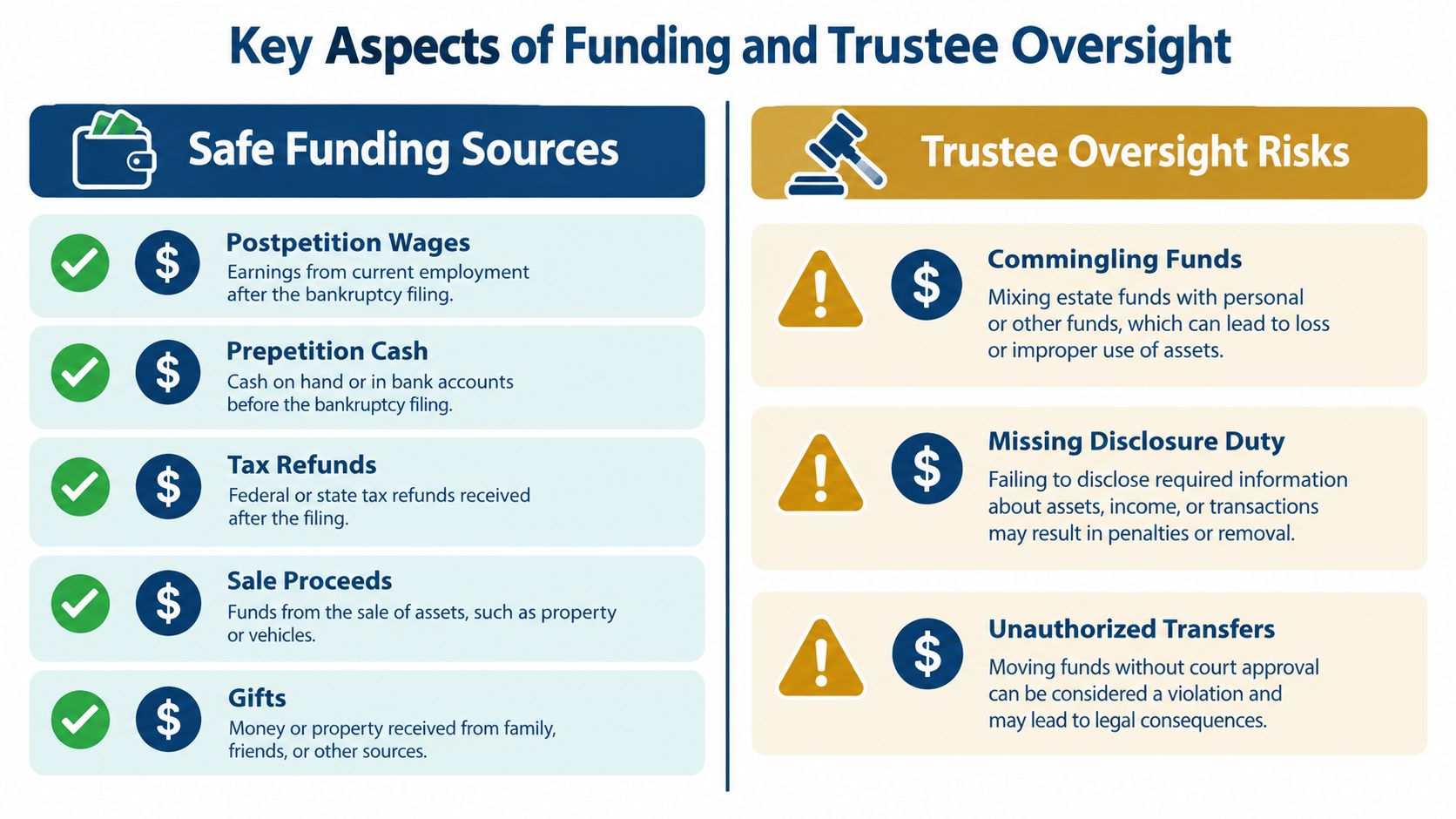
Key Aspects of Funding and Trustee Oversight
The down payment often creates more risk than the vehicle loan itself. A lender may focus on income and credit, while the trustee focuses on whether the cash belongs to the estate or whether the transaction changes the value available to creditors.
Funding sources and risk signals
Postpetition wages are generally the cleanest funding source for an ordinary replacement vehicle. The debtor should preserve pay records and bank statements showing when the wages were earned and deposited. A purchase should still fit the disclosed budget and reflect a reasonable transportation need.
Prepetition cash requires caution. Cash held when the case was filed may have been part of the estate, even if it remains in a personal bank account. A debtor shouldn't assume that moving those funds between accounts changes their legal character.
Tax refunds need tracing. A refund may relate partly to a period before filing and partly to a period after filing. The portion connected to the prepetition period may require disclosure or administration, so counsel should review the underlying tax year and the case's local procedures before the funds are used.
Sale proceeds can be especially sensitive. Money received from selling a vehicle or another asset that belonged to the estate may remain traceable to estate value. Spending those proceeds on a replacement car without disclosure can create a dispute over whether estate property was transferred.
Gifts aren't automatically safe just because someone else supplied the money. The debtor should document the donor, amount, date, and whether the funds were a true gift rather than repayment, compensation, or property belonging to the debtor.
The statutory text of Bankruptcy Code §363 governs estate-property transactions. Non-ordinary-course use, sale, or leasing generally involves notice and a hearing under §363(b), while ordinary-course treatment under §363(c) is different. That framework doesn't turn every car loan into a court motion, but it does make the source of the money central.
Funding test: If the money can be traced to property owned before filing, the debtor should treat the purchase as a disclosure issue before treating it as an ordinary car purchase.
A debtor can also review the trustee's responsibilities in this overview of Chapter 7 trustee duties. The goal isn't to avoid necessary transportation. It's to prevent a preventable argument about commingling, concealment, or unauthorized use of estate value.
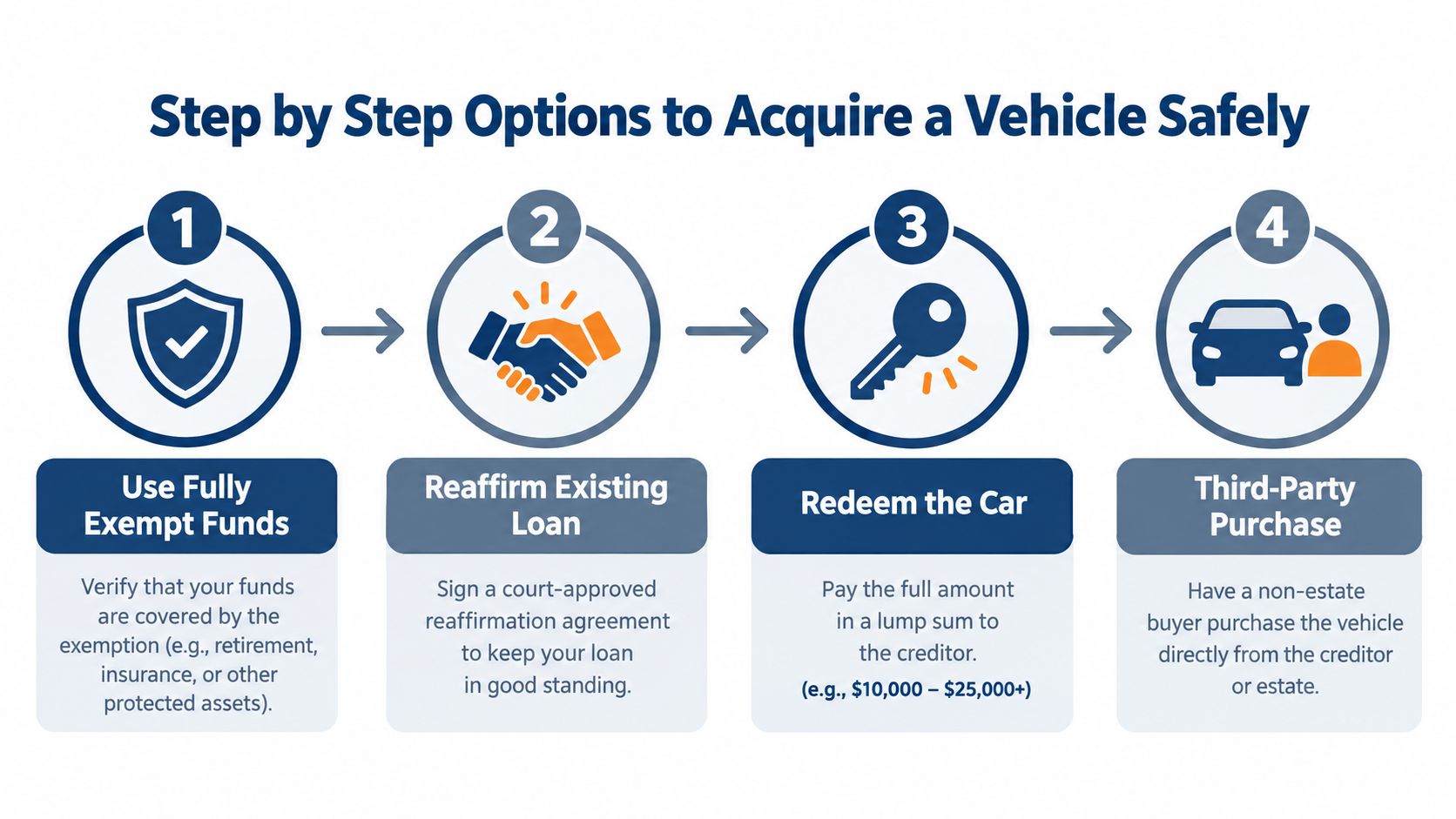
Step by Step Options to Acquire a Vehicle Safely
Different transportation problems call for different solutions. A replacement purchase isn't the only path, especially when the debtor already owns a vehicle that appears in the schedules.
Option one, use documented postpetition income
Before visiting a dealer, the debtor should gather recent pay records, bank statements, the proposed purchase agreement, loan terms, insurance costs, and a short explanation of why transportation is necessary. The debtor or counsel should notify the trustee in writing when the case's circumstances make that prudent, particularly if the funding source could be questioned.
A practical message can read:
“The debtor is considering purchasing a replacement vehicle after the petition date. The proposed purchase price is [amount], the down payment is [amount], and the loan would be from [lender] at [APR] over [term], with a monthly payment of [payment]. The down payment comes from wages earned after filing. The vehicle is needed for [work, medical care, or family transportation]. Please advise whether any additional disclosure or court filing is required.”
Counsel should review the message and replace brackets with accurate information. The debtor shouldn't sign loan documents until counsel confirms that the funding and budget are consistent with the schedules.
Option two, reaffirm an existing loan
If the existing car is financed and the debtor wants to keep personal liability after discharge, reaffirmation may be considered. A reaffirmed automobile loan remains a repayment obligation after discharge, so the debtor needs a realistic budget and a clear understanding of the agreement before signing.
The debtor should first identify the vehicle's value, loan balance, payment history, and condition. Counsel can then explain whether reaffirmation is appropriate and whether the agreement requires court review.
Option three, redeem the vehicle
Redemption involves paying the secured creditor a lump sum based on the vehicle's allowed value rather than continuing under the original loan structure. This option may help a debtor keep a necessary vehicle, but it requires access to funds and careful valuation. Because the payment is substantial and the procedure is technical, counsel should handle the documentation and any required court process.
Option four, arrange a third-party purchase
A relative or another third party may buy a vehicle independently, but the arrangement must be genuine. The debtor shouldn't secretly provide estate funds, use a nominee to conceal ownership, or promise repayment through undocumented transfers. Written records should identify who owns the vehicle, who borrowed the money, who makes payments, and who carries insurance.
Vehicle selection also matters. Families comparing practical transportation should assess reliability, operating costs, cargo needs, and winter conditions rather than focusing only on the monthly payment. A resource such as this guide to AWD vans for fleets may help organize questions about all-wheel-drive transportation, although bankruptcy counsel still needs to review the funding and ownership structure.
After closing, the debtor should keep the purchase contract, lender disclosures, proof of insurance, registration records, funding documents, and trustee communications together. Written counsel review is a sensible safeguard before executing any car loan, especially when the transaction involves a trade-in, gift, refund, sale proceeds, or money held before filing.
State Specific Rules for Minnesota and North Dakota
Exemption law can change the answer for a vehicle owned when the case began. The relevant figure is generally equity, not the vehicle's full purchase price. Equity is commonly calculated by subtracting valid loan payoff amounts and enforceable liens from fair-market value.
Minnesota provides a clear benchmark under Minnesota Statutes section 550.37, subdivision 12a. The Minnesota bankruptcy court materials describe an exemption of up to $10,000 in one motor vehicle's equity, increasing to $25,000 when the vehicle has been modified for, or is used by, a physically disabled person. The figures and conditions should be checked with counsel before relying on them.
| State | Exemption Limit | Notes |
|---|---|---|
| Minnesota | Up to $10,000 in vehicle equity | Up to $25,000 when the vehicle has been modified for, or is used by, a physically disabled person. Equity is fair-market value minus valid liens. |
| North Dakota | State-specific exemption review required | The applicable vehicle limit, election, and conditions should be confirmed under current North Dakota law before filing or purchasing. |
For example, a $24,000 vehicle with a $20,000 loan has approximately $4,000 in gross equity before other issues, while a debt-free $14,000 vehicle may exceed Minnesota's ordinary $10,000 exemption. Those examples illustrate the calculation described in the Minnesota bankruptcy court opinion, not a guarantee that a trustee will sell a particular car.
A trustee also considers liens, exemptions, selling costs, and whether administration would produce a meaningful recovery. Readers in either state can use this Minnesota guidance on buying a home or car after Chapter 7 as a starting point, but North Dakota debtors need state-specific advice before relying on a Minnesota benchmark.
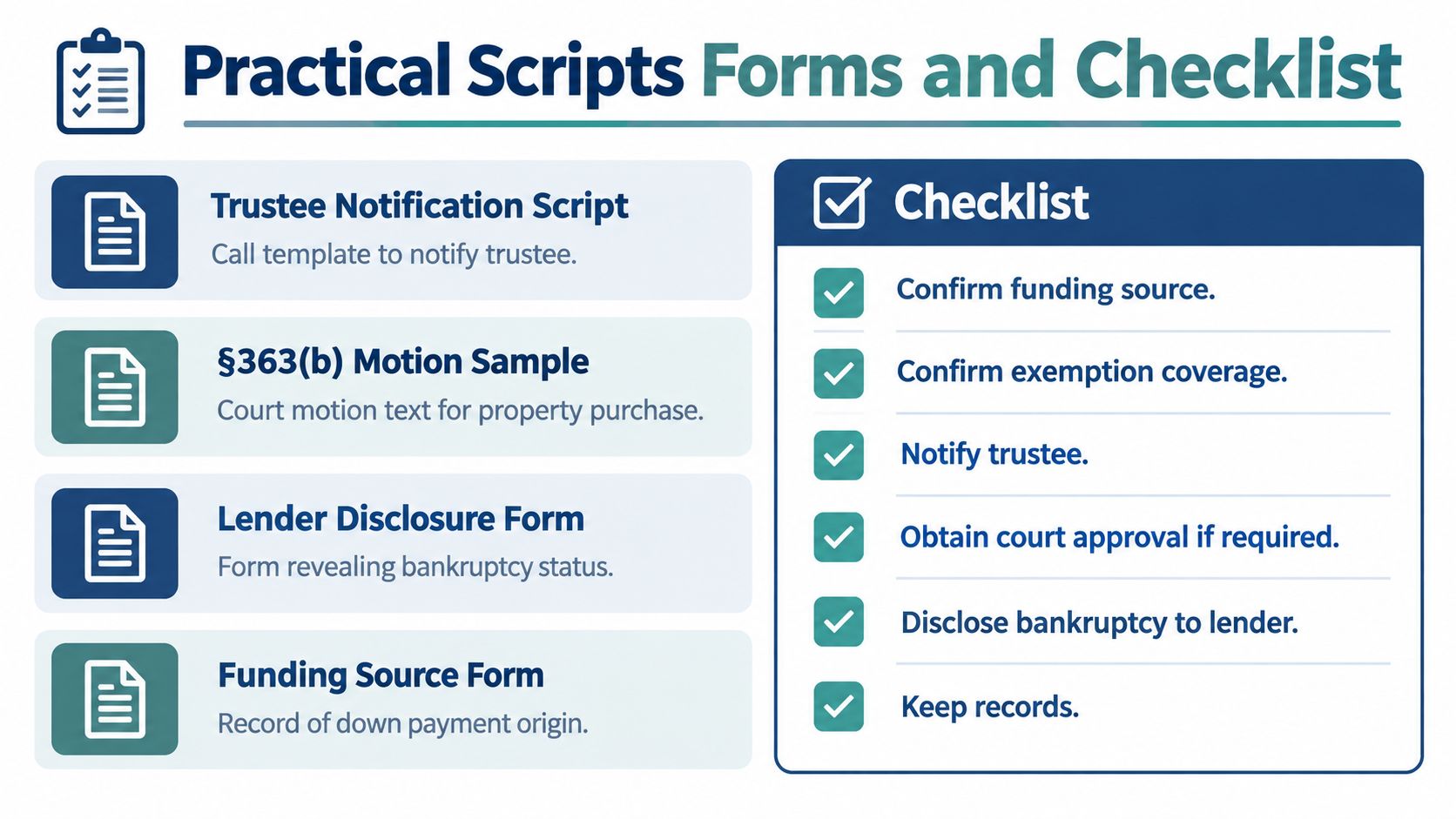
Practical Scripts Forms and Checklist
A short written record can prevent a long explanation later. The debtor should prepare documents before signing, not after the trustee asks how the purchase was funded.
Trustee notification script
“The debtor plans to acquire a replacement vehicle after filing. The proposed vehicle is [year, make, model], purchased from [seller], for [price]. The down payment is [amount] from [precise source], and financing is proposed through [lender]. The expected payment is [amount], with insurance estimated at [amount]. The vehicle is necessary because [specific reason]. Counsel is reviewing whether any motion, notice, or additional disclosure is required.”
Funding source form
The form should identify the account used, the date each payment entered the account, the source of every dollar used for the down payment, and whether any amount came from a refund, asset sale, gift, inheritance, or prepetition savings. Bank statements should support the entries.
Lender disclosure
The debtor should disclose the active Chapter 7 case when required by the lender and provide accurate loan terms. The file should include the lender's name, APR, term, payment, collateral description, fees, insurance requirement, and any trade-in details.
Closing checklist
- Confirm the petition date: Identify what vehicle and funds existed at filing.
- Trace the money: Separate postpetition wages from prepetition or estate-related funds.
- Check equity: Calculate fair-market value minus valid liens for any existing vehicle.
- Review exemptions: Confirm the applicable state exemption and any disability-related condition.
- Notify counsel: Send the purchase contract, funding records, and lender terms.
- Address trustee procedure: Determine whether written notice, a motion, or a hearing is required.
- Disclose accurately: Make consistent statements to the trustee, court, and lender.
- Preserve records: Keep insurance, registration, payment, and ownership documents after closing.
Next Steps and Summary
The safest answer to “can a debtor buy a car without trustee approval in Chapter 7?” begins with classification. A normal replacement vehicle purchased with documented postpetition wages generally isn't treated the same as a vehicle owned on the petition date. A purchase funded with estate property, prepetition proceeds, or traceable value calls for disclosure and possible trustee or court involvement.
The timeline should be straightforward:
- Before shopping: Identify the petition-date assets and funding source.
- Before applying: Prepare the vehicle details, budget, lender terms, and written explanation of need.
- Before signing: Obtain counsel's review and notify the trustee when appropriate.
- Before closing: Complete any required notice, motion, hearing, or order.
- After purchase: Keep proof of funding, insurance, registration, and payments.
Under §363, court authorization for a car transaction is tied to the trustee's use or sale of estate property, while ordinary postpetition purchases usually proceed without formal approval, as summarized by the statutory overview of §363. That distinction is helpful, but it isn't a substitute for reviewing the debtor's actual bank records and schedules.
LifeBack Law Firm, P.A. can review the proposed vehicle, funding source, exemption concerns, and lender terms for Minnesota and North Dakota debtors before a purchase is finalized. A consultation can help determine whether the transaction needs trustee notice or court action, so prospective buyers should visit LifeBack Law Firm, P.A. to request guidance.