
A filer in Minneapolis is often sitting at a kitchen table with a stack of statements, trying to answer one deceptively simple question: How many months of bank statements for Chapter 7 will the trustee want? The practical answer usually starts with 60 to 90 days, but that isn't the whole answer. A Chapter 7 case involves three different review periods, each serving a different purpose: the trustee's routine request, the six-month means-test lookback, and a longer review when deposits, transfers, or business activity raise questions.
A short, clean record can make a 341 meeting routine. Missing pages, unexplained transfers, or undisclosed accounts can turn that same meeting into a document request and delay. Minnesota and North Dakota filers should prepare for the ordinary request while understanding what causes a trustee to look further back.
What You Will Hand Over to the Trustee
A filer in Minneapolis may arrive at the 341 meeting with identification, the filed petition, Schedules A through J, the means-test calculation, recent pay stubs, the credit-counseling certificate, and bank statements for every disclosed account. The folder should answer a basic question: do the records support the information reported in the petition?
For the trustee's routine review, statements usually cover the last two or three months. That is the ordinary packet requested before or at the meeting. It is not a requirement to produce every statement ever issued for an account. A practical guide to what to provide to the Chapter 7 trustee can help match the documents to the case.
The meeting packet has limits
The §341 meeting packet is the starting point, not the boundary of the trustee's review. The trustee may request longer statements, tax records, closing documents, business records, or documentation supporting a deposit or transfer. A record request can arise after the meeting if the filing leaves an unanswered question.
Trustees commonly send their document list by mail or email a week or two before the meeting. Read it line by line. Confirm that every account listed in the petition has matching statements, and check that each statement covers the requested dates. A statement from the correct bank does not cure a missing month or incomplete page.
Local practice varies. In Minneapolis and St. Paul, routine requests often begin with the recent account history, while a trustee may ask for more when deposits or transfers do not fit the schedules. North Dakota filers in Bismarck and Fargo should use the same preparation standard. The trustee's office, not a general internet rule, controls the final document request.
Keep the three review windows separate
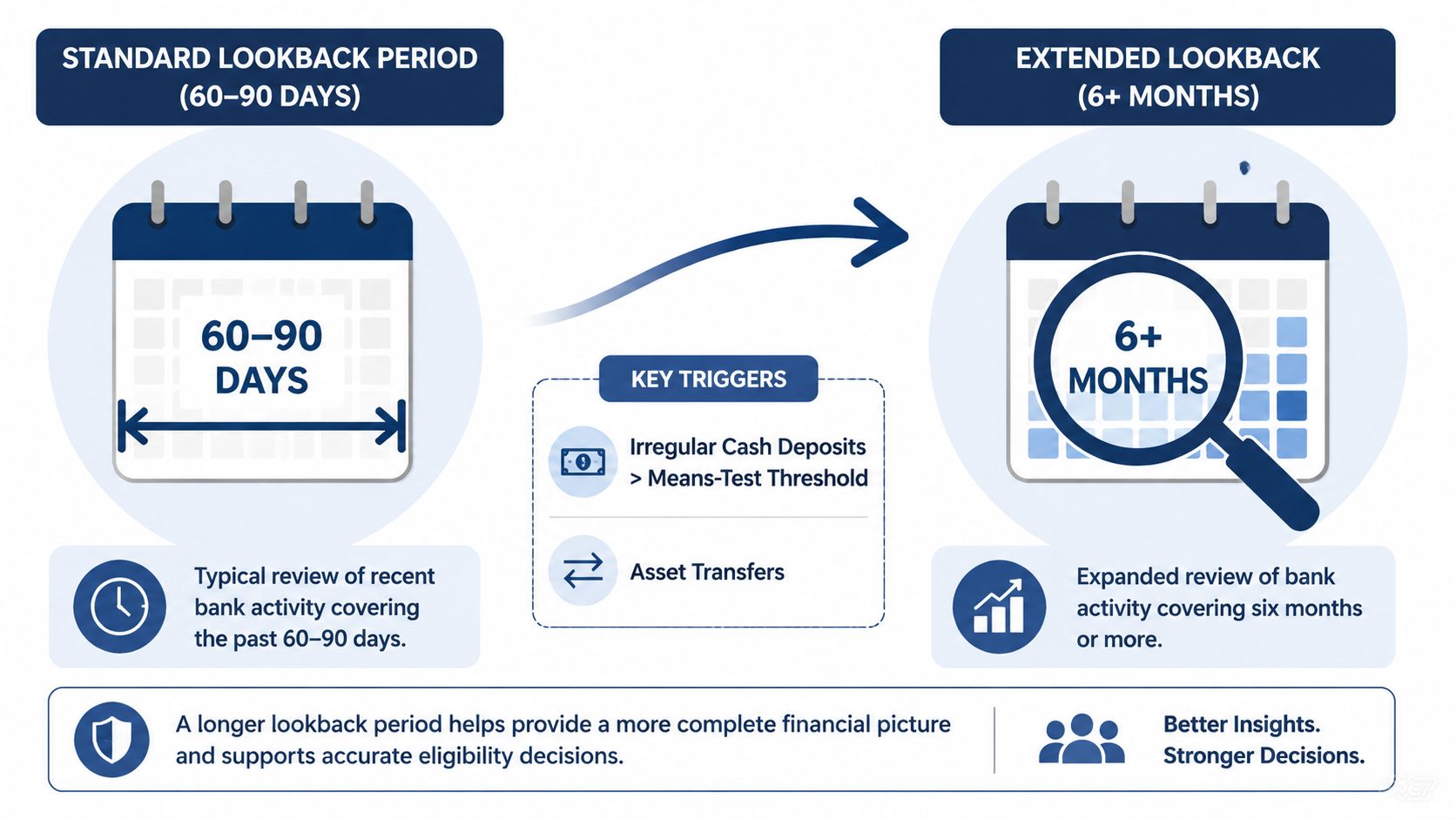
The first window is the routine 60-to-90-day statement period used for the 341 meeting. The second is the six calendar months before filing, which supports the means-test income calculation. The third is an expanded review, often six to twelve months or longer, when unusual deposits, transfers, or business activity require reconstruction.
These periods overlap, but they answer different questions. Organize statements by account, include every page, and provide clear explanations for irregular transactions. A complete, legible packet supports the ordinary review while keeping later requests focused.
Why Trustees Ask for Bank Statements in the First Place
Bank statements function as the verification layer for a bankruptcy petition. The Bankruptcy Code requires a debtor to provide a record of any entity holding a financial account under 11 U.S.C. §521(a)(1)(B)(iv). Federal filing rules also require the schedules, Statement of Financial Affairs, and supporting materials to be filed within the applicable deadline. In a voluntary case, federal court instructions identify a 14-day period after the petition for filing the Statement of Financial Affairs and related forms, making dates important from the start.
The trustee isn't requesting statements merely to create paperwork. The records help answer whether the petition accurately reports income, account balances, transfers, and property. They also help show whether the debtor's answers remain consistent from the filing date through the meeting.
Statements test the means-test calculation
The Chapter 7 means test uses the debtor's average income from the six calendar months before filing. The U.S. Trustee Program explains the official means-testing process and forms through its Chapter 7 means-testing resources. Bank records can help reconcile deposits against pay stubs, tax information, and the current monthly income figures reported in the petition.
A paycheck deposit generally fits an ordinary pattern when it corresponds with employment records. A cash deposit, a transfer from a relative, or a business payment may require a different explanation. The statement doesn't decide the legal issue by itself, but it gives the trustee a starting point for asking whether the schedules and means-test figures are complete.
Statements also test disclosure and transfer history
The Statement of Financial Affairs asks about matters such as income, financial accounts, transfers, and payments to certain people or entities. Bank activity can expose a payment or transfer that the debtor forgot to disclose. It can also reveal a balance that doesn't match the amount listed on the petition.
The trustee may review records for possible preferential transfers under 11 U.S.C. §547, concealed assets, or undisclosed self-employment income. A transfer to a family member, a sudden withdrawal, or funds moved between accounts may be innocent, but the trustee needs enough information to understand it.
Practical rule: A bank statement is the trustee's audit trail for the honesty of the entire filing. The schedules tell the story, and the statements help verify it.
That is why a complete response matters more than a thick response. Producing unrelated documents doesn't fix a missing account or unexplained transaction. The strongest packet connects each account, balance, deposit, and transfer to an answer already made in the bankruptcy papers.
The Typical Number of Months Required at the 341 Meeting
A debtor preparing for a Chapter 7 341 meeting will usually be asked for roughly two to three months of bank statements, often the most recent 60 to 90 days ending on or near the petition date. This routine request is described in Chapter 7 bank-statement guidance, but the assigned trustee's written instructions control the case.
That range reflects local practice, not a single rule that applies to every filing. In the District of Minnesota and District of North Dakota, panel trustees commonly begin with recent activity before the meeting. Minneapolis and St. Paul filers, along with debtors attending meetings tied to Bismarck or Fargo, should follow the actual request rather than a friend's experience or an online checklist.
The period runs backward from the filing
The statement packet should cover the period leading up to the petition date. Monthly statement cycles may not match the requested dates. In that situation, obtain the complete statement and add a transaction history that fills any gap.
Every account disclosed on Schedule B needs review:
- Joint accounts: A spouse's or relative's name does not remove the account from consideration.
- Secondary accounts: Savings, automatic-payment, and emergency-fund accounts still belong in the records.
- Prepaid and online accounts: Funds held through a payment service or prepaid card may require disclosure and supporting records.
- Brokerage cash accounts: Cash-sweep balances and similar holdings can affect the financial picture.
The same practical expectation applies in Minneapolis, St. Paul, Duluth, Bismarck, and Fargo. Administration varies by trustee, yet a routine request generally starts with recent statements for every disclosed financial account. A person comparing bankruptcy documentation with lending requirements should keep the purposes separate. New American Funding loan programs may request a different statement history, which does not determine what a bankruptcy trustee requires.
The ordinary request is only the floor
Providing the requested recent statements may complete the routine document exchange. It does not prevent follow-up questions. A deposit that does not match wages, a transfer to a family member, or a business account connected to the debtor can lead the trustee to request additional records.
The request also fits the purpose of the Chapter 7 341 meeting of creditors. The trustee uses the meeting to verify identity, confirm the petition's accuracy, and ask focused questions. A complete packet helps keep that examination focused, while missing statements can create avoidable delay and additional document requests.
When Trustees Push the Lookback to Six Months or Longer
The request usually expands when recent statements contain activity that the trustee can't explain from the petition alone. The most common triggers include irregular cash deposits, transfers involving relatives, tax refunds, retirement withdrawals, and deposits from self-employment. A review of trustee preferences and Chapter 7 clawback concerns provides additional context for why transfers receive close attention.
The six-month period has a defined statutory role because the means test measures average income from the six calendar months before filing. A request for twelve months or longer, by contrast, generally reflects the trustee's fact-specific effort to understand an unusual pattern rather than a universal filing requirement.
What creates the longer review
A routine payroll pattern is relatively easy to reconcile. The statement shows recurring employment deposits, ordinary household spending, and balances that correspond with the schedules. An isolated refund or transfer may still require an explanation, but it doesn't necessarily create the same concern as repeated unexplained activity.
Irregular activity can look different:
- Cash deposits: Repeated or unusually large cash deposits may require proof of the source and an explanation of whether the funds are income, a gift, a loan, or proceeds from property.
- Family transfers: Payments to or from relatives can raise questions about gifts, loans, repayment, or property moved before filing.
- Tax refunds: A refund may affect the balance on hand and needs to be accounted for if it appears near filing.
- Retirement withdrawals: A lump-sum withdrawal can change the income picture and prompt questions about where the funds went.
- Business deposits: Self-employed and gig workers often have deposits that don't resemble payroll. The trustee may need invoices, ledgers, expense records, and a separation between personal and business funds.
Minnesota trustees in Minneapolis and St. Paul, and North Dakota trustees in Fargo and Bismarck, may ask different follow-up questions because panel practices and case facts vary. The governing principle remains the same: the more difficult it is to identify the source, destination, or purpose of a transaction, the more useful a longer history becomes.
What to Include and What to Leave Out of Your Statements
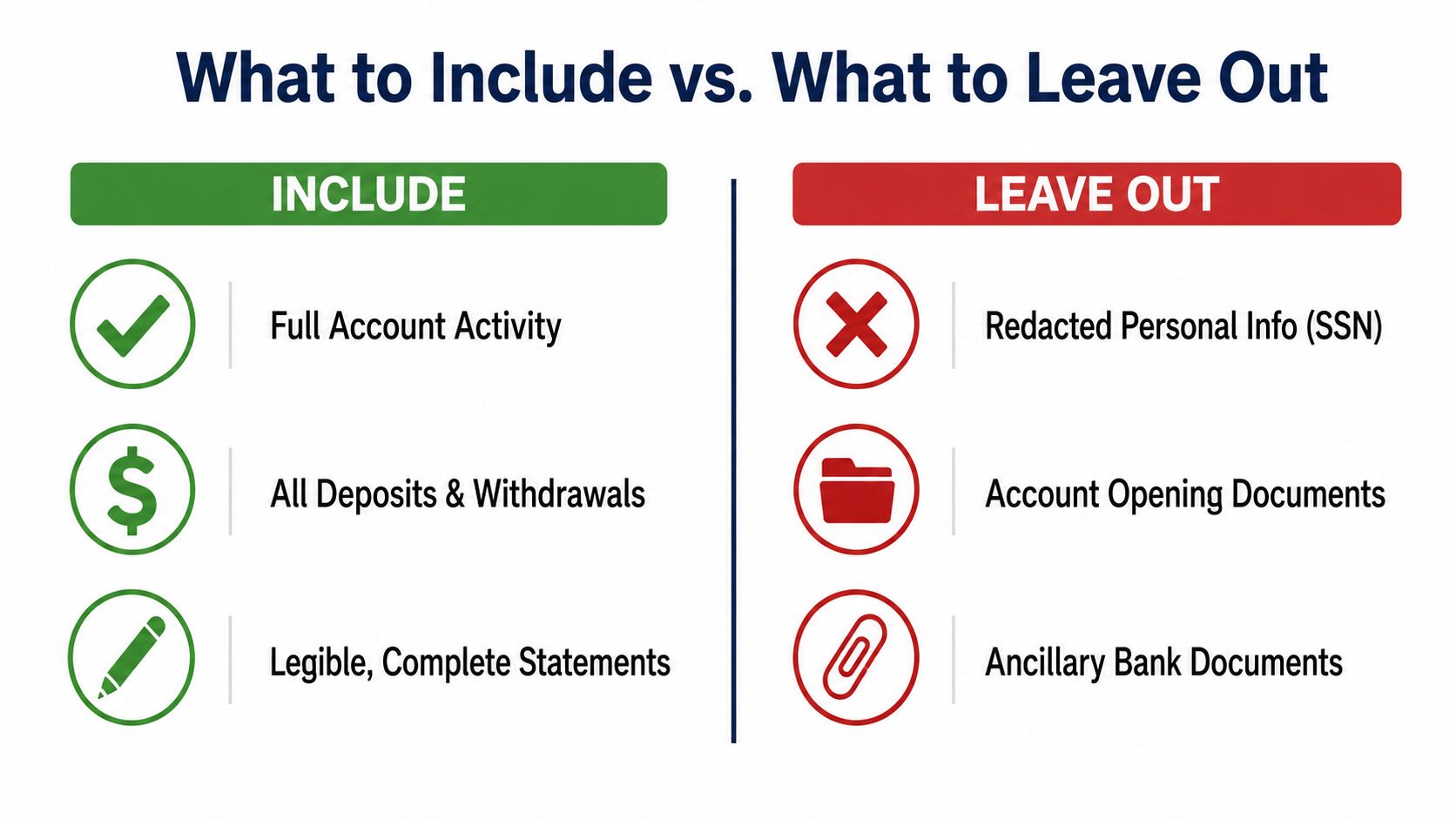
The packet should include complete statements for every account the debtor owns or can access. Checking, savings, money-market accounts, joint accounts, and prepaid debit accounts should be reviewed against the schedules. The requested date range must show the entire transaction history, not just the page displaying the opening or closing balance.
A clean PDF is usually easier for a trustee to review than a series of screenshots. Most financial institutions allow account holders to download statements from an online portal, and older statements may require a branch request or written request. Statements should be saved before they disappear from the portal's available history.
Keep the financial evidence intact
Amounts, dates, descriptions, payees, deposits, withdrawals, and balances need to remain visible. A debtor may need to redact sensitive personal information, but redaction should be limited and deliberate.
The following approach usually works:
- Preserve the account identity: Keep the institution name, account type, statement dates, and the identifying digits permitted by the trustee's instructions.
- Protect private identifiers: Redact Social Security numbers and account numbers beyond the last four digits when appropriate.
- Leave transaction details readable: Don't hide amounts, payees, transfer descriptions, or the running balance.
- Separate ancillary records: Account-opening materials and unrelated bank correspondence generally aren't substitutes for the requested statements.
Organize files for a fast review
Use one folder for each account. Label each file with the institution, account type, and date range, such as “checking, January through March,” rather than using an unclear download name. Arrange the files chronologically so the trustee can follow the balance from one month to the next.
Printed packets should follow the same order. Digital files should open without passwords unless the trustee provides a secure method for receiving them. When sending documents electronically, filers should use a method designed to protect sensitive data in transit instead of attaching confidential records to an ordinary message.
The objective isn't to submit every document connected to a bank account. It is to deliver complete, legible statements for the requested period while excluding unnecessary personal data and unrelated paperwork.
Common Mistakes That Derail a Chapter 7 Filing
The most damaging statement problems are usually simple omissions, not complex financial issues. A debtor may disclose the primary checking account but forget an old savings account, a joint account, or an account recently closed. Another common mistake is sending the cover page and balance summary while leaving out the transaction pages that show deposits and transfers.
Date gaps create the same problem. A packet may contain consecutive monthly statements, but the petition date can fall between statement cycles. If the requested period includes days not covered by the statements, the trustee may ask for a transaction history or an additional statement.
Reconciliation matters more for irregular income
Self-employed filers face a particular challenge because business deposits can look like personal income unless the records explain them. In Minneapolis Division cases, a trustee may continue a meeting when business deposits aren't reconciled to invoices, expenses, or the income reported in the schedules. Fargo trustees may ask pointed questions about intra-family loans that appear as deposits without a corresponding disclosure.
A useful review identifies the transaction before the trustee does:
- Unmatched deposits: Mark the source of every deposit that isn't ordinary payroll.
- Transfers to insiders: Identify payments to relatives, household members, or closely connected businesses.
- Closed accounts: Disclose accounts closed during the relevant reporting period when the petition or Statement of Financial Affairs requires it.
- Cash activity: Prepare a short explanation and supporting proof for substantial cash transactions.
- Schedule inconsistencies: Compare statement balances and income deposits with Schedules B, I, and J.
Silence creates more trouble than an honest explanation
A legitimate transfer can still look suspicious when the debtor offers no context. A family loan, refund, reimbursement, or business payment should be identified clearly and supported with records when available.
A trustee can work with an unusual transaction. A trustee can't work with a missing transaction that appears only after the trustee asks for more records.
Failure to disclose can lead to a continued meeting, additional attorney work, a request for amendments, or deeper investigation. In serious circumstances, concealment can threaten discharge under 11 U.S.C. §727. Moving money shortly before filing, deleting records, or altering statements creates risks that a straightforward explanation would often avoid.
Your Preparation Checklist and Next Steps
Preparation should begin with the trustee's written request, not with assumptions about what another debtor was asked to provide. A Minnesota or North Dakota filer can make the review easier by gathering the routine packet, then testing it against the means-test period and the account history.
Follow the records in order
-
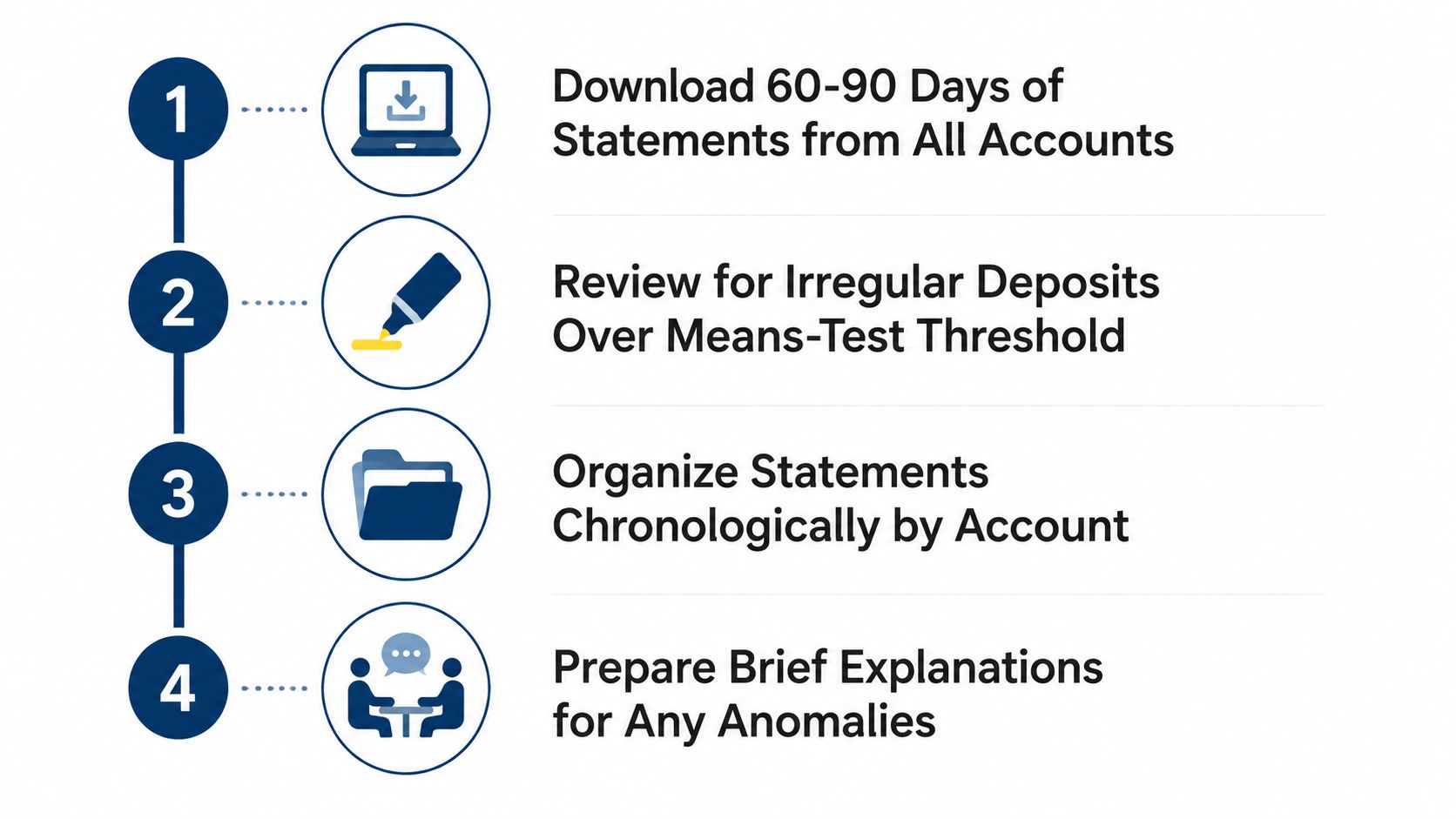
Download recent statements from every account. Obtain the requested 60-to-90-day period for checking, savings, joint, prepaid, and other disclosed accounts. Check whether the petition date falls inside the statement coverage.
-
Collect the six-month income records. Gather the pay stubs, income information, and account records needed to reconcile the means-test lookback. The six-month period should be treated as a separate analysis from the trustee's routine meeting packet.
-
Review every deposit and transfer. Highlight cash deposits, family payments, refunds, retirement distributions, business receipts, and unexplained changes in balances. Write a short factual explanation for each item and locate supporting records before the meeting.
-
Organize statements chronologically. Use separate folders for each account. Name files with the institution, account type, and dates. Keep printed and digital copies that match the versions sent to counsel or the trustee.
-
Redact only sensitive identifiers. Remove Social Security numbers and unnecessary full account numbers while keeping transaction descriptions, payees, amounts, and dates visible. Don't use redaction to hide financial activity.
-
Compare the packet with the schedules. Confirm that account ownership, petition-date balances, income, transfers, and cash on hand agree with the filed documents. Any mismatch should be raised before the 341 meeting.
Account for local practice
In the District of Minnesota, panel trustees in Minneapolis and St. Paul commonly request tax returns along with bank records at or around the §341 hearing. Duluth and other Minnesota locations follow the assigned trustee's instructions, so the written request controls.
The District of North Dakota uses a similar document-verification process, but the exact request can differ between Fargo and Bismarck. Self-employed filers should expect closer attention to business deposits and cash flow. Each filer should confirm the current requirements directly with the trustee's office because panel practices can shift.
Legal help is appropriate when a deposit can't be classified, a family transfer may be questioned, an account was recently closed, or the means-test figures don't reconcile. Minnesota filers can contact Mid-Minnesota Legal Aid, and North Dakota filers can contact Legal Aid of North Dakota. A Minnesota or North Dakota bankruptcy attorney should review the schedules before signing, particularly when the statements show unusual activity.
The firm can also provide case-specific guidance. LifeBack Law Firm, P.A. offers Chapter 7 assistance with means testing, trustee documentation, local filing requirements, and virtual or in-person consultations for Minnesota and North Dakota residents.
Before filing: Don't move funds, close accounts, or discard records to make the statement packet look cleaner. Preserve the history and obtain advice before taking action that could require an explanation later.
For a final check, the debtor should have the requested statements, income records, explanations for anomalies, identification, and any documents listed in the trustee's notice. That preparation won't eliminate every question, but it gives the trustee a complete starting point and helps the filer answer accurately.
LifeBack Law Firm, P.A. helps Minnesota and North Dakota filers prepare Chapter 7 petitions, means-test calculations, schedules, and bank-statement packages for the 341 meeting. Visit LifeBack Law Firm, P.A. to schedule a phone, video, or in-person consultation and get clear guidance on the records the assigned trustee may request.