
A Minnesota wage earner is two years into a five-year Chapter 13 plan. The payments are current, the household budget is tight but stable, and the FICO score has fallen into the high 500s. The filer keeps checking the report and sees the same public-record entry, then wonders whether a Lakeville townhome is gone for good.
That fear is understandable, but the seven-year reporting period isn't the entire credit story. The public record, the score decline, the plan payments, and the borrower's post-filing conduct operate on different timelines. This guide explains how Chapter 13 affects credit, what the bureaus report, how the result differs from Chapter 7, and how Minnesota and North Dakota filers can begin rebuilding before the case closes.
It doesn't cover non-bankruptcy debt-consolidation strategies, tax-resolution specifics, or immigration consequences of filing. The discussion is direct because credit recovery requires realistic expectations. Chapter 13 is a serious negative event, but it isn't a permanent financial identity.
Where Most Chapter 13 Filers Stand Right Now
The filer in Lakeville has two separate problems, not one. The first is the bankruptcy notation that remains visible on the credit report. The second is the practical question lenders ask during an active plan: whether the borrower has established reliable payment behavior after filing.
Those questions matter more than the emotional reaction to a low score. A person can be current on a court-approved repayment plan and still face cautious underwriting, higher borrowing costs, and limited access to new credit. That doesn't mean every future mortgage opportunity has disappeared. It means the borrower has to manage the case and the credit file together.
The report and the lived timeline
Chapter 13 can remain on a credit report for seven years from the filing date, even when the repayment plan ends earlier, as explained by the Consumer Financial Protection Bureau's bankruptcy reporting guidance. A plan can last as long as five years, so the public record may remain after the court-supervised payments are finished.
That distinction is the central point. The reporting window answers, “How long can the bankruptcy appear?” It doesn't answer, “When will a lender see enough positive conduct to approve a car loan or mortgage?”
Practical rule: A discharge is an important legal milestone, but it isn't a credit-rebuilding finish line.
What this guide recommends
A responsible recovery plan starts while the Chapter 13 case is open. The filer should protect every plan payment, inspect each bureau report, correct inaccurate account information, and avoid borrowing without required court or trustee approval.
Federal court data recorded 181,834 Chapter 13 consumer cases closed in 2025, with a median filing-to-closing time of 1,045 days, down from 1,274 days in 2024, according to the 2025 BAPCPA report from the United States Courts. The figures show why filers shouldn't postpone planning until discharge. Many cases resolve after years of repayment, while credit decisions arise throughout the case.
What Chapter 13 Actually Is and Why It Is Different
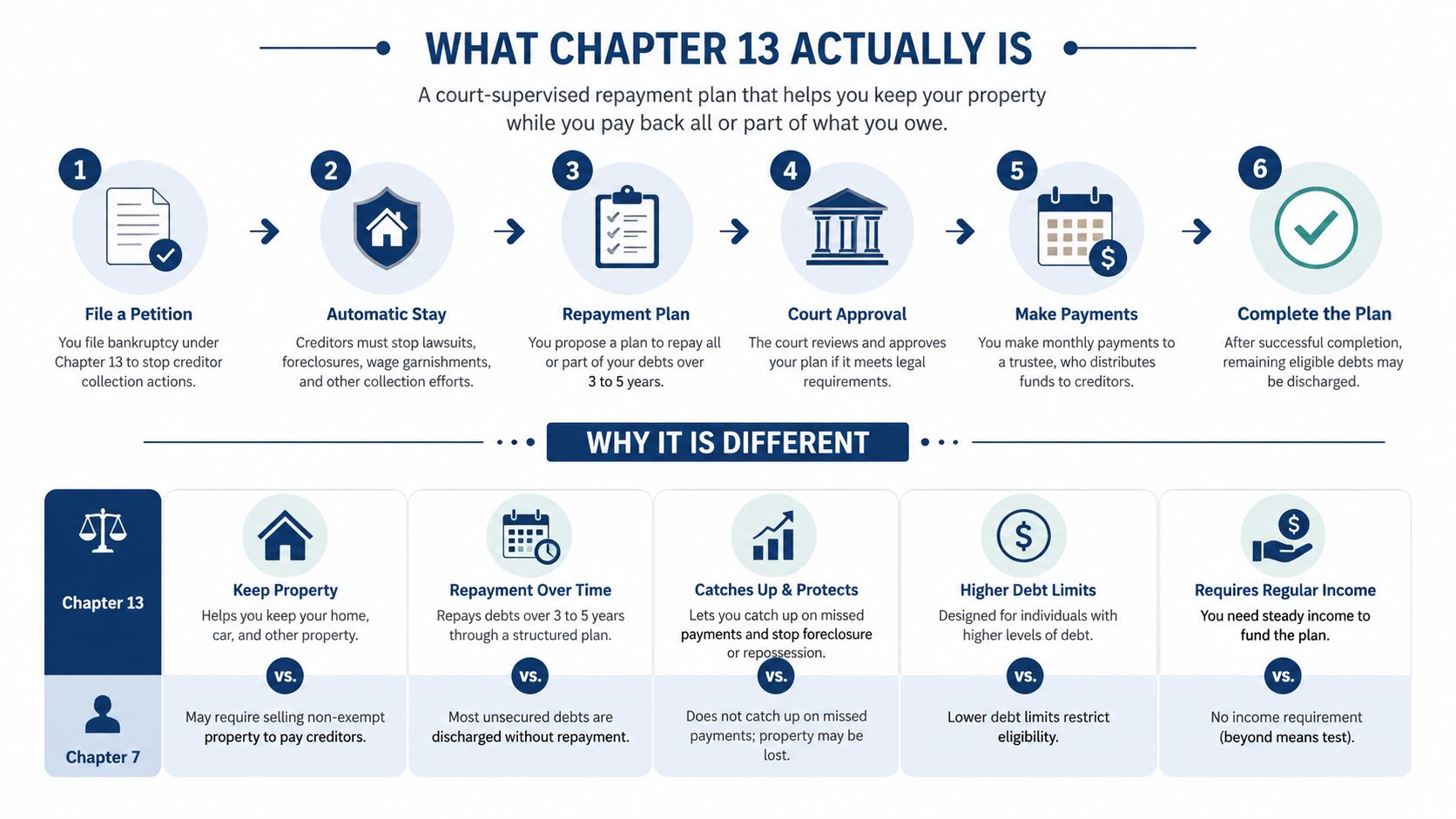
Chapter 13 is a court-supervised repayment plan for eligible individuals with regular income. Instead of immediately liquidating eligible nonexempt property, the debtor proposes payments over a plan that commonly lasts three to five years. The plan can help a wage earner catch up on mortgage arrears, vehicle obligations, or other secured debt while protecting property under the bankruptcy process.
The structure matters because creditors receive payments through the plan. Chapter 7 generally provides a faster discharge of qualifying unsecured debt, while Chapter 13 gives the debtor a supervised method for resolving obligations over time. That difference affects how account histories can appear after filing, although neither chapter produces a credit-neutral result.
The basic process
A prospective filer first completes eligibility analysis, including the applicable income and household-size rules. The means-test framework uses state-specific median-income figures, so a household in Minnesota may be evaluated differently from a household in North Dakota. The correct analysis depends on household circumstances, income sources, allowable expenses, debts, and property.
After filing, the debtor begins making plan payments under the proposed structure. A trustee administers the case, creditors receive notice, and the court determines whether the plan satisfies legal requirements. A filer considering the process can review how a Chapter 13 bankruptcy works before discussing the facts with counsel.
Chapter 13 may also protect certain co-debtors through its legal structure. In some cases, it can address a second mortgage or other secured obligations, but the result depends on lien status, property value, arrears, plan terms, and court requirements. Those issues require a case-specific review rather than a general promise.
Why repayment changes the credit picture
Creditors may report accounts with language indicating that the account was included in bankruptcy, paid through a plan, or otherwise resolved under bankruptcy protection. The exact wording can vary by creditor and bureau. A payment history showing performance under a plan can provide useful positive information, but it doesn't erase the bankruptcy entry or earlier delinquencies.
Cancellation-of-debt rules can also interact with a bankruptcy case, including the treatment of certain tax forms and discharged debt. Tax consequences shouldn't be assumed from the credit report alone. A bankruptcy attorney and qualified tax professional may need to coordinate when a creditor reports cancelled debt.
How Chapter 13 Shows Up on Your Credit Report
A Chapter 13 filing typically creates two layers of reporting. The first is the bankruptcy public record. The second consists of individual creditor accounts affected by the filing.
The public-record entry generally identifies the case as Chapter 13 and includes the filing date. Under the reporting rule described by the Consumer Financial Protection Bureau, the Chapter 13 entry can remain for seven years from filing. Completion of the repayment plan doesn't restart that period and doesn't automatically delete the entry.
Account-level reporting requires separate review
Each creditor may update its own tradeline. A report might show an account as included in bankruptcy, discharged, or paid through the Chapter 13 plan. These labels don't all mean the same thing, and an account can contain separate errors involving balances, delinquency dates, payment status, or post-petition activity.
A filer should review all three bureau reports rather than assume they match. The LifeBack guidance on credit reporting after filing bankruptcy provides a useful starting point for identifying account-level issues and organizing supporting documents.
The score hit is real
Research cited in a Harvard Law School paper reports an immediate Chapter 13 credit-score decline of about 40 to 50 points after filing, as described in the Experian explanation of Chapter 13 bankruptcy. The practical effect can include reduced borrowing power even before the plan ends.
The score decline isn't the only underwriting concern. Lenders may also review the active case, required payment history, debt-to-income ratio, collateral, income stability, and any applicable program rules. A borrower shouldn't treat a single score as a complete approval forecast.
Chapter 13 credit-report itemization
| Report Item | Source | Reporting Window | Typical Status Code |
|---|---|---|---|
| Bankruptcy public record | Bankruptcy filing record | Seven years from filing | Chapter 13 bankruptcy |
| Individual creditor tradeline | Furnisher's account records | Depends on the account and reporting rules | Included in bankruptcy |
| Plan-resolved account | Creditor and plan records | Depends on accurate account reporting | Paid through Chapter 13 plan |
| Post-plan account update | Creditor reporting | Depends on the account record | Discharged or resolved |
Minnesota filers can review federal case records through the District of Minnesota's PACER access, while North Dakota filers use PACER for federal bankruptcy records in that district. Those court records won't replace the credit reports, but they can help confirm filing dates, case status, and plan history when a bureau dispute requires documentation.
Chapter 13 vs Chapter 7 on Your Credit
Chapter 13 and Chapter 7 both damage credit, but they don't create the same recovery path. The choice affects the public-record duration, the payment structure, and the circumstances under which a borrower may seek new financing.
Chapter 13 generally remains on the credit report for seven years from filing, while Chapter 7 can remain for up to ten years, as reflected in the Consumer Financial Protection Bureau's reporting explanation. Chapter 13 also involves a repayment plan, which can give the filer an opportunity to establish post-filing payment conduct before the case closes. That opportunity doesn't guarantee a smaller score decline or quick approval.
Credit-report comparison
| Factor | Chapter 13 | Chapter 7 |
|---|---|---|
| Public-record period | Commonly seven years from filing | Up to ten years from filing |
| Debt structure | Court-supervised repayment plan | Generally a quicker discharge of qualifying unsecured debt |
| Credit during the case | Positive plan payment activity may develop, subject to accurate reporting | Filer rebuilds after discharge and account updates |
| Property and arrears | Often used to address arrears while protecting eligible property | May require liquidation analysis and can be less suited to catching up arrears |
| Best fit | Wage earners with regular income who need structured repayment | Households seeking a clean break and lacking the income for a feasible plan |
A household with no disposable income may need Chapter 7 because a Chapter 13 plan isn't workable. A wage earner protecting a home, curing mortgage arrears, or seeking protection for a qualifying co-debtor may find Chapter 13 more appropriate. Eligibility, exemptions, debt limits, and feasibility determine the answer.
Credit isn't the only factor in the decision. A person weighing bankruptcy against other options can also review a neutral discussion of business debt solutions compared, then obtain advice based on the actual household or business debts. Debt settlement and bankruptcy create different legal and credit consequences, so a generic comparison can't replace legal analysis.
Neither chapter is harmless to credit. The right filing can still be the faster route to stability when the alternative is years of missed payments, collections, judgments, or unaffordable debt.
Your Chapter 13 Credit Recovery Plan
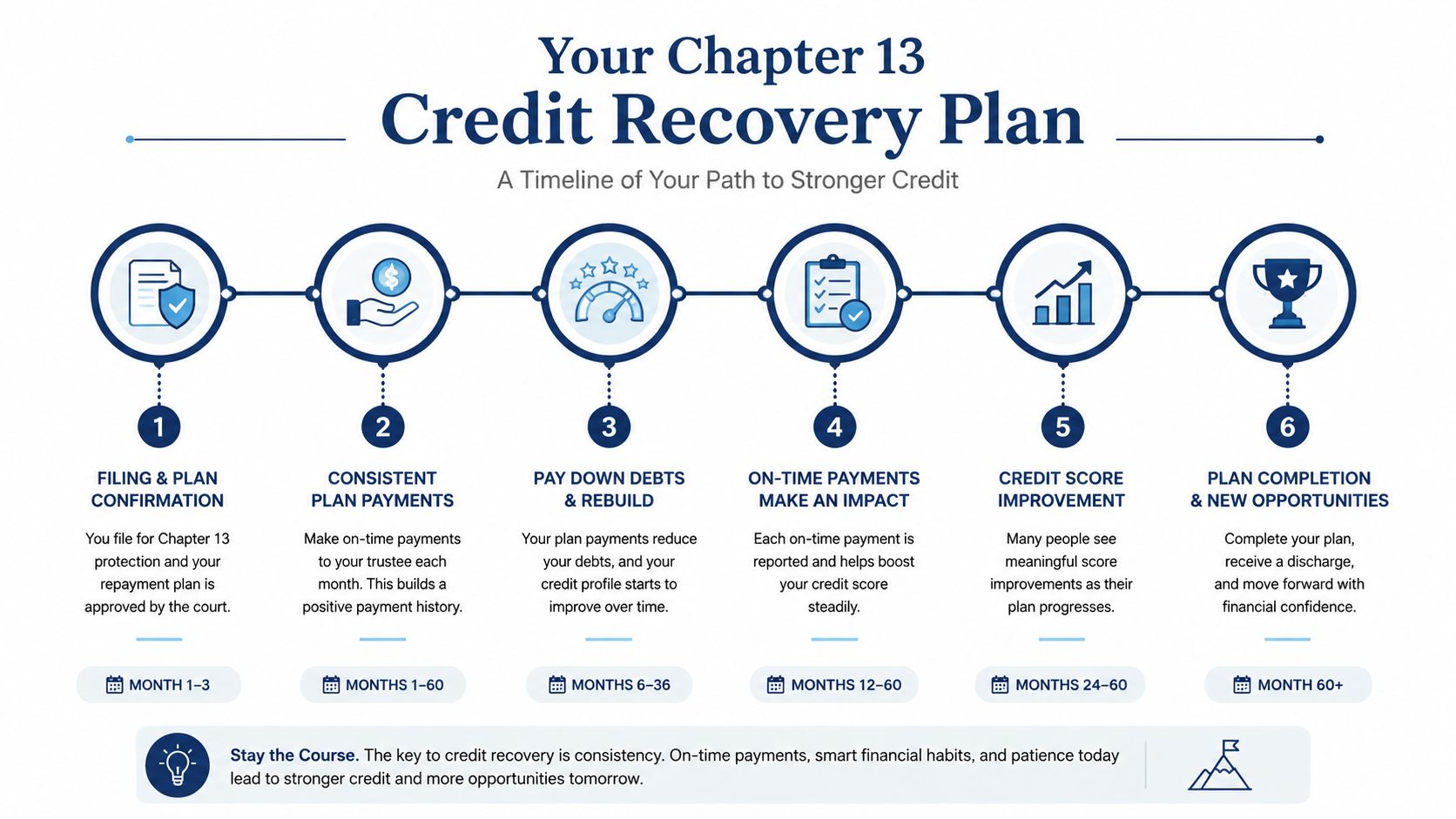
Credit recovery should begin on the first day of the plan, not the day of discharge. The first assignment is administrative: obtain the reports, save them, and create a record of every account affected by the petition.
Free annual reports from Equifax, Experian, and TransUnion give the filer a baseline. The filer should compare names, addresses, case information, account balances, delinquency dates, and post-petition activity. Any inaccurate entry should be documented before a dispute is submitted.
The first year
During the opening months, the priority is stability rather than rapid score chasing. A secured card from a bureau-friendly issuer can be considered if the trustee and bankruptcy counsel confirm that opening and using the account won't violate case requirements. One small recurring bill, paid in full every month, is safer than several new accounts.
The filer should keep the balance low relative to the available limit and avoid carrying debt merely to create a score. A credit card doesn't rebuild a file if the borrower misses payments or uses it to fund a budget shortfall.
A post-bankruptcy service such as LifeBack Law Firm, P.A.'s Post-Bankruptcy Program can combine a credit-report audit, dispute support, and monitoring of reporting issues while the filer follows the plan. It should supplement, not replace, accurate payments and legal compliance. More practical rebuilding guidance appears in five ways to repair credit after bankruptcy.
The middle of the plan
After several months of clean management, an authorized-user arrangement on a trusted family member's well-maintained account may be considered. The account history must be positive, and the primary cardholder must understand that the arrangement doesn't create a guaranteed score result.
A credit-limit increase can reduce utilization only when the borrower doesn't increase spending. The safest approach is to request changes cautiously, review the effect on the budget, and avoid applications that create unnecessary inquiries.
Through the remaining plan period, the filer should:
- Dispute inaccurate balances: Challenge pre-petition amounts or post-petition reporting that conflicts with the court record.
- Avoid store-card pressure: Promotional offers can create new obligations and complicate an already controlled budget.
- Refuse co-signing: A co-signed debt can become a direct household problem if the other borrower misses payments.
- Protect plan payments: The court plan remains the first obligation, ahead of score optimization.
After completion
After discharge, a modest credit-builder loan may be considered if the payment fits the budget. An unsecured card can follow only when the account won't encourage new revolving debt. Mortgage planning should wait until the borrower understands the lender's bankruptcy rules, income review, debt-to-income calculation, and required documentation.
A borrower researching home financing can use a bad credit mortgage 2026 guide for general questions, but lender overlays still control the actual decision. There is no guaranteed score milestone that automatically produces approval. The strongest record is consistent, affordable payment behavior supported by clean documentation.
Minnesota and North Dakota Resources for a Real Fresh Start
A national rebuilding framework becomes more useful when it fits the geography and court process facing the filer. Minnesota and North Dakota households may live far from a bankruptcy courthouse, work irregular hours, or need advice about a home, vehicle, farm-related obligation, or judgment that appears on a report.
LifeBack Law Firm, P.A. serves clients across the Twin Cities, St. Cloud, Rochester, Duluth, Fargo, Bismarck, and Grand Forks, with virtual consultations for rural Minnesota and western North Dakota households. Phone, video, and in-person appointments can help a filer choose a workable format without treating distance as a reason to delay a credit-report review.
Local support should solve distinct problems
Minnesota consumers can use the Minnesota Department of Commerce consumer hotline for state-level consumer concerns. Homeowners facing foreclosure pressure can also look for counseling through the Minnesota HomeOwnership Center's foreclosure-prevention network. North Dakota residents can use Money Smart financial-education classes to strengthen budgeting and financial decision-making after filing.
Each resource serves a different purpose:
- Legal case review: Counsel addresses eligibility, plan feasibility, trustee requirements, and creditor conduct.
- Credit-file review: A report audit identifies inaccurate public-record or account-level information.
- Housing counseling: A qualified housing counselor can help a homeowner understand foreclosure-prevention options.
- Financial education: Budgeting instruction helps prevent new borrowing from undermining the repayment plan.
What a post-bankruptcy program can address
A structured post-bankruptcy program may include a credit-report audit, debt-validation work, dispute letters for inaccurate post-petition balances, and bureau updates that document on-time plan payments when reporting is incomplete or wrong. The work should be based on records, not promises that a legitimate bankruptcy can be erased.
Judgment removal deserves special attention. If a discharged debt remains tied to a judgment and creditors continue reporting it inaccurately, the entry can interfere with future borrowing. LifeBack can provide judgment-removal assistance for discharged debts, subject to the facts and legal requirements of the case.
The local advantage isn't a shortcut around the reporting period. It is coordinated help with the legal file, the credit reports, and the borrowing decisions that occur while the public record remains visible.
Chapter 13 Credit Questions Minnesota and North Dakota Filers Ask Most
Can a filer finance a car during an active plan?
Sometimes, but the borrower usually needs to follow the case's borrowing rules and obtain required trustee or court approval before taking on new financing. The direct answer is don't sign first and ask later.
A Twin Ports or Red River Valley filer should provide counsel with the proposed purchase price, interest rate, payment, vehicle information, income proof, and reason for the purchase. The attorney can determine the required approval path and whether the payment fits the confirmed plan and household budget. A lender's willingness to approve doesn't override bankruptcy requirements.
Can a filer qualify for a mortgage after discharge?
Yes, approval can be possible, but discharge alone doesn't guarantee it. FHA rules, lender overlays, credit history, income, debt-to-income ratios, and documented payment performance all matter. A borrower should ask the lender to explain the applicable FHA Chapter 13 seasoning rule in writing, because the treatment can depend on whether the case is active, completed, or dismissed and whether payments were timely.
A Twin Cities or rural Minnesota borrower should collect the discharge order, plan-payment history, tax and income records, and current credit reports before applying. North Dakota borrowers should take the same approach, especially when a lender serves multiple states but applies stricter internal standards.
Should a filer co-sign for a relative?
No, not during or shortly after a Chapter 13 case unless bankruptcy counsel has reviewed the exact situation. Co-signing makes the filer responsible if the primary borrower doesn't pay. It can also create a new monthly obligation, complicate underwriting, and weaken the budget that supports the existing plan.
A request from a relative in Fargo, Bismarck, or the Twin Cities may feel urgent. The correct response is to protect the filer's own repayment and housing stability first.
Can the public record be removed early?
Usually not when the entry is accurate. A bureau may have to correct or delete an entry that was reported in error, belongs to someone else, contains an inaccurate filing date, or conflicts with reliable court documentation. An accurate Chapter 13 public record generally remains through its reporting window.
A filer should compare the bureau entry with the petition and court docket, preserve supporting records, and submit a focused dispute when a factual error exists. A business owner considering future financing can also review this guide for business buyers for broader financing questions, but business borrowing still requires separate legal and underwriting analysis.
A free consultation with LifeBack Law Firm can help Minnesota and North Dakota filers evaluate a proposed car loan, mortgage application, co-signing request, or credit-report dispute before the decision creates a new problem.
LifeBack Law Firm, P.A. helps Minnesota and North Dakota consumers with Chapter 13 planning, credit-report review, post-bankruptcy recovery, and judgment-removal assistance for qualifying discharged debts. Visit LifeBack Law Firm, P.A. to schedule a phone, video, or in-person consultation before making a major borrowing move.