
Chapter 13 is the only consumer bankruptcy chapter that can discharge certain divorce-related property debts after a completed plan, but alimony, child support, and maintenance are never dischargeable. As of 2026, eligibility generally requires unsecured debts below $526,700 and secured debts below $1,580,125, yet the divorce order's labels still don't control how the bankruptcy court classifies each obligation.
A common Minnesota or North Dakota scenario looks like this: a marriage ends, the decree assigns one spouse the joint credit cards and mortgage arrears, and the paying spouse assumes the ex-spouse's debts through a hold-harmless clause. Then the assigned spouse loses a job, stops paying, or files bankruptcy. The creditor may still pursue the other person because a divorce decree allocates responsibility between former spouses, but it doesn't automatically erase a creditor's contract rights.
That's why chapter 13 and divorce settlements require more than reading the final judgment. The central question is whether an obligation is a domestic support obligation or a property-settlement debt. Support survives bankruptcy. A qualifying property-settlement debt may be discharged only after successful completion of a Chapter 13 plan.
Why Chapter 13 and Divorce Settlements Create a Unique Problem
Divorce changes who is supposed to pay a debt, but it often doesn't change who legally owes the creditor. A marital settlement agreement might require one spouse to pay a joint credit card, refinance a mortgage, or protect the other spouse through a hold-harmless clause. If the responsible spouse defaults, the creditor can often pursue both borrowers even though the divorce court assigned the account to one person.
The same problem appears with equalization payments. One spouse may keep the home, retirement account, or business interest and promise to pay the other spouse for that share. The obligation can look like a simple debt, but its bankruptcy treatment depends on what the payment was designed to accomplish and how the court characterizes it.
Chapter 7 offers limited relief in this setting. Domestic support obligations remain protected, and divorce-related property obligations covered by the federal divorce-debt exception generally survive Chapter 7. Chapter 13 works differently. Under the completed-plan discharge described in the bankruptcy treatment of divorce debts, § 1328(a) doesn't include § 523(a)(15) property-settlement debts among the exceptions to discharge, while support obligations remain excluded.
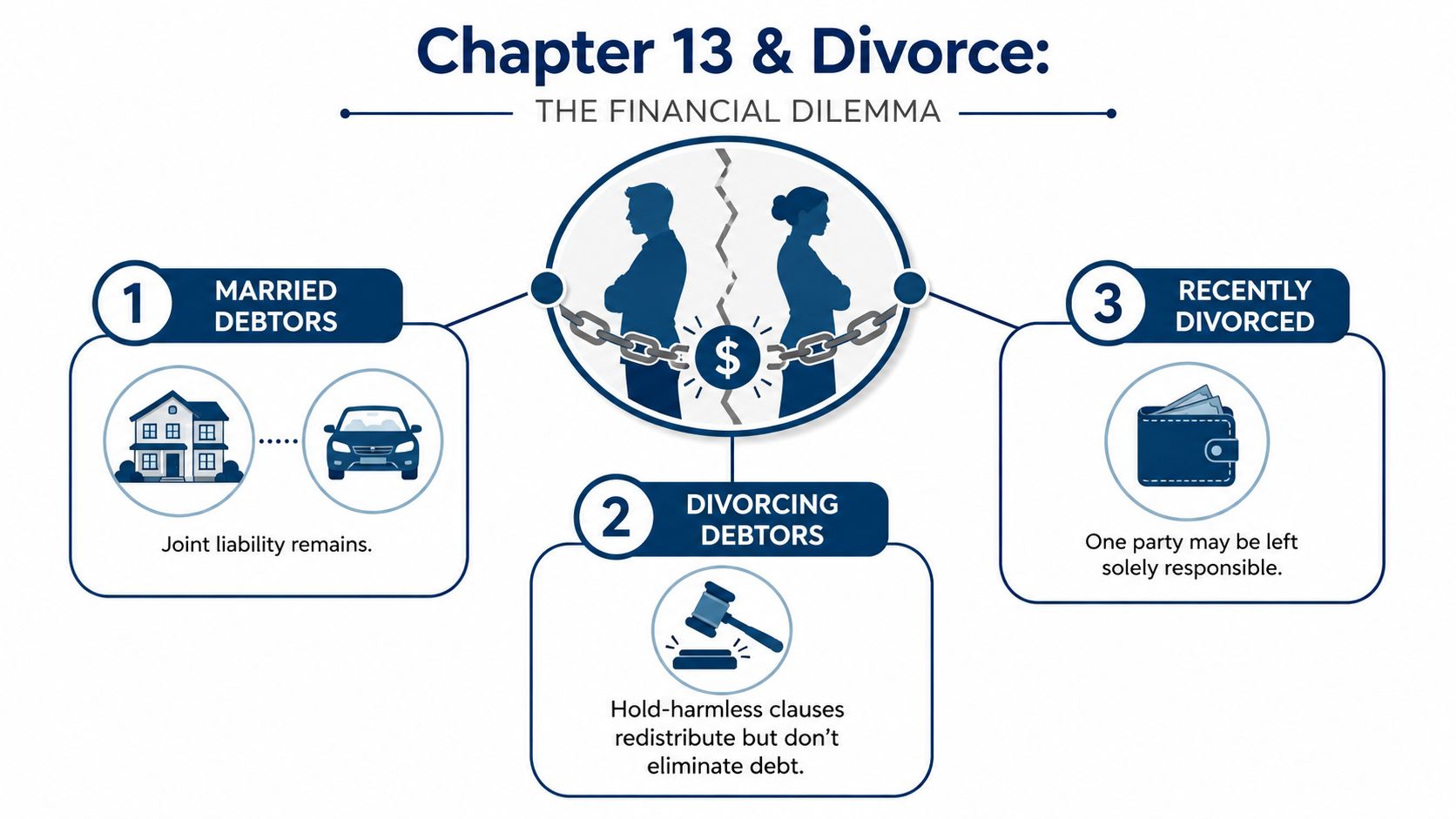
The three situations that create the most confusion
- Married debtors: Both spouses may remain liable on joint mortgages, vehicle loans, and credit cards even while considering divorce.
- Divorcing debtors: The divorce court may redistribute payments, but the bankruptcy court and outside creditors still apply federal law.
- Recently divorced debtors: One former spouse may carry debts assigned entirely through the decree while lacking the income to pay them.
Chapter 13 provides a structured repayment period generally lasting three to five years, giving an eligible debtor time to address support arrears, mortgage arrears, and other marital debt. It can also discharge certain non-support property obligations after every required plan payment and other case duties are completed.
Readers sorting through the broader financial consequences of separation may also benefit from these post-divorce financial strategies. The practical lesson is simple: the decree is important evidence, but it isn't the final word on dischargeability.
How Chapter 13 Eligibility and Debt Limits Work in 2026
Chapter 13 isn't available merely because divorce debt feels unmanageable. The debtor must fit within federal eligibility limits and propose a plan that can be completed. As of 2026, the U.S. Courts identify an unsecured debt ceiling of $526,700 and a secured debt ceiling of $1,580,125 for Chapter 13 filers. The figures apply to the debtor's qualifying debts, not just the amount owed to a former spouse. The U.S. Courts' Chapter 13 overview provides the controlling public explanation of these limits and plan structure.
A divorcing homeowner should total every relevant obligation before assuming Chapter 13 is available. That review may include a mortgage, home-equity loan, vehicle financing, joint credit cards, personal guarantees, tax claims, and an equalization note. A debt can be disputed, assigned to an ex-spouse, or secured by property and still affect the eligibility analysis.
| Threshold or Term | 2026 Figure / Rule | Why It Matters for Divorce Debt |
|---|---|---|
| Unsecured debt limit | Below $526,700 | Joint cards, personal loans, and some property-settlement claims can consume available eligibility. |
| Secured debt limit | Below $1,580,125 | Mortgage, home-equity, and vehicle debt may matter even when the divorce decree assigns payment to one spouse. |
| Plan duration | Generally three to five years | The debtor needs enough time to cure support or mortgage arrears while maintaining current obligations. |
| Support treatment | Support must be paid in full and kept current | Ongoing support competes directly with housing, transportation, and other plan expenses. |
Eligibility and feasibility are separate tests. A debtor may fall below both debt caps but still lack enough monthly income to fund a plan. Courts and trustees examine income, allowed expenses, disposable income, secured arrears, priority claims, and the debtor's ability to make payments consistently.
The plan length also matters. A debtor with regular income may need a longer plan to handle support arrears and marital debt without creating an impossible payment. Above-median-income calculations can further affect disposable-income projections and the amount available for creditors. A plan that ignores support obligations isn't a workable plan, regardless of how attractive the proposed treatment of property debt appears.
Which Divorce Debts Are Dischargeable and Which Are Not
Bankruptcy divides divorce obligations into two tracks. The first is the domestic support obligation, which includes alimony, maintenance, child support, and other debts that function as support. The second is the property-settlement debt, which represents the division of marital assets or liabilities.
Domestic support obligations are not dischargeable in Chapter 7 or Chapter 13. They also receive first-priority treatment in Chapter 13. A debtor must pay prepetition support arrears through the plan and remain current on postpetition support to receive a discharge.
A true property-settlement debt receives different treatment. Equalization payments, certain hold-harmless obligations, and assigned marital debts can potentially be discharged after a Chapter 13 plan is completed. The distinction reflects the federal rules discussed in this explanation of domestic support obligations, but classification depends on the facts, not a convenient label in the decree.
Substance controls over labels
Courts examine whether an obligation is “in the nature of” support under 11 U.S.C. § 101(14A). They may consider the parties' financial circumstances, the purpose of the payment, the structure of the obligation, and whether the payment helped provide necessities for a spouse or child.
A decree calling a debt “property equalization” won't guarantee dischargeability. Conversely, a payment described in family-court documents may still be property division if the facts show that it compensated a spouse for an asset rather than providing support.
| Type of Obligation | Example from a Divorce Decree | Dischargeable in Chapter 13? |
|---|---|---|
| Child support | Monthly support or arrears | No |
| Alimony or maintenance | Monthly maintenance obligation | No |
| Support-related medical or family expense | Payment serving the support function | No, if it is in the nature of support |
| Equalization payment | Payment for one spouse's share of marital property | Potentially, after plan completion |
| Assigned joint credit card | One spouse agrees to pay and hold the other harmless | Potentially, unless the facts show it functions as support |
| Property buyout note | Promissory note for equity or other marital property | Potentially, if treated as a property debt |
Hold-harmless clauses deserve particular scrutiny. They may be ordinary property-division provisions, but they can also protect a former spouse from a liability connected to housing or basic financial support. The bankruptcy court will examine the substance.
When divorce is still being negotiated, bankruptcy counsel should review proposed language before the settlement becomes final. The safest drafting approach identifies the economic purpose of each obligation, separates support from property division, and avoids assuming that a family-court label will bind the bankruptcy judge.
Timing the Filing Before or After Your Divorce
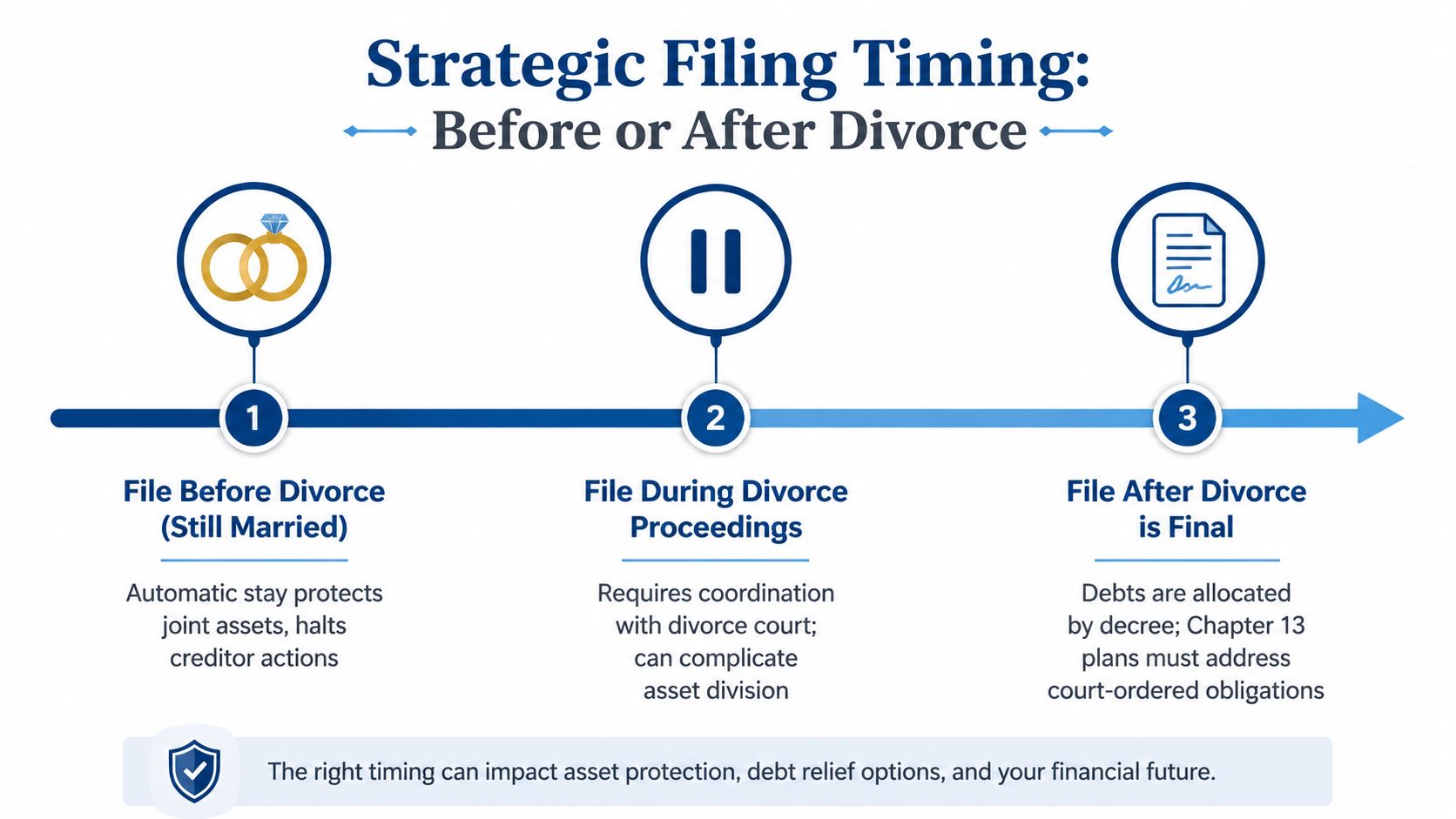
Timing can change the practical value of Chapter 13. Filing while spouses remain married may allow a joint case, but it also places shared income, property, and debt under one bankruptcy analysis. Filing after the divorce creates a cleaner individual financial picture, yet the debtor may lose the administrative advantages of a joint filing and may already be solely responsible for debts assigned by the decree.
A bankruptcy filing generally triggers the automatic stay, which can halt many collection actions. That protection may affect joint accounts, marital property, foreclosure activity, and creditor lawsuits. It doesn't give either spouse permission to ignore the divorce court, transfer estate property freely, or rewrite the parties' family-law rights without coordination.
Filing before the decree
A pre-divorce filing can make sense when joint debt, foreclosure pressure, or creditor activity is driving the financial crisis. It can also complicate property division because the bankruptcy estate and trustee may have an interest in marital property. The divorce court's proposed allocation may not control what happens to estate assets or creditor claims.
The filing decision should therefore be coordinated with both bankruptcy and family-law counsel. The practical guidance in this discussion of whether divorce or bankruptcy should come first reinforces the need to analyze both proceedings together rather than treating them as unrelated cases.
Separation during an existing case
If spouses file jointly and later separate, the case may need to be severed. The court can separate the debtors' cases, require new schedules, and recalculate the remaining debtor's plan based on individual income, expenses, property, and support duties.
The family home requires special care. A divorce decree doesn't automatically remove property from the bankruptcy estate or release a joint borrower from the creditor's claim. Changes involving the home, refinancing, sale, or transfer generally require attention from the trustee and bankruptcy court.
Filing after the divorce
A post-divorce filing may simplify the household budget and clarify which obligations the debtor is carrying. It may also eliminate the possibility of jointly administering a case. The debtor must disclose the decree, settlement agreement, support orders, joint debts, and transfers connected to the divorce.
Support claims and payments also require careful timing analysis. Counsel should review payment history, pending collection activity, and any recent transfers before filing, rather than assuming that a finalized decree has resolved every bankruptcy issue.
Real-World Scenarios That Show the Rules in Action
The legal difference becomes clearer through representative fact patterns. Each example turns on the purpose of the obligation, the evidence surrounding it, and whether the debtor completes the Chapter 13 plan.
A hold-harmless clause that functions as support
A decree labels an obligation “property equalization,” but the provision requires one spouse to pay debts that supported the other spouse and children. The paying spouse has higher income, the recipient has limited resources, and the payment structure replaces financial assistance that would otherwise have been provided as maintenance.
A bankruptcy judge could treat that obligation as support because its function matters more than its heading. If the court finds that it is in the nature of support, the debt remains nondischargeable and must receive priority treatment in Chapter 13.
The trap is relying on a single phrase from the decree. The full settlement, financial affidavits, payment history, and surrounding circumstances can matter.
An equalization note tied to property value
A spouse keeps the marital home and signs a promissory note for the other spouse's share of equity. The note represents a property buyout, not monthly support, and the recipient has independent income. The debtor later files Chapter 13 and classifies the note as a general unsecured property-settlement claim.
If the court accepts that classification, the debtor pays the amount required by the confirmed plan. After completing the plan and satisfying all discharge requirements, the remaining qualifying property-settlement balance may be discharged.
The opportunity is real, but it depends on accurate schedules, proper notice, and a plan that survives to completion. Missing payments or failing to address the claim can destroy the expected result.
A family home facing foreclosure
A divorcing couple remains jointly connected to a home, but one spouse has custody of the children and wants to remain there. Mortgage arrears and a junior secured claim threaten the property. A properly structured Chapter 13 case can protect estate property, provide a mechanism to cure arrears, and address the junior claim under applicable bankruptcy rules.
The divorce court still must address ownership, possession, and sale issues. Bankruptcy protection doesn't automatically transfer the home to the custodial parent, and the trustee or court may need to approve changes affecting the estate.
Practical rule: A divorce decree allocates obligations between former spouses. It doesn't automatically rewrite the rights of a mortgage lender, card issuer, or bankruptcy trustee.
These examples show why a lawyer must review the entire financial history, not just the judgment's caption. The same words can produce different outcomes when the underlying purpose changes.
Plan Confirmation and Support Priority Issues
A Chapter 13 plan involving divorce debt succeeds or fails on cash flow. The debtor must fund the plan while paying ongoing support, housing costs, transportation expenses, and any obligations secured by property the debtor intends to keep.
Domestic support obligations receive first-priority status under federal bankruptcy law. That means support arrears must be addressed before most general unsecured claims. The debtor also must maintain current support after filing. A plan that proposes to pay credit cards while leaving child support or maintenance unpaid won't satisfy confirmation requirements.
What the trustee examines
The standing trustee reviews whether the proposed payment is realistic and whether the schedules match the debtor's actual obligations. For a Minnesota or North Dakota filer, that review may focus on:
- Current support: The budget must show ongoing alimony, maintenance, or child-support payments.
- Arrears: Prepetition support claims must be identified and paid according to the plan's required treatment.
- Housing costs: Mortgage payments and arrears must fit alongside support, not replace it.
- Income stability: Recent pay records and household changes must support the projected payment.
- Divorce-related claims: The debtor must identify the former spouse, the legal basis for each claim, and any dispute about classification.
If support payments fall behind during the case, the trustee or support creditor may seek dismissal or other relief. The debtor may need to request a plan modification, but modification isn't a substitute for ignoring current support.
| Obligation Type | Priority Status | Must Be Paid in Full? | Dischargeable After Plan? |
|---|---|---|---|
| Ongoing child support | Domestic support obligation, first priority | Yes, current obligations must remain current | No |
| Child-support arrears | First-priority domestic support claim | Yes, through the plan | No |
| Alimony or maintenance | Domestic support obligation, first priority | Yes, including required arrears | No |
| Property equalization debt | Generally nonpriority property claim if properly classified | Not necessarily, subject to plan treatment | Potentially, after completion |
| Assigned joint credit card debt | Generally unsecured property-related claim if properly classified | Not necessarily, subject to plan treatment | Potentially, after completion |
The interaction between 11 U.S.C. § 1322(a)(2) and § 1328(a) matters. Priority support claims must be paid as required before a completed-plan discharge can issue, while qualifying property-settlement debts may fall outside the discharge exceptions.
Your Next Steps as a Minnesota or North Dakota Resident
A divorce-related bankruptcy review should begin with documents, not assumptions. The debtor needs the final divorce decree, marital settlement agreement, support orders, payment records, mortgage statements, vehicle information, tax records, pay records, and statements for every joint and individual account.
The purpose is to build a debt map. Each obligation should be tagged as support, property division, secured debt, tax debt, or ordinary consumer debt. That classification gives counsel a basis for estimating a feasible plan and identifying issues that require a separate court determination.
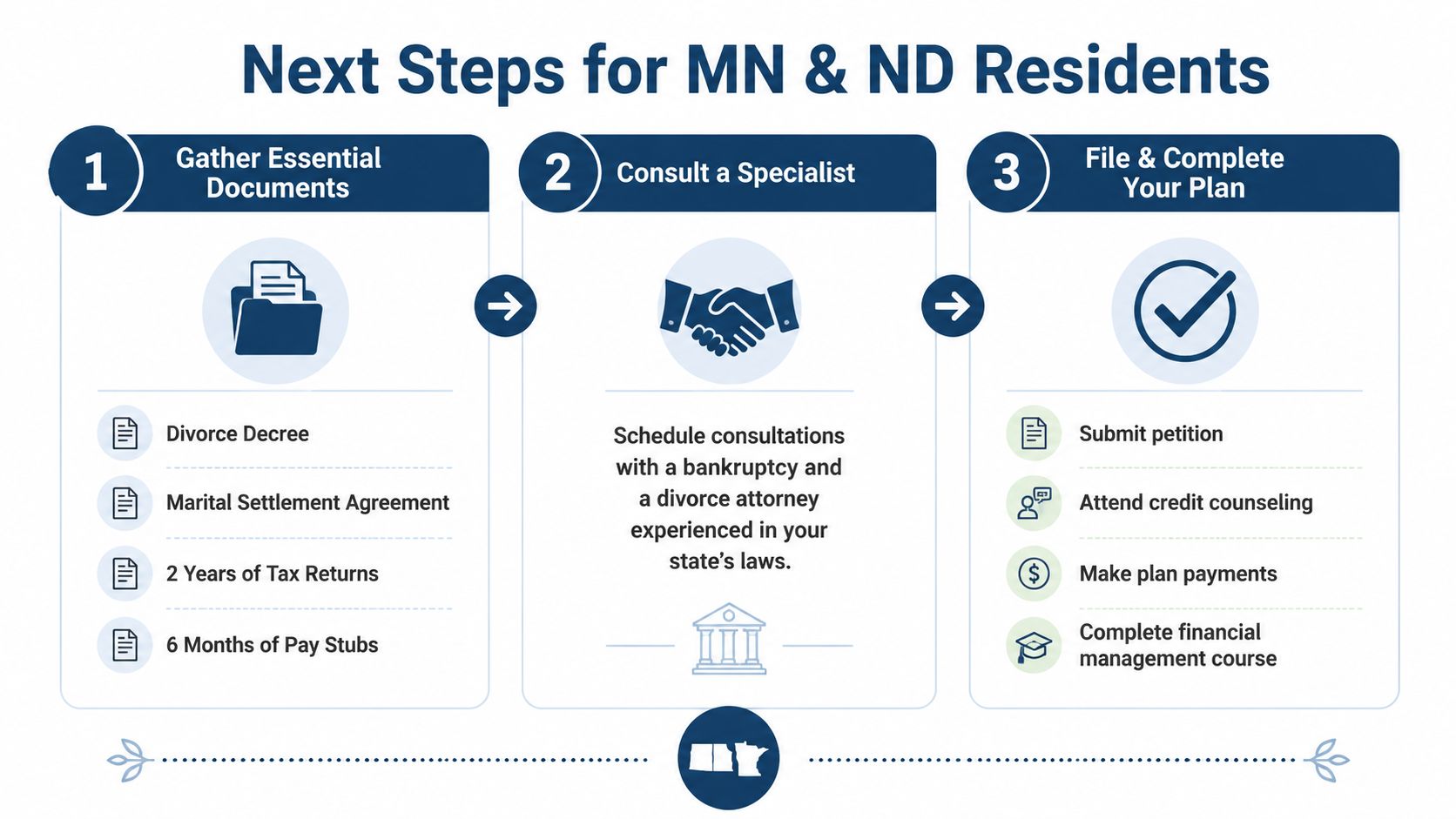
A practical preparation sequence
-
Gather the financial record. Collect the divorce decree, settlement agreement, two years of tax returns, six months of pay stubs, current mortgage statements, vehicle titles or loan records, support payment history, and creditor statements. Missing joint-account information can lead to incomplete schedules and incorrect plan projections.
-
Confirm eligibility and affordability. Apply the current 2026 debt caps, review household income, complete the required means-test analysis where applicable, and calculate the payment needed for support arrears, secured arrears, trustee expenses, and other priority claims. The state residency requirements for Chapter 13 should also be checked before selecting the filing district.
-
Complete counseling and obtain legal advice. Credit counseling from an approved provider must occur within 180 days before filing. A bankruptcy attorney should then compare Chapter 7 and Chapter 13, while family-law counsel reviews how the bankruptcy may affect property division, support, and the family home.
Minnesota and North Dakota residents should confirm the correct venue based on where the debtor lives and maintain accurate local court and trustee information. Filing in the wrong place, omitting an ex-spouse's claim, or treating a support obligation as ordinary unsecured debt can create avoidable problems.
LifeBack Law Firm, P.A. offers Chapter 7 and Chapter 13 consultations for Minnesota and North Dakota consumers, including review of means testing, eligibility, local filing requirements, and the interaction between bankruptcy and divorce obligations. A free initial case review can help a debtor identify the right questions before signing a fee agreement or finalizing a settlement.
LifeBack Law Firm, P.A. can review the divorce decree, classify support and property debts, and evaluate whether a Chapter 13 plan is feasible in Minnesota or North Dakota. Visit LifeBack Law Firm, P.A. to schedule a phone, video, or in-person consultation and get a clear plan for protecting income, property, and the fresh start ahead.