
In most Chapter 7 cases, employers aren't automatically notified, and federal law says a private employer can't fire, demote, or discriminate against a current employee solely because of the filing. The main exceptions happen when payroll gets involved, when the employer is a creditor, or when a job has unusual financial disclosure requirements.
That answer matters because those asking, Will My Employer Know If I File Chapter 7, aren't merely curious. Instead, they're driven by fear. They may already be behind on bills, trying to keep up at work, and worrying that one legal step toward relief could create a new problem with a boss, a manager, or Human Resources.
The fear usually sounds the same. If the court files paperwork, won't the company get a copy? If bankruptcy is public, won't someone at work see it? If payroll finds out, will that turn into gossip or career damage?
Those are reasonable worries. The good news is that Chapter 7 is usually much more private than people expect. The important part is knowing where privacy holds, where it can break, and what legal rights protect a worker if an employer does learn about the case.
The Worry Keeping You Up at Night
A lot of readers reach this question after staring at the ceiling at 2 a.m., replaying the same chain of events. Debt collectors have called. A lawsuit may already have happened. A paycheck may be smaller because of garnishment. Then the thought lands: filing Chapter 7 might solve the debt problem, but what if it creates a work problem.

That fear is often bigger than the legal reality. For most current employees, the filing does not trigger some automatic alert to a supervisor or HR office. And even if an employer learns about it, federal law gives strong protection against being fired or punished just for filing.
Still, anxiety doesn't usually come from the general rule. It comes from the unknowns.
The questions that usually sit underneath the fear
Some people worry about embarrassment. Others worry about losing a promotion, being treated differently, or having a manager subtly decide they're now "risky." A person in Minnesota or North Dakota who works in banking, payroll, bookkeeping, sales, or any role involving money may feel that pressure even more.
Most people don't need a lecture about bankruptcy law. They need a clear answer about what actually happens at work on Monday morning.
That is where the details matter. There is a big difference between the court not notifying an employer and the employer learning through payroll or another side channel. A person with no garnishment and no unusual job requirements often has a very different experience from someone whose paycheck is already being touched by a creditor.
What readers usually need to know first
A worried worker usually benefits from sorting the issue into two buckets:
- The default rule: Chapter 7 is usually private enough that the employer doesn't receive automatic notice.
- The practical exceptions: Payroll action, creditor status, background checks, and certain regulated roles can change that.
- The legal protection: Learning about a filing is not the same as having a lawful reason to punish an employee.
Those distinctions lower panic and replace it with a plan.
Why Bankruptcy Filings Are Usually Private
Chapter 7 is a public record, but that doesn't mean it's broadcast to every part of a person's life. Public record is closer to a file that exists in a system than an announcement sent to an employer. Someone generally has to be looking for it.
A simple way to think about it is a courthouse bulletin board in a building most employers never visit. The information exists, but it isn't pushed out to supervisors, HR teams, or coworkers.
Who the court normally contacts
In most Chapter 7 cases, employers are not automatically notified, and the court sends notices to the debtor, the debtor's attorney, and listed creditors, not to HR or a general employer office, as explained in this discussion of who receives notice in a Chapter 7 case.
That default process surprises many people. They assume the court must contact an employer because income information appears in the case. Usually, that isn't how it works. The debtor provides pay information as part of the filing, but the employer does not typically receive a formal notice just because the employee filed.
For readers concerned about day-to-day privacy, this overview of protecting privacy during a Minnesota bankruptcy helps explain how the process is usually kept limited to the people who legally need the information.
Why "public" doesn't mean "everyone knows"
A bankruptcy case can be found through court records, but most employers are not randomly searching employee court histories. Most businesses are focused on attendance, performance, customer issues, deadlines, and payroll. They are not spending time digging through filing systems unless they already have a reason.
That is why many people file Chapter 7 and continue working without any workplace discussion at all.
| Common concern | What usually happens |
|---|---|
| "Will HR get a court letter?" | Usually no |
| "Will my manager be called?" | Usually no |
| "Will payroll know automatically?" | Usually no, unless payroll is involved for a specific legal reason |
| "Can someone find it if they search?" | Yes, because the case is public record |
A public filing and an employer notification are not the same thing.
The private baseline matters
This baseline is important because it helps readers stop assuming the worst. If there is no garnishment, no debt owed to the employer, and no special work-related disclosure issue, many current employees move through Chapter 7 without any employer involvement at all.
That doesn't make every case identical. It just means the starting point is far more private than is commonly feared.
When Your Employer Can Find Out
The most useful way to answer Will My Employer Know If I File Chapter 7 is to stop talking in broad rules and talk about triggers. Employers usually find out because something specific brings the case into the workplace.
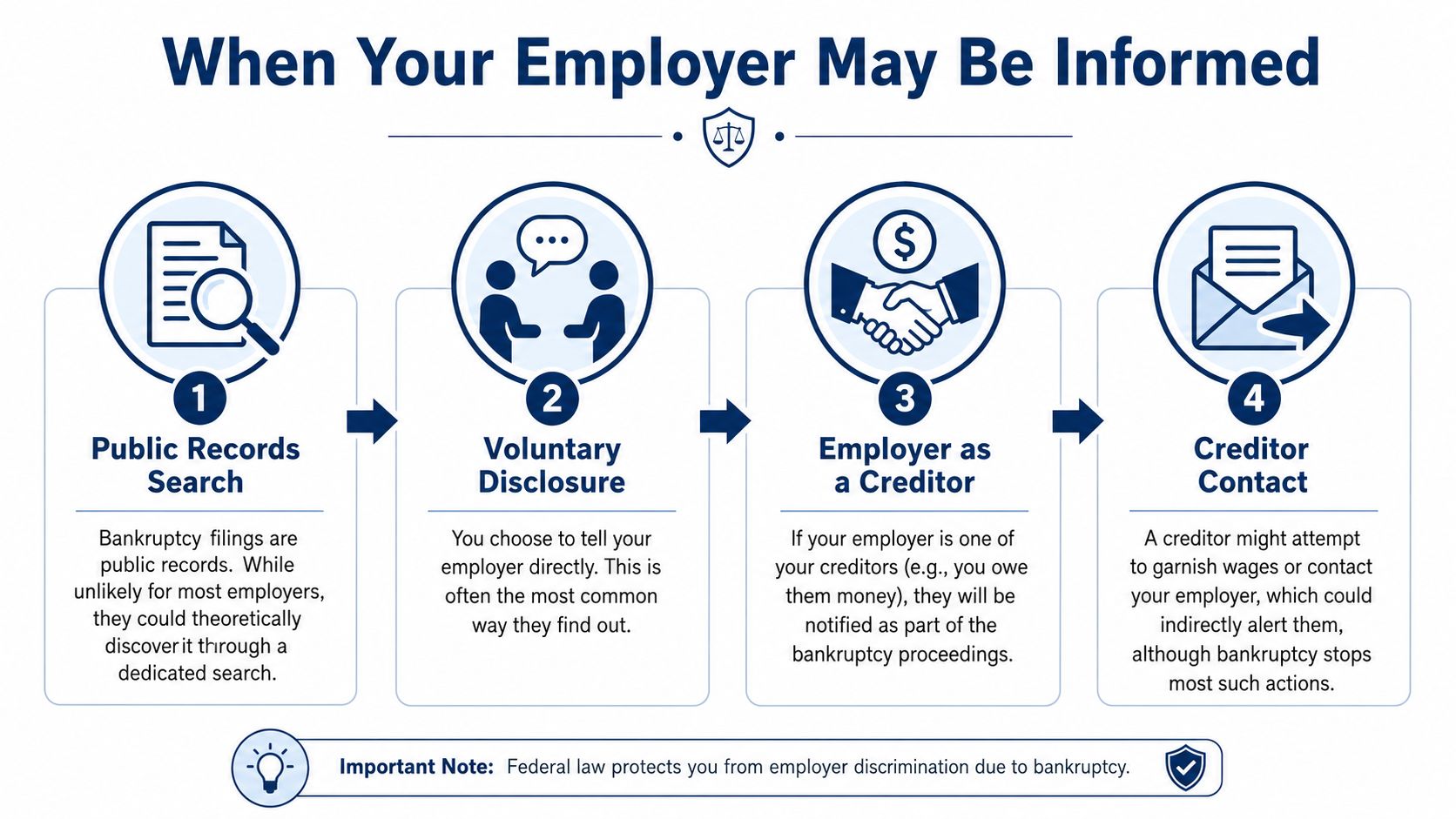
Wage garnishment is the big one
If wages are already being garnished, privacy changes fast. The bankruptcy filing creates an automatic stay that stops most collection activity, and payroll has to stop sending money out under that garnishment.
In 60 to 70% of cases where garnishment occurs, the employer's payroll system receives a formal Notice of Automatic Stay within 3 to 5 business days, which means payroll learns about the filing because it must act on it. That specific employer-discovery issue is the most important exception to the general privacy rule, and it is discussed in this article on how an employer could find out about a bankruptcy.
For many readers, this is the point that clears up the confusion. A guide may say employers "won't know," but if payroll is already processing a garnishment, payroll often learns because the law requires the deduction to stop.
Practical rule: If a paycheck is currently being garnished, the employee should assume payroll may learn about the bankruptcy.
Other ways an employer may learn
Some situations are less common but still real.
- Employer as creditor: If the employer is owed money and is listed as a creditor, it may receive notice in that role.
- Voluntary disclosure: Some workers decide to tell HR or a supervisor first, especially if they want to control the conversation.
- Background screening for a new role: A public-record search may reveal a bankruptcy during hiring for another job.
- Job-specific disclosure rules: Bonding, licensing, fiduciary responsibilities, or security-sensitive positions may require disclosure outside the normal rule.
These aren't automatic in every case. They are fact-specific.
Minnesota and North Dakota context
For workers in Minnesota and North Dakota, the practical issue is often less about "the employer" in a broad sense and more about which office inside the employer gets the information. In garnishment cases, the first stop is often payroll. The employee's direct manager may know nothing unless payroll says something or the employee chooses to explain it.
That distinction matters because it affects how much personal detail enters the workplace. Some procedural updates in Minnesota and North Dakota have focused on limiting unnecessary employer exposure to confidential financial information in garnishment-related notice situations. The core idea is simple. Even when disclosure can't be avoided, it should be kept as narrow as possible.
A simple way to think about risk
A worker can often estimate the chance of employer awareness by asking three questions:
- Is a wage garnishment already in place?
- Is the employer also a creditor?
- Does the job require unusual financial trust, bonding, or disclosure?
If the answer to all three is no, employer awareness is much less likely. If one of them is yes, the worker should plan for a possible conversation.
Your Employment Rights Under Federal Law
A lot of people fear one moment in particular. Payroll gets notice that a garnishment should stop because of a bankruptcy filing, word travels, and now a supervisor sees them differently at work.
Federal law gives current employees meaningful protection against that kind of reaction.
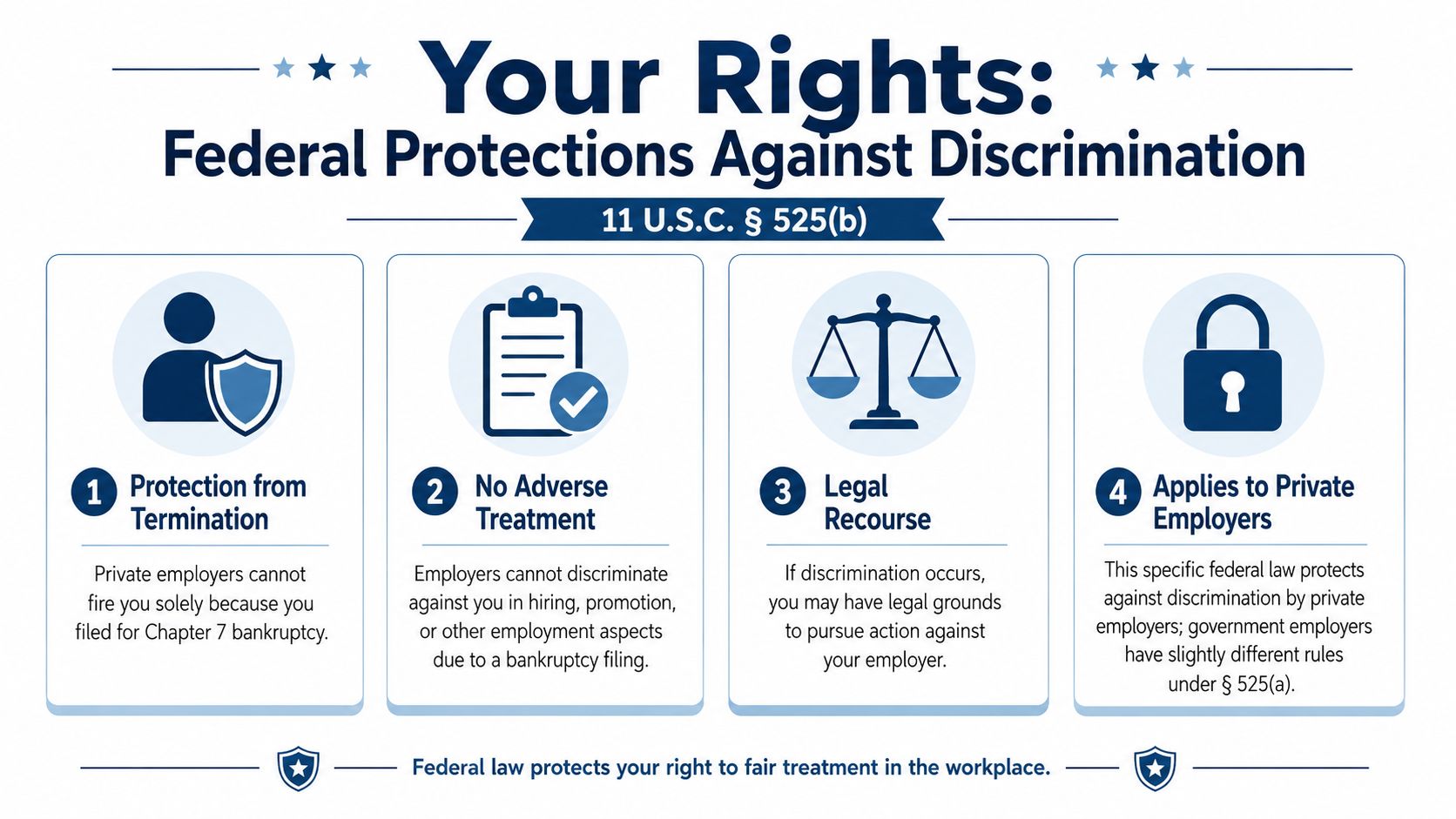
Under 11 U.S.C. § 525(b), a private employer cannot terminate your employment, demote you, or otherwise discriminate against you solely because you filed bankruptcy. The rule applies automatically. You do not have to file a separate workplace form or give special notice to claim it.
That matters most in practical situations discussed earlier, especially if an employer learns about the case because a wage garnishment stops. The law does not erase the awkwardness of that moment, but it does put a fence around how the employer can respond.
What the law clearly covers
The easiest way to read this protection is to focus on the word solely. Filing Chapter 7, by itself, cannot lawfully be the reason a private employer takes negative action against a current employee.
That includes:
- Firing you because you filed
- Demoting you because you filed
- Treating you worse in a material way because you filed
If the timing is suspicious, that can matter. For example, if payroll learns of the case, a garnishment stops, and a worker is suddenly pushed out with no clear performance issue, that raises a serious legal question.
A worker dealing with that kind of fallout may need bankruptcy advice and, if the dispute becomes workplace discrimination or retaliation, help from an employment lawyer.
Where the gray area begins
This is the part many articles skip.
Federal law gives stronger protection to your current job than to every future opportunity inside the company. In plain English, your employer usually cannot fire you just because you filed Chapter 7. But promotion and advancement decisions can be harder to judge, especially in jobs tied to money handling, fiduciary duties, bonding, or security-sensitive responsibilities.
Why? Because those decisions are often based on a mix of stated reasons. An employer may point to trust, internal policy, licensing concerns, or the specific duties of the higher role. Sometimes that explanation is legitimate. Sometimes "financial concern" is just a dressed-up version of bankruptcy bias.
That is the gray area.
For a fuller explanation of how bankruptcy-related workplace discrimination is analyzed, see this guide on bankruptcy discrimination and employee rights.
How this plays out in Minnesota and North Dakota
In Minnesota and North Dakota, the legal rule is federal, but the workplace reality is often local and practical. If an employer finds out because of a garnishment, the first people involved are usually in payroll or HR, not your direct supervisor. That narrower flow of information can help limit workplace exposure.
Still, if you work in banking, accounting, cash management, lending, bookeeping, or another position built around financial trust, questions about advancement may feel more personal after a filing. The law still protects your current employment from action based solely on the bankruptcy. It just does not guarantee that every promotion decision will be simple to prove or challenge.
A useful way to think about it is this. Federal law locks one door firmly. Your employer cannot use the filing alone to push you out of your current job. Other doors inside the workplace, like promotions into sensitive roles, may involve more facts and more argument.
That does not mean you are unprotected. It means you should understand where the rule is clear, and where legal advice may be needed if an employer starts treating the bankruptcy as a reason to hold you back.
How to Handle Conversations with Your Employer
If an employer finds out, the goal is not to overexplain. The goal is to stay calm, keep the discussion narrow, and bring the focus back to work.

Many workers make the conversation harder by volunteering too much detail. They start defending every past bill, every emergency, and every creditor. That usually isn't necessary. A short, professional explanation often works better.
A simple script for a payroll or HR discussion
If payroll needs to stop a garnishment, a worker can keep the statement brief:
"A bankruptcy case was filed, and the garnishment should stop. Any needed case information can be provided for payroll processing."
If a supervisor asks about it, the response can stay focused:
- Keep it factual: "This was a legal step to address personal debt."
- Keep it current: "The issue is being handled through the court process."
- Keep it job-centered: "Work performance and responsibilities remain on track."
That approach reduces drama and gives the employer less room to wander into personal territory.
What not to do
Some habits create more risk than protection.
- Don't overshare: Detailed creditor lists, medical history, or family conflicts usually don't belong in a workplace conversation.
- Don't apologize for existing: Bankruptcy is a lawful financial remedy, not a workplace confession.
- Don't speculate aloud: Guessing about future promotions, gossip, or management reactions can make a short discussion longer and more uncomfortable.
- Don't ignore a questionable response: If a manager reacts by threatening discipline based solely on the filing, the employee should document what was said.
What to document
A worker who senses bias should keep a simple record of facts:
| What to note | Why it matters |
|---|---|
| Date employer learned of filing | Helps establish timeline |
| Who said what | Preserves details accurately |
| Any change in duties or treatment | Shows whether workplace action followed |
| Performance records | Helps separate real work issues from possible discrimination |
For people who want legal process support without needing to make the filing a bigger workplace event than necessary, LifeBack Law Firm, P.A. handles Chapter 7 and Chapter 13 matters for Minnesota and North Dakota filers and offers guidance on common employer-notification questions as part of that process.
Take Control with a Fresh Start in Minnesota and North Dakota
The short answer is still the right one. In most Chapter 7 cases, an employer won't be automatically notified, and a current employee has federal protection against being fired or demoted solely for filing. The biggest exception is wage garnishment, because payroll often has to act quickly once the case is filed.
That means the task isn't guessing. It's planning. A worker in Minnesota or North Dakota should know whether payroll is already involved, whether the employer is a creditor, and whether the job has any unusual trust or disclosure rules. Once those points are clear, the fear usually becomes much more manageable.
A careful filing can do two things at once. It can stop debt pressure, and it can reduce the uncertainty that comes from not knowing who will find out and what the law allows.
LifeBack Law Firm, P.A. helps Minnesota and North Dakota clients file bankruptcy with a step-by-step process that can be handled by phone, video, or in person. The firm offers $0 up-front Chapter 7 filings, serves clients across Minnesota and in Fargo and Bismarck, and provides a free 90-day Post-Bankruptcy Program for rebuilding after the case is over. For anyone worried about employer notice, garnishment, or workplace fallout, a judgment-free consultation can clarify what applies in that specific situation before anything is filed.