
The popular advice to file Chapter 13 to save the house leaves out the hardest part: keeping the house requires an affordable budget after filing. Court protection can stop an immediate crisis, but it doesn't replace the income needed to make the next payment.
The benefits of filing Chapter 13 are clearest when someone needs time to catch up and a way to preserve important property. The right question is not just whether filing can stop collection. It is whether the household can sustain the obligations that follow.
What Chapter 13 Can Actually Do for You
Chapter 13 benefits by the problem that needs solving
| Your goal | What Chapter 13 provides | How long it lasts | What can undo it |
|---|---|---|---|
| Stop foreclosure before sale | Automatic stay plus time to cure mortgage arrears | Through the court-approved repayment period while regular mortgage payments continue | Completed pre-filing sale, or missed plan or mortgage payments |
| Stop garnishment or most lawsuits | Automatic stay against most collection | From filing until the stay ends or the case is dismissed | Dismissal or a creditor obtaining stay relief |
| Keep a home or vehicle | Opportunity to retain property while arrears are addressed | Through a confirmed, current plan, subject to its terms | Falling behind on plan payments or required direct payments |
| Catch up delinquent secured payments | Arrears spread across trustee payments instead of an immediate lump sum | Length of the confirmed plan | A payment the budget cannot sustain |
| Address unsecured debt | Court-supervised treatment; eligible balances generally discharged after completion | Discharge generally follows successful completion | Dismissal before completion, leaving unpaid debts enforceable |
Chapter 13 is primarily a tool for gaining time and protecting property, not a promise that every bill disappears quickly. Filing generally pauses foreclosure and most collection lawsuits and wage garnishments. The repayment process then gives eligible debtors a structured way to address the obligations that caused the crisis.
A homeowner may need relief from overdue mortgage installments rather than from the mortgage itself. A worker may need to preserve a vehicle needed for employment while resolving delinquent payments. Someone facing several collection claims may benefit from replacing competing demands with a court-supervised process.
Choose the result that matters most
A prospective filer should identify a primary objective before evaluating a proposed payment:
- Protect housing: Determine whether the household can afford the home going forward, not merely stop the next foreclosure step.
- Preserve transportation: Separate the need for reliable transportation from the desire to keep a particular vehicle.
- Restore usable wages: Identify the garnishment and determine which underlying obligation caused it.
- Organize collection pressure: Gather lawsuit papers, judgments, and creditor notices so counsel can assess the actual threats.
That distinction prevents a common misunderstanding: stopping an action isn't the same as permanently resolving its cause. A foreclosure sale completed before filing may not be undone by opening a case, and protection can end if required payments aren't made.
Practical rule: A useful bankruptcy goal names both the property or income being protected and the payment needed to keep that protection.
Eligible remaining unsecured debts, such as qualifying credit card or medical balances, are generally discharged after successful plan completion. Until then, the household needs a workable payment routine, complete records, and a prompt response whenever circumstances change.
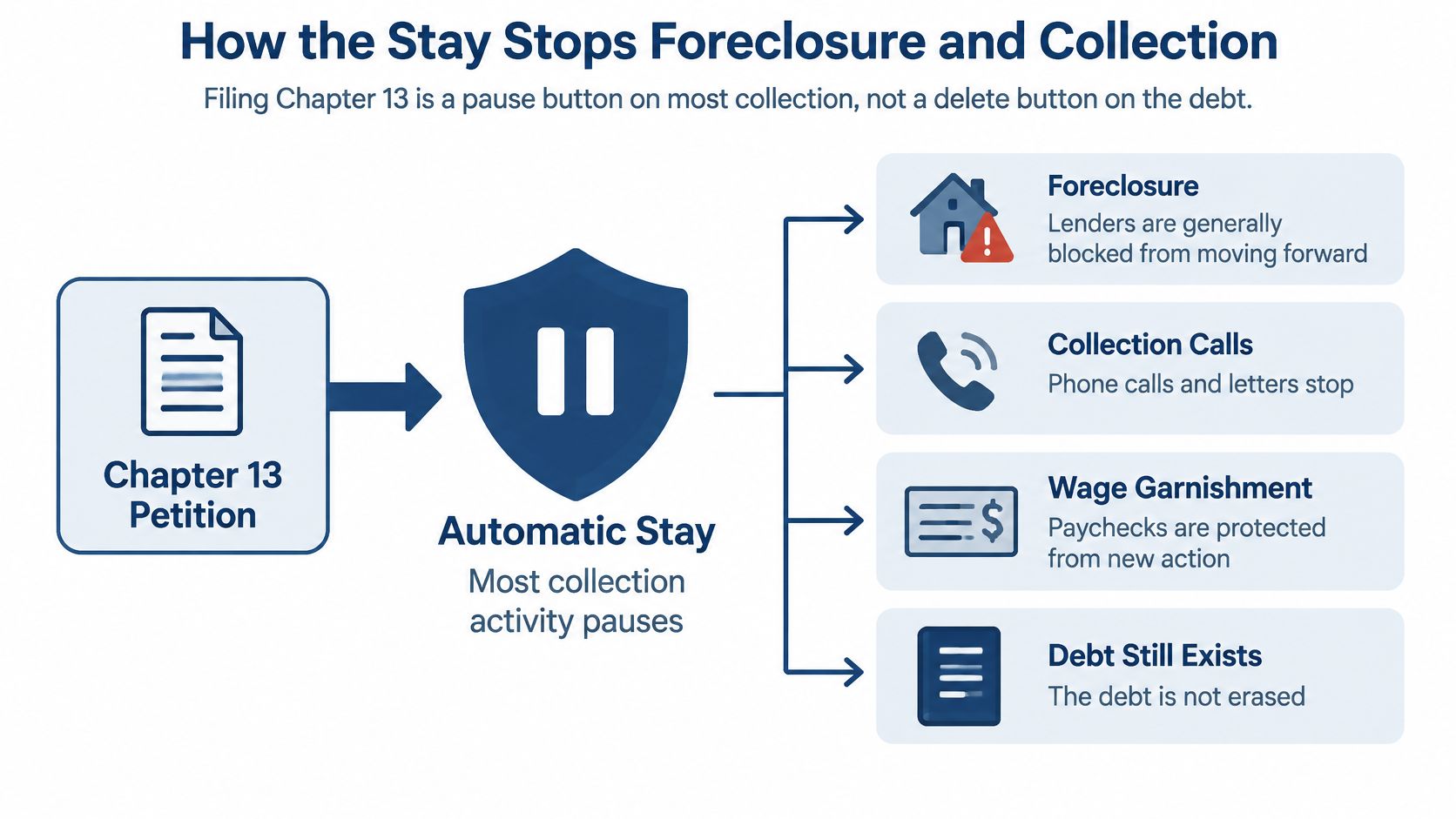
How the Stay Stops Foreclosure and Collection
A Chapter 13 filing can trigger the automatic stay under 11 U.S.C. § 362. The U.S. Courts' Chapter 13 guide explains that the stay can interrupt many collection actions while the case is active. It does not erase a mortgage or guarantee that a home is safe from foreclosure.
The stay gives a debtor room to pursue a court-supervised repayment plan. That protection depends on following the case requirements, so a household with no room in its budget may struggle to keep it in place.
A homeowner has separate payment responsibilities
The lender has scheduled a foreclosure sale and demands more than a wage earner can pay at once. The homeowner has returned to work after a temporary interruption in employment, but the missed mortgage payments remain.
If the homeowner files an eligible case before the sale is completed, the stay can stop the lender from moving ahead with the sale while the stay is in effect. The homeowner must still account for both the overdue installments and the mortgage payments that come due after filing. How Chapter 13 may help save a home from foreclosure explains this process for homeowners facing a sale deadline.
The two payment responsibilities serve different purposes:
- Past-due installments: Plan payments address the mortgage delinquency that existed when the case began.
- New mortgage installments: Ongoing payments keep the loan from falling further behind, often through direct payments to the lender.
Payment routing can vary under local practice and the confirmed plan. Confirm who receives each payment, when it is due, and how to document delivery.
A pause still requires action
Paying the trustee while ignoring the current mortgage installments can leave the homeowner at risk. Keeping the mortgage current while missing required plan payments creates a separate risk: the lender or another party may ask the court for permission to resume collection or enforcement.
The stay also may not undo a foreclosure sale completed before filing. Review sale notices promptly, and have counsel examine the actual documents rather than assume a last-minute filing will preserve every option.
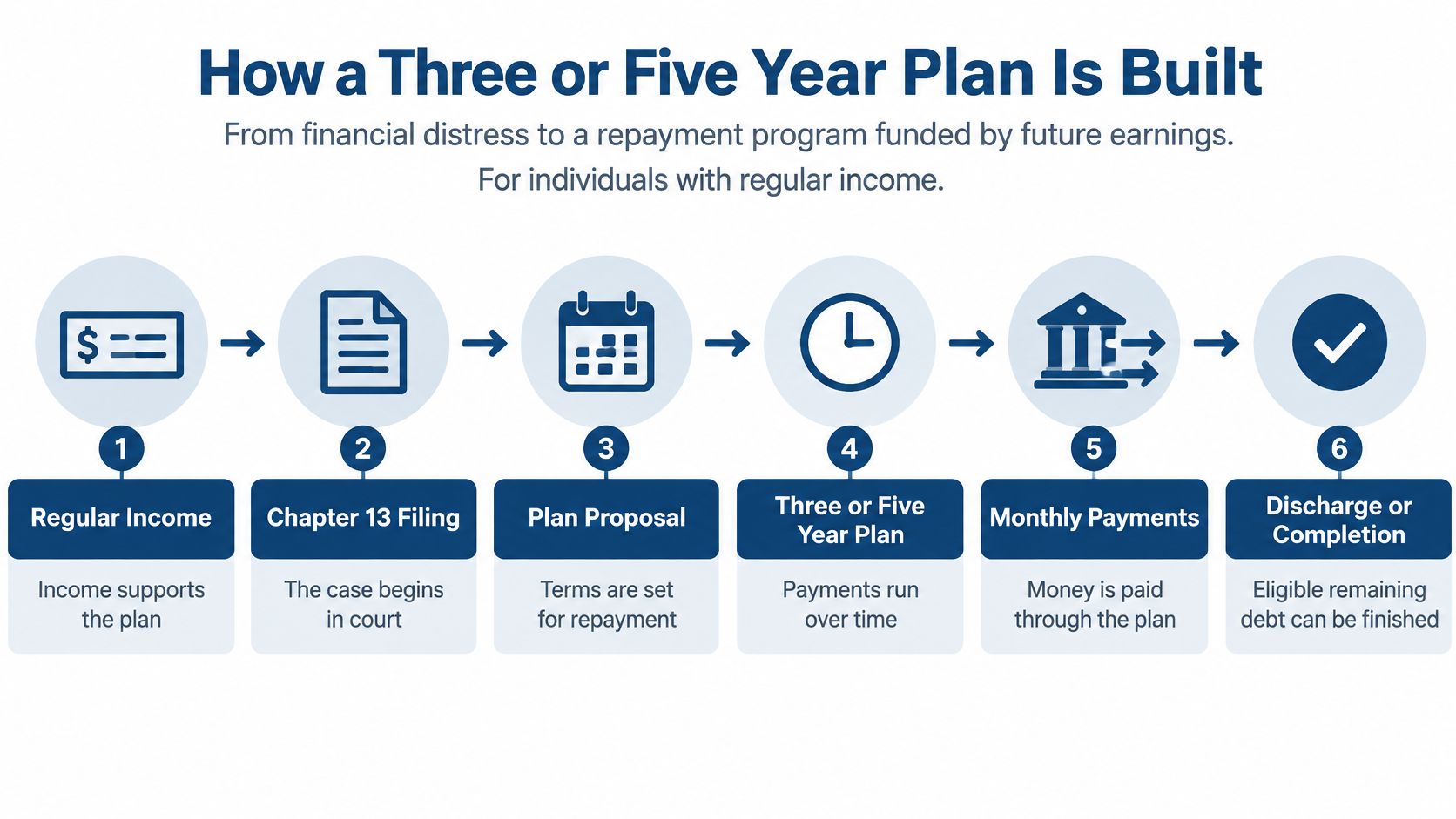
How a Three or Five Year Plan Is Built
Chapter 13 uses future earnings to fund a court-approved repayment program. The U.S. Bankruptcy Court for the District of Hawaii's debtor guidance explains that plans commonly last three or five years, depending on income and other statutory factors.
The benefit is spreading an overdue obligation across time rather than requiring an immediate cure. The debtor makes payments to a trustee, who distributes funds according to the confirmed plan and applicable legal priorities.
Why dividing debt by months gives the wrong answer
The proposed trustee payment isn't the total balance on credit reports divided by the repayment period. Different debts receive different treatment, and some payments may remain outside the plan.
Counsel must evaluate disposable income, secured claims backed by property, priority claims, trustee compensation, administrative costs, and applicable exemptions. Exemptions protect qualifying property interests and can affect what unsecured creditors must receive.
A household with substantial unsecured debt doesn't necessarily owe all of it through the plan. Conversely, a household with relatively modest credit card balances may still need a significant payment because of mortgage arrears, priority obligations, or protected-property calculations.
Test feasibility against ordinary life
A prospective filer can prepare for that calculation with a practical cash-flow check:
- Document take-home income. Use pay stubs and reliable business records, not the strongest recent month or anticipated overtime.
- Subtract essential living expenses and a realistic reserve. Include groceries, utilities, insurance, transportation, medical needs, and irregular costs such as vehicle repairs.
- Set aside required direct payments. Account for any mortgage or vehicle payment that must be made outside the trustee payment.
- Compare the remainder with the proposed plan payment. Counsel must confirm that the proposed treatment also satisfies bankruptcy requirements.
- Reject perfect-month budgeting. A plan that works only when nothing breaks, nobody gets sick, and every shift remains available needs revision.
A reserve isn't automatically an amount the court will approve. It should reflect documented, reasonable expenses and be discussed with counsel rather than hidden in the budget.
Payment reliability is a design requirement, not a character test. A household can't overcome an unaffordable plan through determination alone.
Discharge generally follows completion, so the proposal needs to survive ordinary life rather than merely look acceptable on filing day. For a seasonal worker or small-business owner, that means reviewing slow periods, taxes, inventory needs, and business expenses before treating apparent income as available cash.
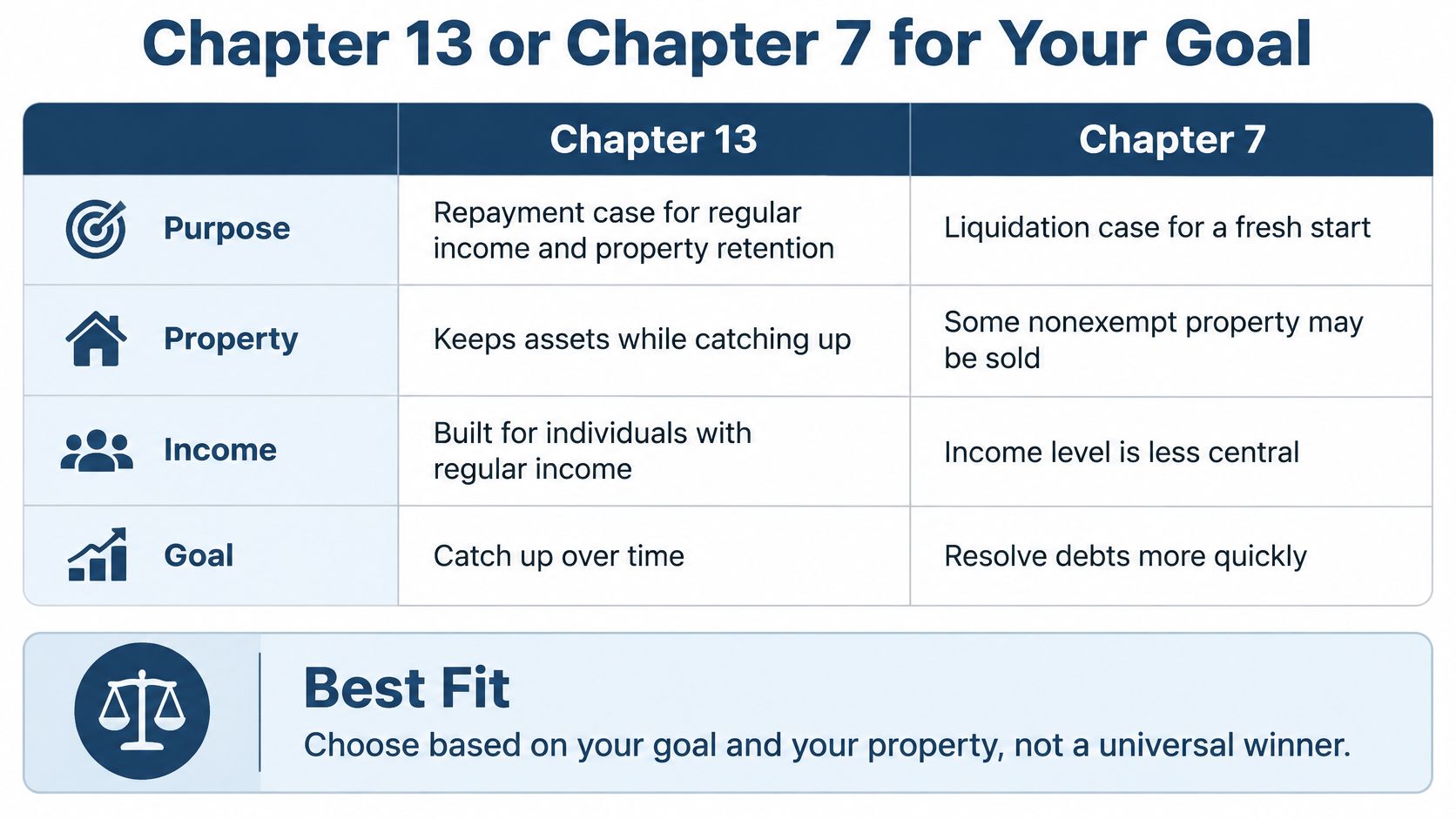
Chapter 13 or Chapter 7 for Your Goal
A homeowner is behind on mortgage payments but can afford the regular payment now. A renter has mostly unsecured debt and no property they need to protect. Those situations point toward different questions: can a repayment plan solve the immediate problem, and can the household sustain it?
| Decision point | Chapter 13 | Chapter 7 |
|---|---|---|
| Typical path | Extended court-approved repayment plan | Liquidation case, often completed more quickly |
| Who it fits | Eligible individual with regular income | Eligible debtor, with means-test review where applicable |
| Property | Property can be retained by meeting plan requirements | Nonexempt property can be sold for creditors |
| Mortgage or car arrears | Can address arrears over time while required payments continue | Doesn't provide an extended repayment plan to cure arrears |
| Unsecured debt | Treatment follows income, priority, and other legal requirements; eligible balances generally discharged at completion | Eligible unsecured debt can be discharged without completing an extended repayment plan |
| Main risk | An unsustainable payment can lead to dismissal | Nonexempt assets may be lost, or eligibility may be unavailable |
Choose the chapter that solves the specific problem. Chapter 13 may fit when a person needs time to catch up on arrears or protect property and can maintain plan payments. Chapter 7 may fit when the person is eligible, has no pressing arrears problem, and needs a faster discharge.
Match the situation to the remedy
A homeowner who can afford the regular mortgage but can't immediately cure the delinquency may benefit from Chapter 13. The plan can spread arrears over time while the homeowner continues required payments. A faster discharge alone does not provide that repayment structure.
A renter with mostly unsecured debt and little nonexempt property may be better served by Chapter 7, if eligible. An extended payment obligation may add little if there is no important asset to retain or arrears to cure.
Eligibility and affordability shape the choice. A debtor who does not qualify for Chapter 7 may need to consider Chapter 13, but a plan that the household cannot sustain risks dismissal and loss of the protections tied to it.
Eligibility and equity come before preference
Chapter 13 requires regular income and debts within applicable statutory limits. Those limits can change, so counsel should confirm the current rules. In either chapter, Minnesota and North Dakota exemption rules and property equity affect how assets are treated. Bring realistic home and vehicle values, loan payoff information, and ownership documents to a consultation.
Tax debt also requires separate analysis because collection expiration and bankruptcy discharge are different issues. Omni Tax Help on tax debt expiration explains the expiration question; bankruptcy counsel can assess how particular tax obligations affect a case.
The Chapter 7 versus Chapter 13 comparison can help organize questions for a consultation. Focus on the result you need, such as retaining property, curing arrears, or obtaining the fastest available discharge for which you qualify.
Value Even When Unsecured Debt Is Not Paid Off
A Chapter 13 plan can provide value even when credit card creditors receive only a small distribution. For a worker commuting a long distance to a job, keeping a reliable vehicle may protect the income needed to support the household and make plan payments.
The value comes from the result the plan makes possible, while the repayment process demands steady attention. Chapter 13 protection is earned month by month: if payments or required paperwork fall behind, the case can be at risk.
Demand doesn't establish suitability
The U.S. Courts' Judicial Business report states that Chapter 13 filings reached 203,118 in 2025, representing 36% of all bankruptcy filings. Those figures show that many people use Chapter 13, but they do not show whether a particular household can sustain a plan.
For the worker, keeping transportation may help preserve employment even if unsecured creditors receive only a partial payment. That benefit has to fit the household's budget and justify the ongoing obligations.
Weigh the benefit against the work
A practical assessment puts the intended result beside the commitment it requires:
- Asset preservation: Is the home or vehicle affordable and important enough to justify the plan?
- Collection relief: After enforcement stops, is enough income left to make plan payments?
- Arrears resolution: Can the proposed cure address a temporary setback, or does it leave an ongoing shortfall unresolved?
- Administrative demands: Can the household provide records, answer trustee questions, and keep payment documentation?
- Budget flexibility: Can the household handle necessary changes through the required approval process?
Paperwork affects whether a case stays on track. Missing documents, misunderstood payment instructions, or unreported changes can cause problems even when the debtor intends to comply.
Keeping an asset can also strain the budget. A home with unaffordable ongoing costs or a vehicle that needs constant expensive repairs may consume money needed for basic expenses and plan payments.
A sound strategy preserves something worth keeping while leaving enough room for the rest of the household budget.
The value calculation includes both the legal result and its practical cost. Chapter 13 makes sense when the goal is worth the sustained payments, paperwork, and limits on financial flexibility.
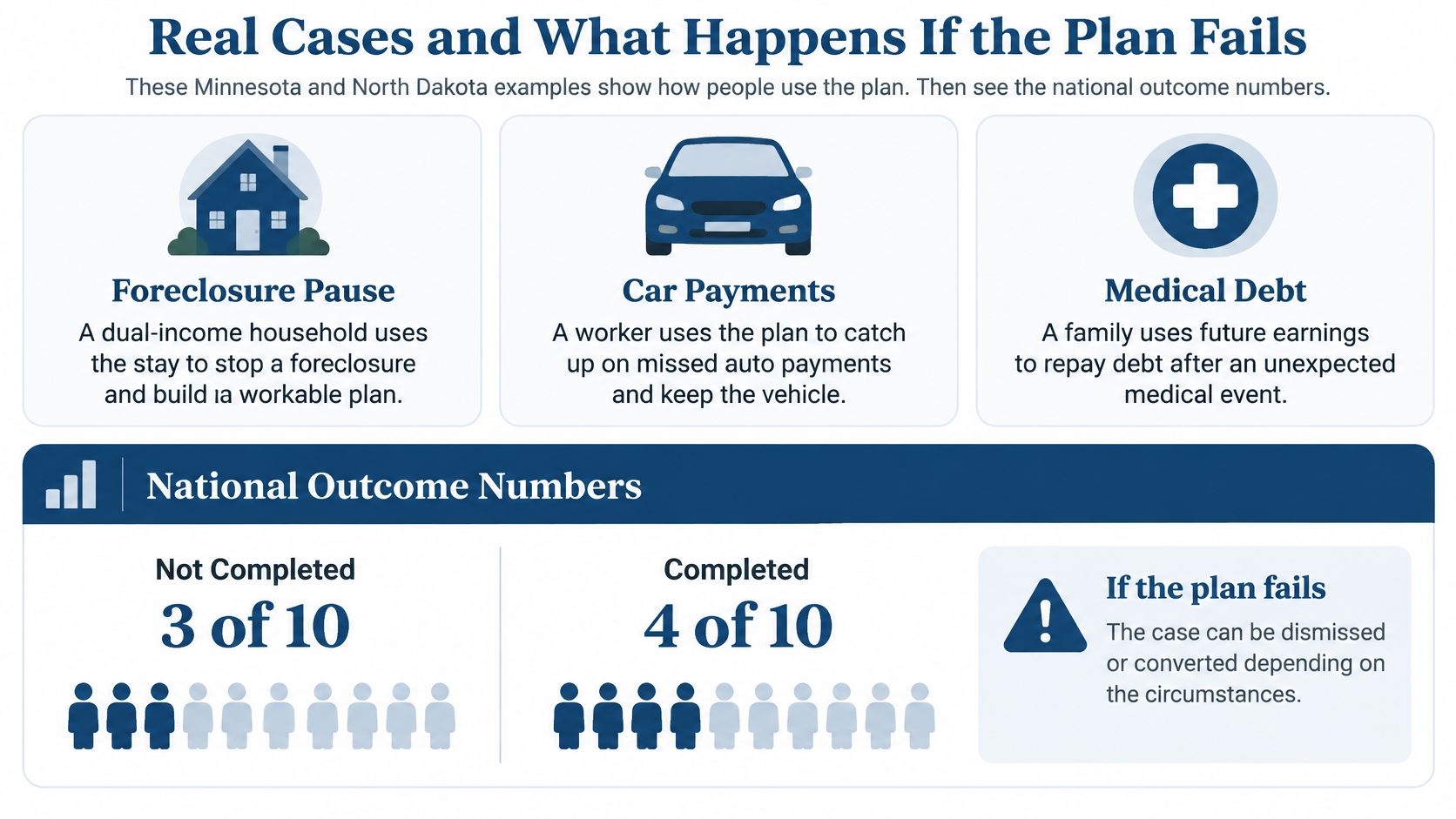
Real Cases and What Happens If the Plan Fails
The following scenarios are illustrative composites, not actual client results. No dollar amounts are presented, and the outcomes aren't predictions.
- A Minnesota household facing foreclosure: After a temporary job interruption, both earners return to steady work. Their proposed cure fits alongside the regular mortgage and necessary living expenses, making home retention a realistic objective.
- A North Dakota worker facing garnishment: The worker needs a vehicle to maintain employment. A plan addresses secured and priority obligations while providing only a partial distribution to credit card creditors.
- A seasonal business owner without a reserve: Strong summer receipts make the proposed payment appear manageable. Winter revenue falls, necessary repairs arrive, and the owner misses payments because the budget never accounted for the slow season.
National outcomes require caution
The U.S. Courts' 2025 bankruptcy consumer-protection report provides the national consumer-case figures below, including 101,709 dismissals, 82,099 discharges after completion, and missed payments cited in 50% of dismissals.
2025 Chapter 13 consumer case outcomes
| 2025 measure | Value |
|---|---|
| Chapter 13 consumer cases dismissed | 101,709 |
| Cases ending in discharge after plan completion | 82,099 |
| Share of closed consumer cases discharged | 45% |
| Dismissals citing missed plan payments | 50% |
| Average case length | 1,102 days |
| Median case length | 1,045 days, about three years |
| Cases refiled after dismissal | 13,508, up 8% from 2024 |
These are outcomes for cases ending during the reporting period, not a prediction for people filing during that period. They demonstrate substantial failure risk without establishing that every dismissal had the same cause or consequence.
Dismissal isn't a completed discharge
When a case is dismissed, unpaid debts generally remain enforceable, subject to payments already credited and applicable law. Collection can resume when bankruptcy protection ends.
Refiling may be possible, but it isn't a free reset. Repeat filings can affect available stay protection, and the affordability problem that undermined the earlier case still needs an answer.
A debtor should contact counsel immediately after an income disruption or missed payment, rather than wait for a dismissal request. Depending on circumstances, counsel may evaluate modification, conversion, or another response; the firm's guide to dismissal or conversion of a Chapter 13 bankruptcy explains those alternatives.
The practical lesson isn't that Chapter 13 lacks value. It's that its benefits require ongoing maintenance, including room for repairs, medical expenses, and ordinary interruptions in income.
Chapter 13 Benefits Questions Answered
Can a debtor convert to Chapter 7 if the plan becomes unaffordable?
Conversion may be possible, but the debtor's circumstances and property exemptions affect the decision. Before stopping plan payments, gather an up-to-date budget and a list of assets and debts for counsel to review. Conversion does not guarantee that every asset will remain protected.
Can the plan change after an income drop?
A debtor may ask the court to modify the plan, but approval is not automatic. Contact counsel promptly and bring recent pay stubs and household expenses so a revised payment can be assessed against the changed budget.
Will the filer have to attend a hearing?
Filers are typically asked to attend one meeting of creditors, usually a short session with the trustee. The trustee reviews identity and financial information, and creditors may ask questions. Bring the requested identification and financial records, and ask counsel whether the court requires any additional appearance.
Will credit recover?
Bankruptcy can remain on credit reports for years, and filing or receiving a discharge does not guarantee a particular score improvement. Consistent payments, accurate reporting, and cautious use of permitted credit can support recovery. Keep copies of payment records and review credit reports for errors; a discharge does not automatically erase the reporting history.
Decide Whether to File in Minnesota or North Dakota
Filing should follow a realistic decision test, not panic over the latest collection notice. A prospective filer needs a specific objective, enough income to fund the proposed plan, and the ability to keep required direct payments current.
Conditions worth confirming before filing
- A defined legal objective: The proposed case addresses a concrete problem, such as curing mortgage arrears or protecting essential transportation.
- A credible monthly margin: The budget accounts for ordinary irregular expenses instead of assuming uninterrupted income and no emergencies.
- Affordable ongoing obligations: Mortgage or vehicle payments outside the plan remain manageable alongside the trustee payment.
If those conditions aren't present, counsel should evaluate whether a different proposal, Chapter 7, or another approach is safer. Waiting without advice can also be dangerous when a foreclosure or collection deadline is approaching.
Prepare for a local consultation
A Minnesota or North Dakota bankruptcy practice can review means testing, eligibility, exemptions, and local filing requirements. Useful preparation includes pay stubs, tax records, bank statements, lawsuit papers, property values, and current mortgage or vehicle arrears information.
The publisher offers phone, video, and in-person consultations, along with a fully virtual option. Its service locations include Minneapolis–St. Paul, Eagan, Maple Grove, St. Cloud, Duluth, Brainerd, Rochester, Bismarck, and Fargo.
Prospective clients should ask for a clear explanation of fees, payment responsibilities, document requirements, and available post-bankruptcy support. Bringing a realistic monthly budget makes that conversation more useful than arriving with debt totals alone.
This information is educational, not individualized legal advice. Filing decisions require review of the household's actual income, assets, debts, and deadlines.
LifeBack Law Firm, P.A. offers Chapter 13 representation and Chapter 7 eligibility review for Minnesota and North Dakota households. A consultation can test whether protecting a home, vehicle, or paycheck is compatible with a sustainable repayment budget. Prospective filers can visit LifeBack Law Firm, P.A. to schedule a consultation and prepare their income records, arrears statements, and monthly expenses.