
A lot of Minnesota homeowners reach the same point the same way. Bills pile up on the kitchen counter. Mortgage statements stop feeling routine and start feeling threatening. Every unknown phone call creates a jolt of panic. The fear underneath all of it is simple: if bankruptcy gets filed, the house will be gone.
That fear is understandable. A house isn't just an asset on paper. It's where children sleep, where mail arrives, where routines hold a family together when everything else feels unstable.
Still, what happens to your house after bankruptcy in Minnesota is often far different from what people expect. Bankruptcy can protect a home, pause foreclosure, and create room to catch up or move forward in an orderly way. Minnesota law gives homeowners some unusually strong tools. When those tools are used correctly, keeping a home is often much more realistic than people assume.
The First Step Overcoming the Fear of Losing Your Home
A homeowner in Minnesota might be behind on credit cards, dealing with medical debt, and trying to stretch each paycheck far enough to cover the mortgage. That person may assume bankruptcy means handing over the house keys. In many cases, that assumption is wrong.
Bankruptcy exists to protect people from uncontrolled collection pressure. For a homeowner, that matters because the house is often the most important thing to preserve. The law doesn't treat every debt the same way, and it doesn't treat every home the same way either.
Why the fear feels bigger than the legal reality
Upon hearing the word "bankruptcy," an immediate association with loss often arises. This perception includes a trustee liquidating valuable assets, the necessity of moving out on short notice, and the idea of irreparable, lasting damage.
That isn't how many Minnesota cases play out.
A home is often protected by exemption law. A mortgage is handled differently from a credit card balance. A missed-payment problem may call for one chapter of bankruptcy, while an equity-protection problem may call for another. The result depends on details, not panic.
A bankruptcy filing doesn't automatically take away a Minnesota home. It starts a legal process that asks what equity is protected, whether payments can continue, and which chapter fits the situation.
The question that matters most
The better question isn't "Will bankruptcy take the house?" The better question is, "What is the strategy for this house under Minnesota law?"
That strategy usually turns on a few practical issues:
- Mortgage status: Is the homeowner current, or behind and needing time to catch up?
- Equity position: Is there protected equity in the property?
- Type of bankruptcy: Would Chapter 7 or Chapter 13 better match the goal?
- Long-term affordability: Can the homeowner realistically keep making payments after the case begins?
Once those questions are answered, the situation usually becomes much less mysterious. Fear thrives in uncertainty. Home protection works best with a plan.
The Automatic Stay Your Immediate Shield Against Foreclosure
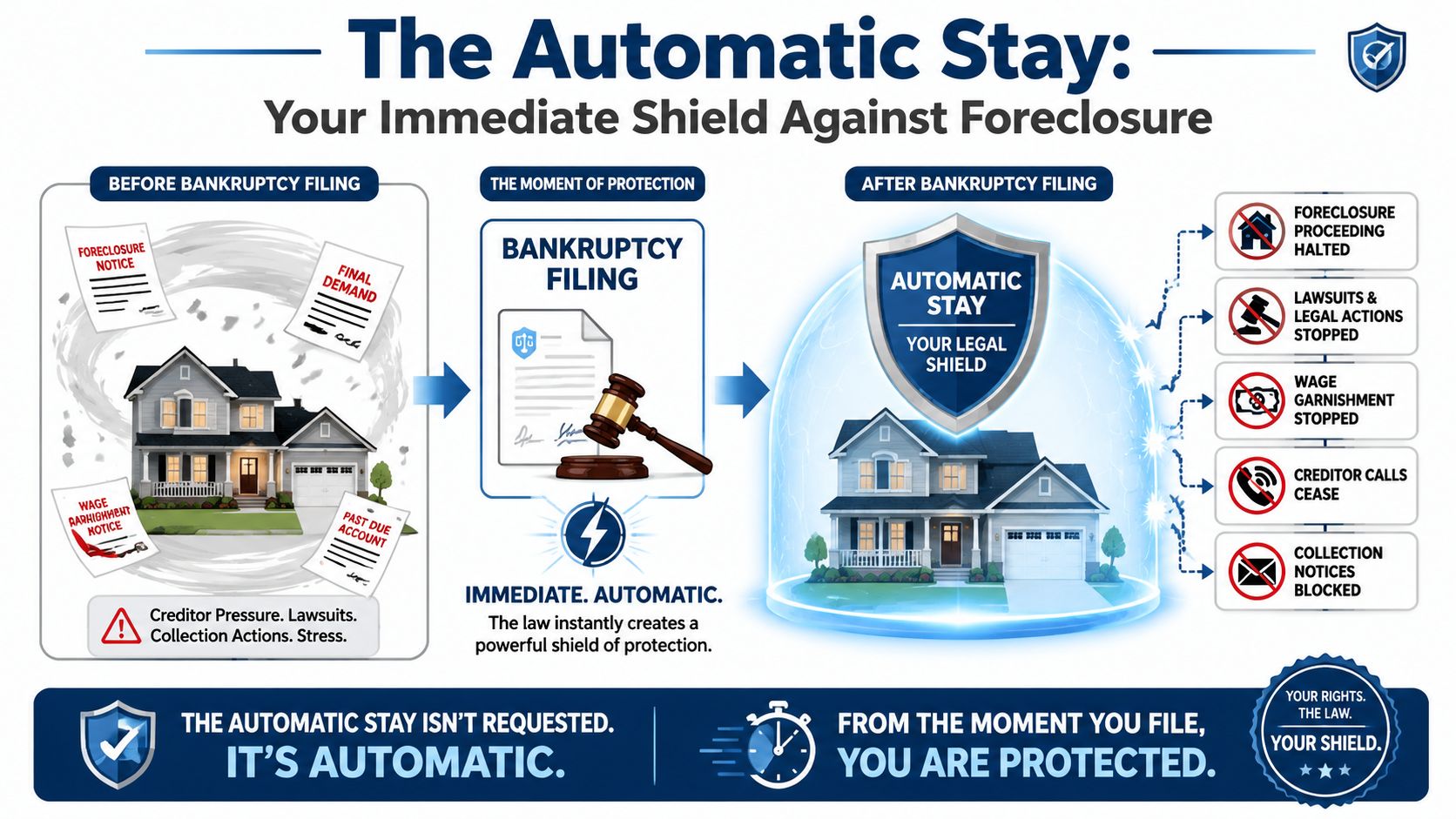
A Minnesota homeowner may be only days from a sheriff's sale when bankruptcy suddenly becomes less abstract and very practical. Once the case is filed, the automatic stay begins right away. That court order tells creditors to stop collection activity, including many foreclosure steps, while the bankruptcy case is pending.
For someone worried about losing a house, that pause can feel like hitting the emergency brake on a train that was already moving. The train has not disappeared. The mortgage has not disappeared either. But the filing creates space to make decisions before the foreclosure process rolls ahead.
What the automatic stay changes right away
The biggest benefit is time.
If the lender has started foreclosure, the stay usually stops the process from continuing as scheduled. If other creditors are calling, suing, or garnishing, many of those actions must stop too. That gives the homeowner and attorney a chance to sort out three practical questions: how far behind the mortgage is, whether the home equity is protected under Minnesota law, and which chapter gives the best chance of keeping the property.
That last point matters more than many people expect. In Minnesota, home protection is often stronger than people assume because state exemption law can protect a large amount of homestead equity. The automatic stay is the first layer of protection. The exemption strategy is what often supports the house after that first pause.
A few common results of the stay are:
- Foreclosure activity pauses: A pending sale or foreclosure step usually cannot keep moving forward once the case is filed.
- Collection pressure drops quickly: Calls, letters, lawsuits, and many other collection actions have to stop.
- Planning becomes possible: The homeowner gets a short but valuable window to review income, missed payments, equity, and affordability with clear eyes.
LifeBack has a local explanation of how the automatic stay law works in Minneapolis, MN if you want more detail about how this protection works in practice.
What the automatic stay does not do
This is the part that causes the most confusion. The automatic stay stops action. It does not solve the mortgage problem by itself.
If the goal is to keep the house, there still needs to be a workable plan after filing. For one homeowner, that may mean staying current on future payments. For another, it may mean using Chapter 13 to catch up on arrears over time. If the lender asks the court for permission to continue foreclosure, the court will look at whether there is a realistic path for the house.
A simple way to view it is this: the automatic stay buys breathing room, and breathing room is only useful if it is used well.
For Minnesota homeowners, that breathing room can be especially valuable because local law often gives more room to protect a homestead than people expect. Filing quickly can preserve options. Waiting too long can shrink them.
Chapter 7 vs Chapter 13 Two Paths for Your Home
A lot of Minnesota homeowners reach this point with one question in mind: which chapter gives me the better chance to keep my house?
The answer depends on the problem you are trying to solve.
How the two chapters differ
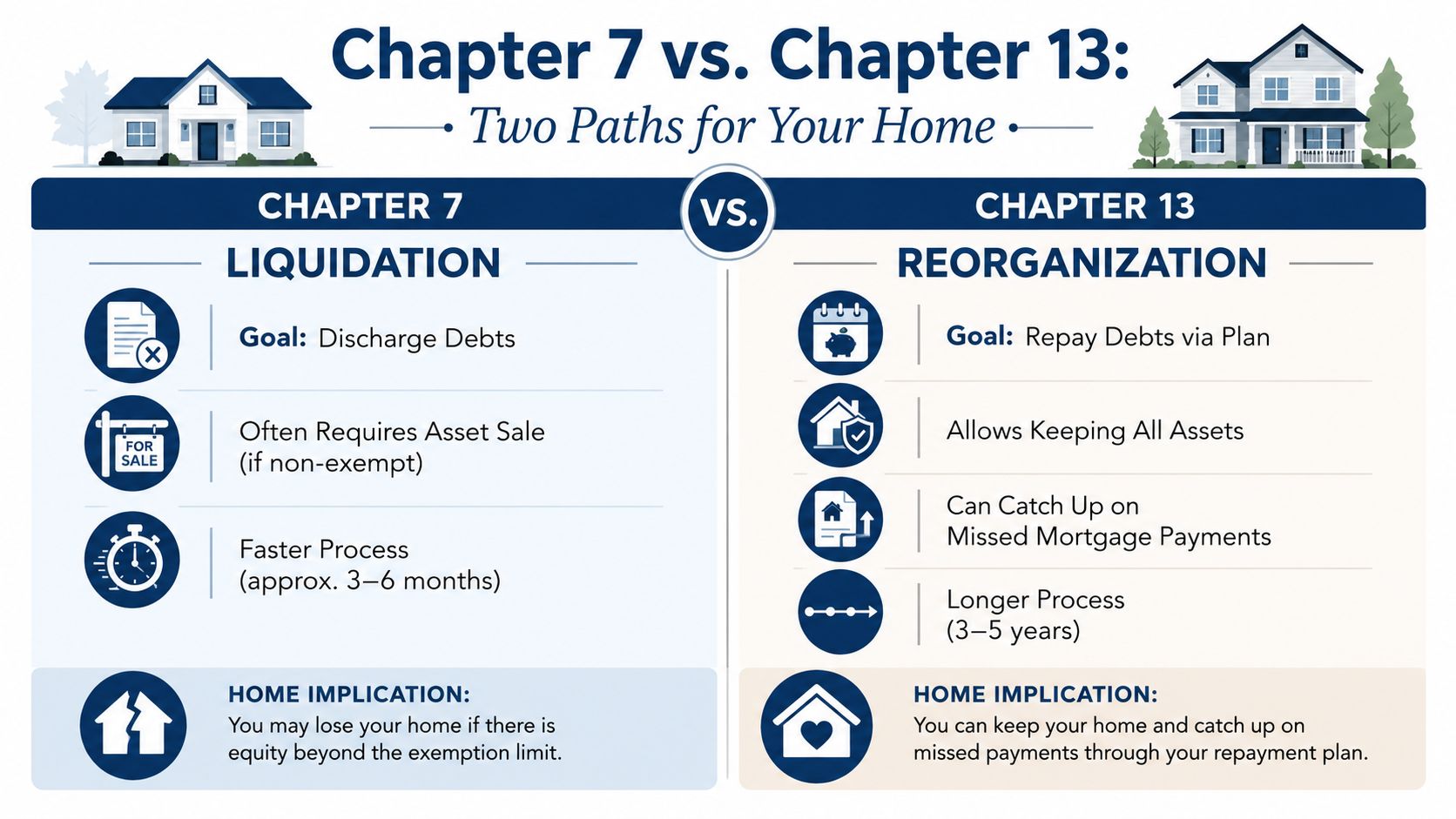
Chapter 7 and Chapter 13 both protect people from collection pressure, but they treat a home in very different ways. A simple way to sort them out is to ask: are you mainly dealing with too much debt, or are you mainly dealing with missed mortgage payments?
| Path | Best fit for the house | Main housing outcome |
|---|---|---|
| Chapter 7 | Homeowner is current, or close to current, on the mortgage and the home's equity is protected under Minnesota law | Unsecured debts may be discharged, which can free up room in the budget to keep paying for the house |
| Chapter 13 | Homeowner is behind on mortgage payments but has enough regular income to fund a plan | Past-due mortgage payments can be caught up over time through a court-approved repayment plan while the homeowner keeps the property |
Chapter 7 and the house
Chapter 7 is often the better fit when the house itself is still affordable, but credit cards, medical bills, or other unsecured debts are making everything harder. In that situation, Chapter 7 can clear out much of that outside pressure and leave the mortgage in place.
That last part matters. Bankruptcy can wipe out personal liability on many debts, but a mortgage lien usually stays attached to the home. In plain terms, if you want to keep the house, you usually need to keep paying for it.
For Minnesota homeowners, Chapter 7 is often more useful than they expect because state law can protect a large amount of homestead equity. That means some people who assume they have "too much equity" to file are in a safer position than they realize. The exemption rules matter, and in Minnesota they are often more favorable than in many other states.
Chapter 7 also moves faster than Chapter 13 in many cases. Speed can help if your main goal is to get rid of unsecured debt and stabilize your budget quickly.
Chapter 13 and the house
Chapter 13 solves a different housing problem. It is often the stronger option when you want to keep the home but need time to catch up on missed mortgage payments.
It works like a court-approved catch-up plan. Instead of coming up with the full past-due amount at once, you pay the arrears over time while also keeping up with current mortgage payments. For many families, that is the difference between losing the house and getting a realistic second chance.
This chapter can also be especially helpful in Minnesota because homeowners here often have meaningful equity worth protecting. If you have fallen behind but have built value in your home, Chapter 13 may give you a way to preserve that value rather than lose it in a foreclosure sale.
A practical way to choose
Here is the simple version:
- Chapter 7 is often a better fit if the mortgage payment is manageable and the main problem is other debt.
- Chapter 13 is often a better fit if you are behind on the mortgage and need time to cure the default.
A lot of people assume the faster chapter is automatically better. That is usually the wrong question. The better chapter is the one that matches the actual problem attached to the house.
If you are current on the mortgage, Chapter 7 may be enough.
If you are several payments behind, Chapter 13 may give you the structure Chapter 7 cannot.
For a closer look at eligibility, timing, and tradeoffs, see LifeBack's guide to Chapter 7 vs Chapter 13 bankruptcy.
One point that causes confusion
People sometimes ask whether filing Chapter 7 means they "get to keep the house" automatically. It does not work that way. Important questions are whether the equity is protected, whether the mortgage is current or can be brought current, and whether the monthly payment still fits the household budget.
That is why choosing a chapter is less like picking the faster line and more like picking the right tool for a specific repair. A hammer is not better than a wrench. It depends on what needs fixing.
Minnesotas Powerful Homestead Exemption Explained
A lot of Minnesota homeowners reach this point and ask the same question: "My house has value. Does that mean I could lose it?"
Usually, the answer turns on one word: equity.
Equity is the part of the home that belongs to you after subtracting the debt attached to it. If your home would likely sell for $350,000 and the mortgage balance is $250,000, the equity is about $100,000. Bankruptcy law does not look only at the home's price tag. It looks at how much of that value is yours and how much of it the law protects.
Why Minnesota gives homeowners a real advantage
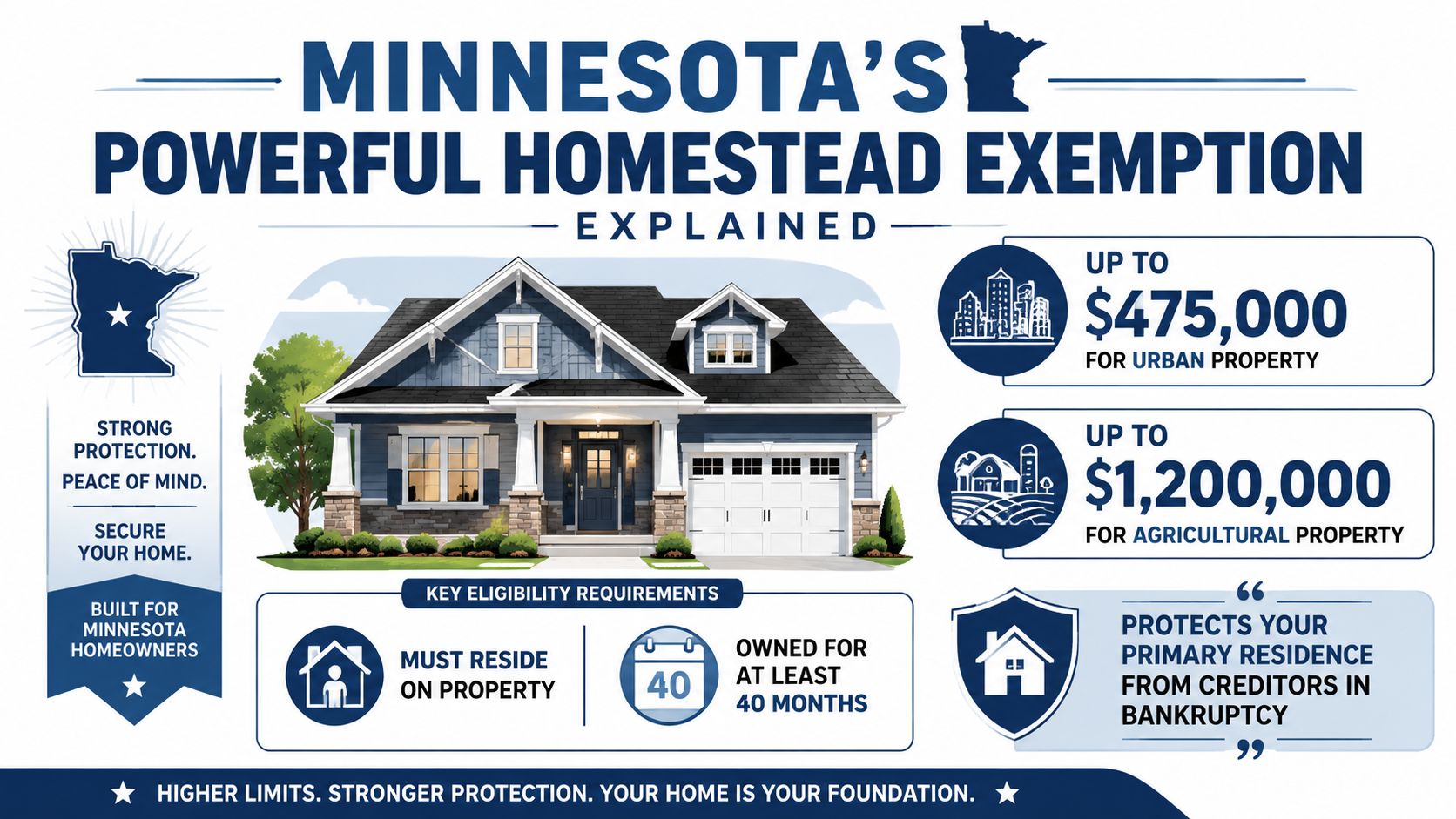
Minnesota has a strong homestead exemption compared with what many people expect in bankruptcy. That matters because the exemption protects equity in your primary residence. In plain terms, it creates a legal shelter around part of the value you have built in your home.
That shelter is often large enough to protect the full equity of a typical Minnesota homeowner. This is one of the reasons keeping a home here is often more realistic than people assume, especially when the mortgage payment is still affordable.
How the exemption works in real life
A simple way to picture it is to treat the exemption like a fence around a certain amount of home equity. If your equity stays inside that fence, a Chapter 7 trustee usually has no reason to force a sale of the property.
The math is simple:
- Start with the home's current fair market value
- Subtract the mortgage balance
- Subtract any other valid liens
- What is left is your equity
If that equity fits within Minnesota's homestead protection, the house is often protected in a Chapter 7 case.
One point causes a lot of confusion. The exemption protects equity, not the full market value of the home. A home can be worth a substantial amount and still be safe if the debt against it leaves only protected equity.
Why this section matters so much
Minnesota's homestead rules can change the whole analysis. In some states, a homeowner with moderate equity may face more risk. In Minnesota, the state exemption often gives people much more room to protect the home they live in.
That is why an accurate equity review matters. Online estimates can be off. Payoff balances may be different from what you expect. A small error in value or loan balance can change the legal analysis, so it helps to review recent mortgage statements, tax records, and a realistic home value before filing.
For a closer explanation of how this works in both chapters, see LifeBack's guide to the Minnesota homestead exemption in Chapter 7 and Chapter 13.
The practical takeaway is reassuring. Filing bankruptcy in Minnesota does not mean your house is automatically at risk. In many cases, the homestead exemption is the rule that helps keep the roof over your head.
Navigating Mortgages and Liens in Bankruptcy
Equity protection is only half the housing question. The other half is the debt attached to the house.
A homeowner may fully protect the equity in a property and still have to make careful decisions about the mortgage, any second mortgage, or a home equity line of credit. Bankruptcy affects personal liability and collection rights differently, and that difference matters.
The mortgage usually stays with the house
A mortgage lender has a lien on the property. Bankruptcy may discharge personal liability on many debts, but the lien usually remains unless a specific legal process changes it.
That means a homeowner who wants to keep the house generally has to keep dealing with the mortgage in one of a few practical ways:
- Stay and pay: The homeowner keeps the property and continues making payments.
- Reaffirmation: In some cases, the homeowner signs an agreement that keeps personal liability on the mortgage in place under certain terms.
- Surrender: If the home is no longer affordable, bankruptcy can provide a structured way to give it up and address surrounding debt pressure.
Each option has consequences. Reaffirmation can preserve a more traditional relationship with the lender, but it may also keep liability alive. Continuing to pay without reaffirming may be possible in some situations, but local practice and lender behavior matter. Surrender can be painful emotionally, yet sometimes it's the most stable financial choice.
Why second liens create special issues
A first mortgage gets paid first from the home's value. A second mortgage or home equity line stands behind it. That ranking becomes important in Chapter 13.
If the value of the home doesn't reach the second lien after accounting for the first mortgage, Chapter 13 may offer a way to address that junior lien through a process often called lien stripping. The basic idea is that a wholly unsecured junior lien may be treated differently from a secured claim.
This area is technical. It depends on valuation, lien order, and chapter choice. It also usually requires formal legal steps, not just a statement in the bankruptcy petition.
Homeowners often think all mortgages are treated the same. They aren't. A first mortgage and a junior lien can have very different outcomes in Chapter 13.
The practical decisions homeowners need to make
The best housing outcome often comes from answering a few grounded questions early:
- Is the regular mortgage payment affordable going forward?
- Is there a past-due amount that needs to be cured over time?
- Is there a second mortgage or HELOC that may need separate analysis?
- Does keeping this house help the household recover, or trap it in ongoing strain?
Those aren't just legal questions. They're budget questions, family questions, and timing questions too.
For homeowners who want chapter-specific guidance, a Minnesota bankruptcy practice such as LifeBack Law Firm, P.A. can review mortgage status, lien structure, and exemption issues and explain what options are available under Chapter 7 or Chapter 13.
Practical Steps to Protect Your Home Before You File
The strongest home-protection cases usually begin before the petition is filed. Good preparation makes the legal analysis cleaner and helps avoid preventable mistakes.
What to gather and review
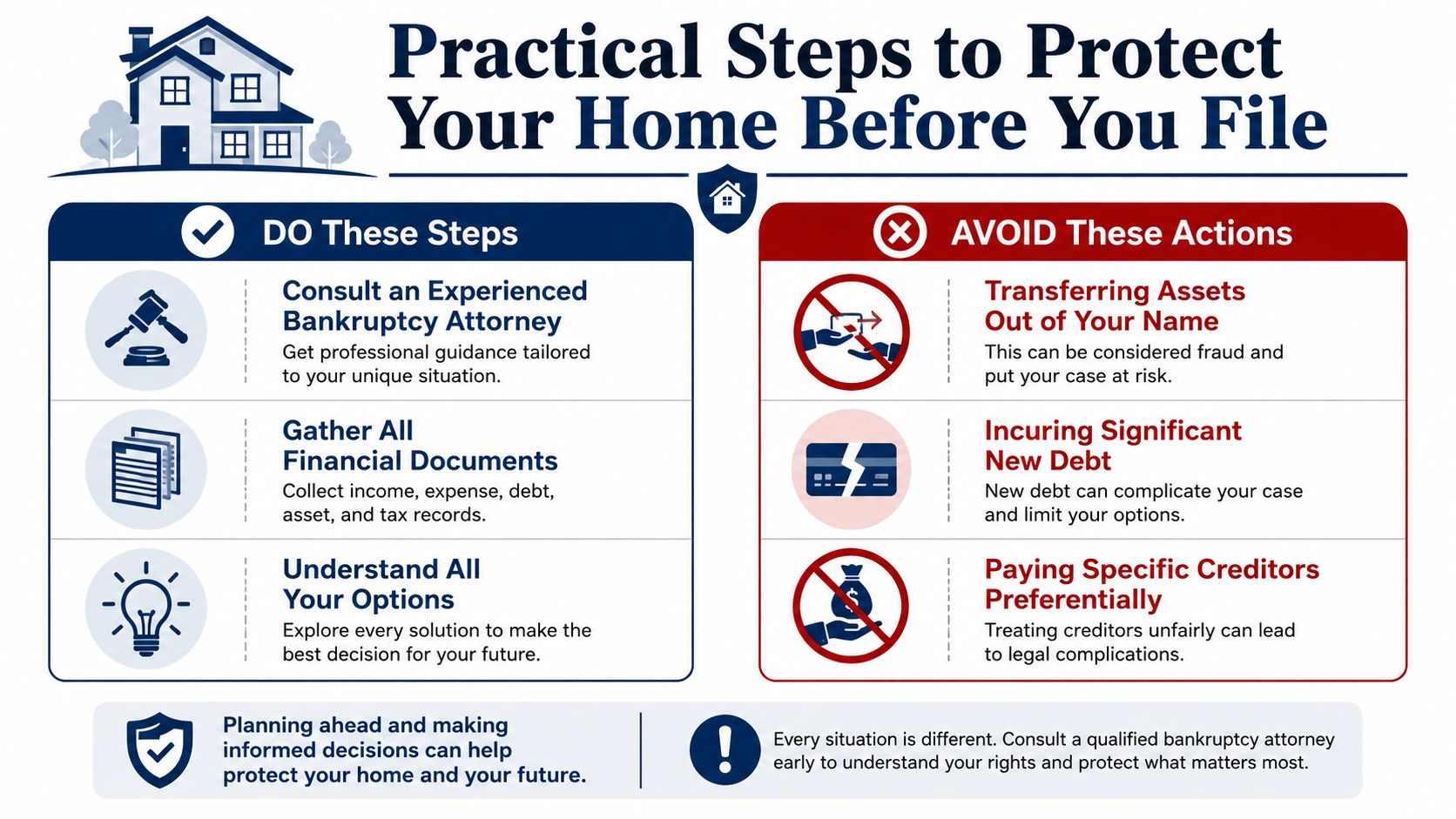
A homeowner should start with the paper trail. That means recent mortgage statements, property tax records, homeowner's insurance information, and any notices from the lender or sheriff related to foreclosure.
A realistic home value matters too. Online estimates can be a starting point, but they aren't always precise enough for legal planning. A careful review of local market conditions, condition issues, and comparable sales helps produce a more reliable picture of equity.
For homeowners trying to understand the property's condition before discussing value or future sale options, a practical resource like this essential yearly home checklist can help identify deferred maintenance issues that may affect how the house should be evaluated.
What to avoid before filing
Some of the most damaging mistakes happen when a homeowner tries to "protect" the house without legal advice.
- Don't transfer the deed to a relative: That can create serious problems and may be reversed.
- Don't take on new debt to patch over old debt: That often makes the situation worse.
- Don't pay one creditor based on fear alone: Uneven last-minute payments can complicate the case.
- Don't guess about value or exemptions: A small misunderstanding can lead to a major strategic error.
A rushed pre-bankruptcy transfer often creates more risk, not more protection.
A short pre-filing checklist
- Collect housing documents: Mortgage, taxes, insurance, payoff information, and any foreclosure notices.
- Write down the timeline: When payments were missed, when notices arrived, and whether a sale date is pending.
- List all liens: First mortgage, second mortgage, HELOC, judgment liens if any.
- Review monthly affordability: The goal isn't only to save the home today. It's to know whether the home can be kept tomorrow.
A prepared filing gives the homeowner and attorney better options. A rushed filing can still help, but it leaves less room for strategy.
Common Questions About Your Home and Minnesota Bankruptcy
Homeowners usually understand the basics once the process is explained. The remaining stress tends to come from edge cases. Those details matter because houses rarely fit into perfect textbook examples.
What if the equity is slightly above the exemption?
That doesn't always mean the house will be lost. It means the case needs careful analysis.
Sometimes valuation is the key issue. Sometimes liens or costs change the equity picture. In other situations, Chapter 13 may offer a better structure than Chapter 7 because it can help protect assets while debts are handled through a plan.
Can a homeowner sell the house during bankruptcy?
Possibly, but it depends on timing and chapter.
If a bankruptcy case is still open, court approval may be required before a sale can move forward. The house may still be part of the bankruptcy estate, and the sale proceeds have to be handled correctly. After the case is closed, selling is usually more straightforward, though the homeowner still has to deal with any mortgage payoff and related closing issues.
What if only one spouse files?
That situation can get complicated quickly. Ownership structure matters. So do the mortgage documents, the deed, and whether both spouses are liable on the note.
A non-filing spouse may still have rights in the property, but that doesn't remove the need for a careful exemption and lien review. Cases involving one filing spouse and one non-filing spouse should never be treated as routine.
How can a homeowner tell if the payment is still affordable?
A debt-to-income review can help frame that question. It won't answer every bankruptcy issue, but it helps a household see whether the mortgage still fits inside the broader budget. This simple DTI calculation guide is a useful starting point for that analysis.
If the house can be saved legally but can't be sustained financially, the better strategy may be different from the initial emotional instinct.
Will the lender foreclose right after discharge?
Not automatically, but the risk doesn't disappear if payments aren't made. A discharge removes personal liability on many debts, yet the mortgage lien usually remains attached to the property. If the homeowner falls behind after the case, the lender may still enforce its rights against the house.
The central point is this: what happens to your house after bankruptcy in Minnesota depends on equity, mortgage status, chapter choice, and timing. Those pieces work together. A homeowner who understands all four is in a much stronger position than one acting from fear alone.
LifeBack Law Firm, P.A. helps Minnesota homeowners evaluate those exact issues, including home equity protection, foreclosure timing, Chapter 7 eligibility, and Chapter 13 repayment options. Anyone worried about losing a house can contact LifeBack Law Firm, P.A. to discuss the property, the mortgage, and the available next steps in a confidential consultation.