
Most Chapter 13 lawyers charge roughly $3,500 to $5,200 for a straightforward consumer case, with the national median base fee near $3,750. Most of that bill is paid through the repayment plan rather than in cash on filing day.
A worried wage earner usually isn't asking about an abstract legal average. The immediate concern is practical: a creditor is calling, a mortgage or car payment is behind, and the household may not have several thousand dollars sitting in a checking account. Chapter 13 can address that cash-flow problem because local courts commonly allow the attorney's approved fee to be paid through the plan over time.
The advertised fee still doesn't tell the whole story. The district where the case is filed, the court's presumptive fee schedule, the work included before confirmation, and complications involving a home, taxes, business income, or prior filings can change the final cost. The most useful question isn't, “What does Chapter 13 cost?” It's, “What must be paid before filing, what gets paid through the plan, and what work will create an additional fee?”
Chapter 13 Lawyer Fees: Upfront Cash Versus the Plan Balance
For a straightforward consumer Chapter 13 case, a realistic total attorney-fee range is roughly $3,500 to $5,200. The national median base fee is about $3,750, while the National Consumer Bankruptcy Research Center survey reported an average presumptive base fee of $3,888. Where that arrangement was available, 66% of cases used it. The national fee discussion and survey figures are summarized by Nolo.
Those figures provide context, not a quote for your case. The local bankruptcy court controls the presumptive fee structure, and the services included can differ by district. Ask for the district's approved amount and compare it with the lawyer's written agreement.
The cash needed before filing
Most firms use a flat no-look or presumptive fee for ordinary plan work instead of open-ended hourly billing. The debtor rarely pays the entire attorney fee on filing day. An initial retainer commonly falls around $1,500 to $2,000, although the firm, district, urgency, and pre-filing work can change that amount.
The remaining approved fee is proposed in the Chapter 13 plan and paid through trustee disbursements after the case begins. This structure can make filing possible for a household that cannot produce several thousand dollars immediately. It does not make the balance disappear. The plan must account for that payment, and the written fee agreement should identify both the upfront amount and the portion paid through the plan.
| Fee Component | Typical Range | Median |
|---|---|---|
| Total attorney fee, straightforward consumer case | $3,500 to $5,200 | $3,750 |
| Initial retainer before filing | $1,500 to $2,000 | Not established |
| Remaining approved fee through the plan | Depends on retainer and court rules | Not established |
Before signing, get four answers in writing:
- Total fee: What is the complete base charge?
- Day-one cash: What must be paid before the petition is filed?
- Included services: Does the fee cover schedules, the trustee meeting, plan objections, and confirmation work?
- Extra work: Which events trigger a supplemental fee application?
Push back on a quote that gives only one number. A local court may authorize a different presumptive fee than a nearby district, and a case that appears routine at intake can cost more if litigation or repeated plan changes arise. Your practical target is clear: know the cash required to file, the amount assigned to the plan, and the work that falls outside the base fee.
How Chapter 13 Flat Fees and No-Look Fees Work
A no-look fee, also called a presumptive fee, is a flat amount that a local bankruptcy court considers reasonable for ordinary Chapter 13 services. If the case meets the court's conditions, the attorney can request that amount without submitting a detailed application for every task.
The arrangement works like a flat-rate oil change. The customer pays for a defined service instead of a separate charge for each minute spent inspecting the vehicle. A no-look fee applies the same basic idea to routine bankruptcy work. The court assumes that a standard case requires a predictable package of legal services.
What the court is approving
A lawyer's quote does not make the fee automatically lawful. The attorney must disclose compensation under 11 U.S.C. § 329, and the court may review whether the payment is reasonable. Under 11 U.S.C. § 330(a)(4)(B), the court evaluates compensation for a Chapter 13 debtor's attorney under a reasonableness standard. A federal court guideline explains the presumptive-fee process and the role of §§ 329 and 330.
A fee above the local presumptive amount generally requires a supplemental fee application. The application should identify the additional work, explain why it was necessary, and request court approval. The trustee or creditors may object. The judge decides whether the extra compensation is justified.
Practical rule: A no-look fee is a simplified approval route, not a blank check.
The preset amount usually covers petition preparation, schedules, plan drafting, routine communications, the meeting of creditors, and standard confirmation work. It may exclude an adversary proceeding, lien litigation, extensive post-confirmation work, or a contested motion.
Read the fee agreement for the dividing line. It should separate the base package from excluded services and state whether the flat fee ends at confirmation or continues through the case. Those promises carry different financial risks, so ask for the answer in writing before signing.
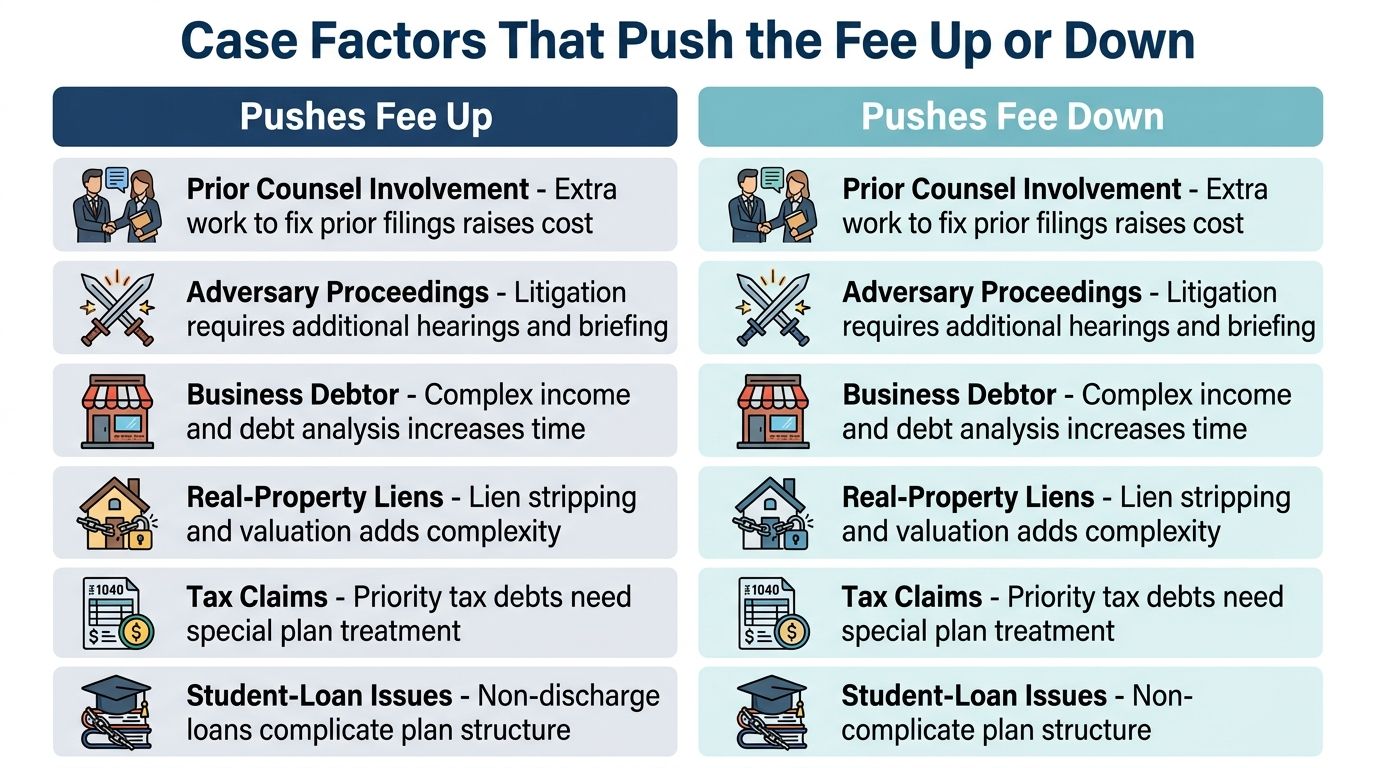
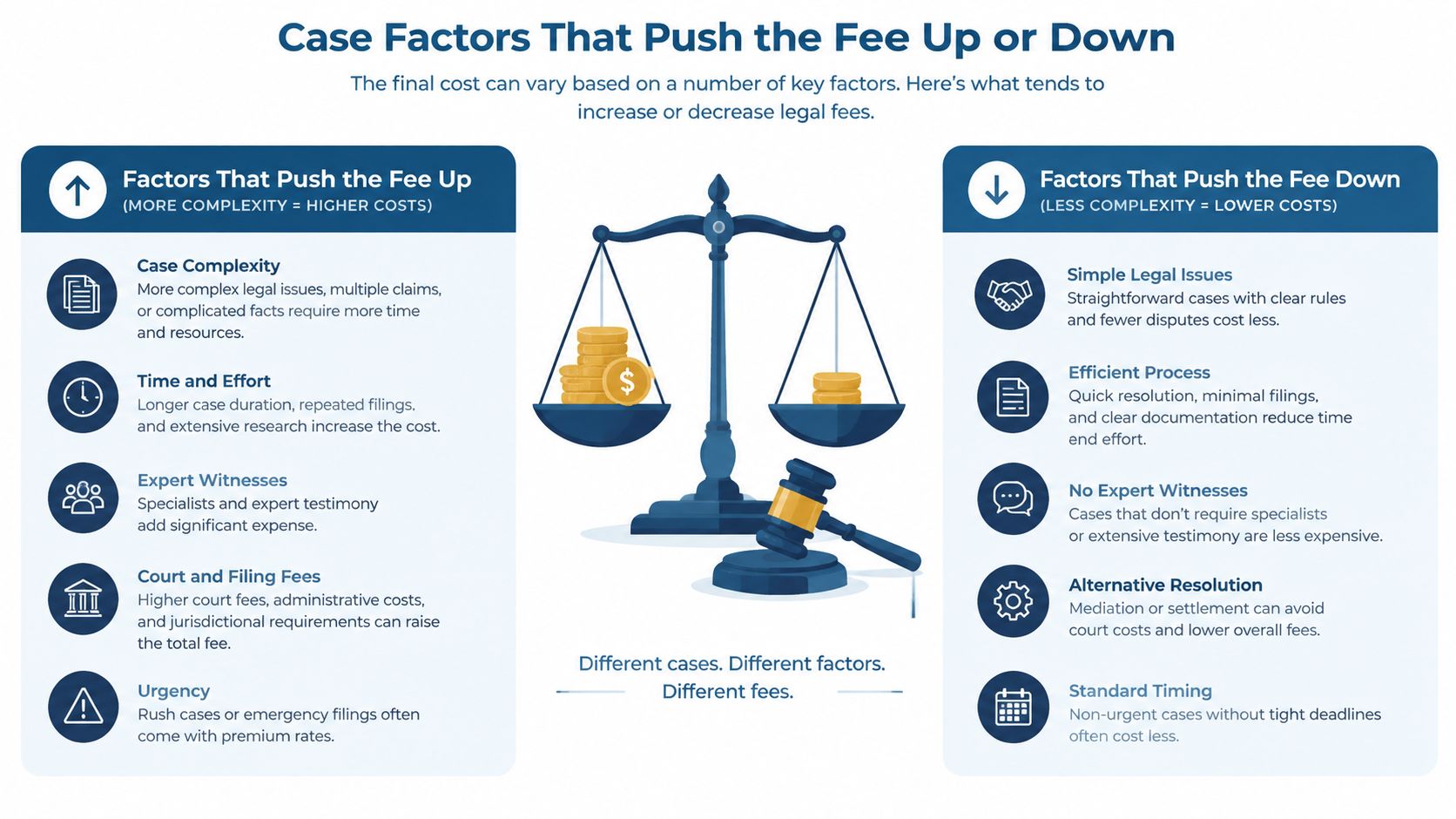
Case Factors That Push the Fee Up or Down
A clean wage-earner case usually stays near the local presumptive fee. Problems arise when the attorney must repair an earlier case, investigate business records, negotiate with secured creditors, or litigate an issue that the standard fee doesn't cover.
Prior filings and prior counsel
A dismissed case creates work that a first filing may not require. The lawyer must review the earlier petition, determine why the case failed, assess eligibility and stay issues, and build a plan that avoids repeating the problem. Converting from Chapter 7 or filing while another attorney remains on the record can also require file review, substitution paperwork, and communication with prior counsel.
The debtor should disclose every prior bankruptcy at the first consultation. Concealing it doesn't reduce the fee. It increases the risk of rushed work, inaccurate schedules, and a later request for additional compensation.
Litigation and business complications
An adversary proceeding is a separate bankruptcy lawsuit, not routine plan administration. A junior-lien dispute, dischargeability challenge, or defense against a creditor's dismissal request can require pleadings, discovery, hearings, and briefing. The research brief identifies separate proceeding fees ranging from $1,500 to $5,000, depending on the matter and the work involved. The district-fee discussion describes how litigation and case complexity affect Chapter 13 compensation.
A self-employed debtor adds another layer. The attorney may need to distinguish personal debt from business obligations, explain business income, review operating expenses, and coordinate issues involving a sole proprietorship or single-member entity. That analysis takes longer than preparing schedules for a wage earner with a single employer.
Property, taxes, and student loans
Real-property liens can require valuation work and lien-stripping analysis. Mortgage arrears create plan-treatment questions, especially when ongoing payments, escrow changes, and proof of claim disputes are involved. Priority tax claims need accurate classification and a workable payment structure, while student-loan issues may affect feasibility and long-term plan design.
The fee moves down when the case has:
- Complete records: Pay stubs, tax information, debt statements, and asset information arrive promptly.
- Stable income: A consistent paycheck makes plan calculations easier.
- No litigation: No creditor challenges, lien disputes, or dismissal motions require separate work.
- A simple asset picture: No business, complex real estate, or unusual ownership interests need investigation.
The fee moves up when the lawyer must repeatedly amend schedules, respond to contested claims, defend the case, or seek approval for work outside the presumptive package. A low initial quote can become a poor bargain if it excludes the exact problem threatening confirmation.
Fee Ranges by District and What Minnesota and North Dakota Look Like
Local court rules matter more than a national average. Federal bankruptcy districts set procedures and presumptive fees, so similar consumer cases can receive different quotes across state lines or even between nearby districts. Your first question should be, “What does this district allow, and how much must I bring on day one?”
Published court guidelines show representative base fees of roughly $3,500 in some districts and $5,200 or more for a basic case. Other districts authorize $5,200, $5,500, or $8,500 for certain nonbusiness cases. A federal court's Chapter 13 guidelines illustrate how local schedules define presumptive compensation.
| District | Typical No-Look Base Fee | Notes |
|---|---|---|
| Lower-fee districts | About $3,500 | Local presumptive schedule and case type control |
| Mid-range districts | About $4,000 to $5,200 | Ordinary consumer cases may fit the standard package |
| Higher-authorized districts | $5,200 to $8,500 | The amount can depend on case type and local guideline conditions |
| District of Minnesota | Roughly $4,000 to $5,200 | Published schedules sit toward the upper part of the national range |
| North Dakota | Generally $3,500 to $4,500 | Rural divisions may have lower market quotes in some cases |
Minnesota consumers should use $4,000 to $5,200 as a consultation benchmark for many standard Chapter 13 matters, not as a guaranteed quote. The District of Minnesota's published schedule and the assigned judge's procedures can affect what a firm treats as routine. For a state-specific breakdown, read this guide to the cost of filing bankruptcy in Minnesota.
North Dakota often has a lower practical range, generally $3,500 to $4,500. Complexity and division-specific practice still affect the quote, and a rural office may price differently from a firm handling complicated cases in a larger city.
The documents that affect the quote
Review the attorney fee disclosure, local Form 21 requirements, trustee-office practices, and the assigned judge's procedures. These details can change the amount and determine which work belongs inside the presumptive package. A quote above the presumptive ceiling usually requires a detailed application under 11 U.S.C. § 330 and may need court approval before payment.
Ask two local firms to identify the district's no-look amount, included services, required retainer, and every excluded task. Compare the cash required on day one with the total fee proposed through the plan. Push back on any quote that gives only one number without explaining what happens if claims are disputed, schedules need amendments, or work falls outside the standard package.
Three Real-World Scenarios With Sample Costs
The following examples use the fee ranges and case features identified in the research brief. They aren't promises of a particular quote. They show how the upfront question differs from the total attorney charge.
Scenario A, the straightforward wage earner
A single wage earner has $40,000 in unsecured debt, no house, no prior bankruptcy, and regular employment. The case has no lien dispute, business records, or unusual tax issue.
A reasonable total attorney fee lands near the $3,750 median, with the client paying roughly $500 to $1,000 on day one in this example and proposing the balance through the plan. The specific retainer can be higher under a particular firm's policy, so the written agreement controls.
The practical day-one cash requirement is the agreed retainer plus any required filing-related costs. The debtor should not assume that a low retainer means a lower total fee.
Scenario B, the homeowner with arrears
A married couple wants to keep a home, cure $12,000 in mortgage arrears, address one priority tax debt, and pay off a vehicle through the plan. The attorney must coordinate mortgage claim treatment, tax classification, vehicle information, and feasibility.
The total attorney fee may run $4,500 to $5,500 because the arrearage workout and tax-claim analysis add work beyond a bare petition. The couple's day-one cash is the retainer stated in the engagement agreement, not the full total fee, but they should also budget for any separate filing or counseling costs disclosed by the firm.
Scenario C, the self-employed filer
A self-employed debtor has business income, a prior dismissed Chapter 7, and a small business debt. The attorney must analyze income, review the earlier case, separate business and personal obligations, and defend against a creditor's motion to dismiss.
The total base fee can climb to $6,000 to $8,500, with a separate adversary or contested-matter fee of $1,500 to $3,000 in the example. The day-one cash requirement is the negotiated retainer, plus any amount the lawyer requires before undertaking the contested work. The rest depends on court approval and plan treatment.
These scenarios show why a firm should quote both numbers separately: cash required before filing and total compensation requested in the case. A debtor who compares only the retainer can choose the wrong lawyer or underestimate the plan's long-term cost.
How the Attorney Fee Gets Paid Through the Plan
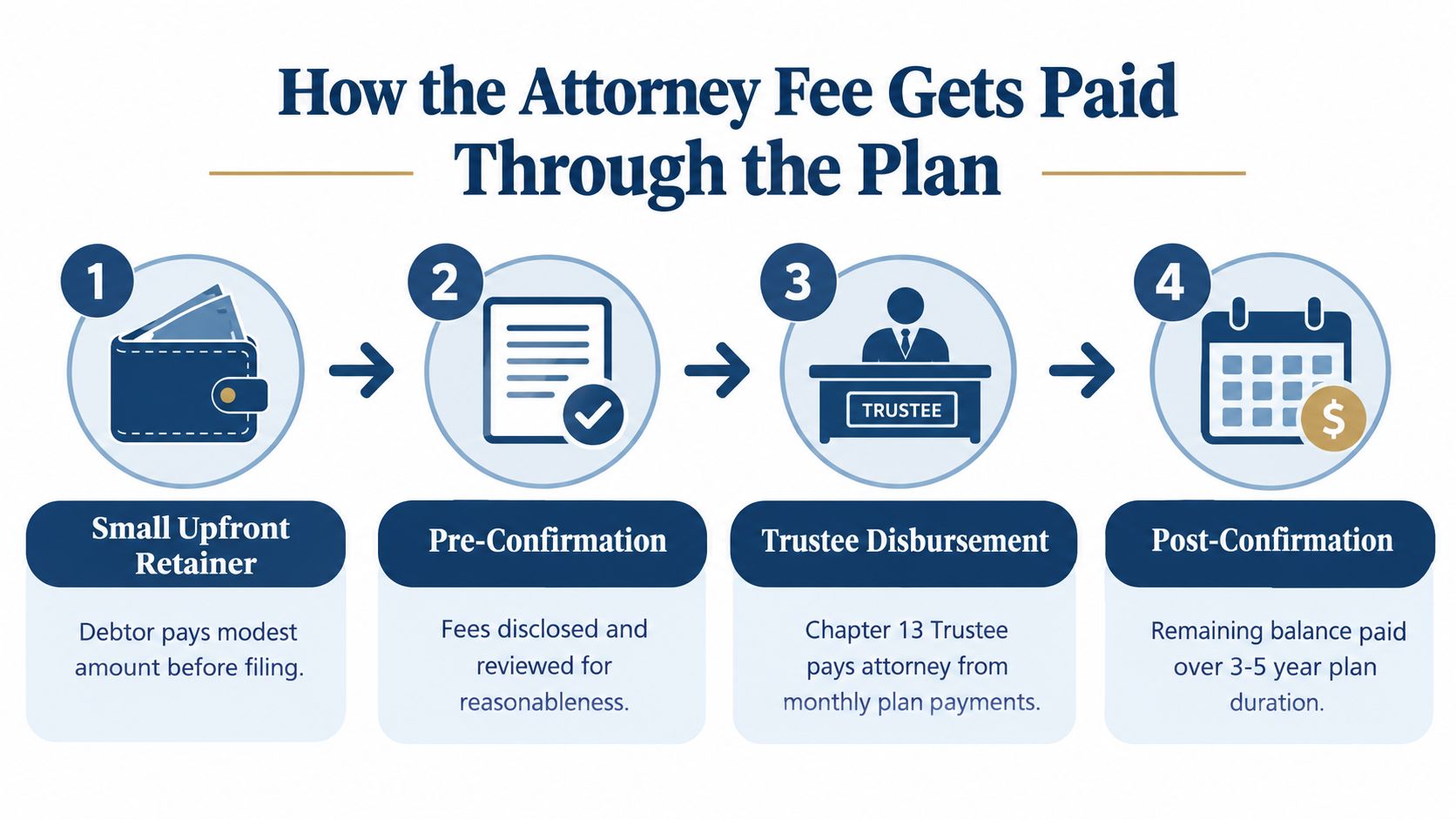
Chapter 13 attorney fees often enter the repayment plan instead of being paid as one large check. The debtor pays the Chapter 13 trustee according to the confirmed plan, and the trustee distributes funds under the district's payment priorities. Attorney compensation is then paid from approved plan distributions.
Before confirmation
Before filing, the lawyer typically collects the agreed retainer and prepares the petition, schedules, statements, and proposed plan. The fee disclosure identifies the total compensation and the amount already paid. The court and trustee can review whether the arrangement complies with local rules and remains reasonable.
The plan must work financially. An attorney fee doesn't create extra household income, so the debtor's plan payment still has to fit the budget and satisfy applicable legal requirements.
After confirmation
Once the plan is confirmed, trustee payments are distributed under the local disbursement structure. The unpaid approved portion of the base fee is generally paid over the plan's life, which is commonly 36 or 60 months. This explanation of paying Chapter 13 attorney fees through the plan provides additional consumer-focused context.
The exact timing depends on the district, plan language, trustee practice, and available funds. If the case pays unsecured creditors in full, the source of attorney compensation may differ from a plan that pays unsecured claims less than their full balances.
What creates a supplemental fee
Extra compensation usually requires more than a phone call or a vague invoice. Common triggers include:
- Adversary proceedings: Separate litigation over dischargeability, liens, or creditor conduct.
- Plan modifications: A later income change, missed payments, or revised treatment of a secured claim.
- Post-confirmation litigation: Contested motions, evidentiary hearings, or disputes requiring court briefing.
- Lien work: Valuation, lien avoidance, or treatment that falls outside routine plan drafting.
- Dismissal defenses: A motion that threatens the case and requires a formal response.
The attorney should request approval before taking on substantial excluded work when local rules require it. If the court doesn't approve the requested amount, the lawyer may not collect it from the plan. That creates a predictable source of disputes, especially when a case lasts longer than expected or the client believes the original flat fee covered everything.
A plan-paid fee is still a real obligation. It may reduce what unsecured creditors receive, increase the plan's required funding, or affect how the case is structured.
Choosing a Chapter 13 Lawyer and Negotiating the Fee
The first consultation should function as a hiring interview. A debtor isn't merely purchasing paperwork. The lawyer will shape the plan, respond to objections, protect the automatic stay, and explain decisions that affect the household for years.
Ask direct operational questions:
- Case volume: How many Chapter 13 cases does the attorney file and personally supervise?
- Court appearances: Who attends the meeting of creditors and confirmation hearings?
- Staff roles: Will a paralegal or associate prepare schedules, and who reviews the final work?
- Included services: Does the base fee cover plan objections, amendments, and routine trustee requests?
- Extra billing: What specific events trigger a supplemental application?
- Post-confirmation rates: What hourly rates apply to work outside the flat-fee package?
- Dismissal refunds: What happens to unearned fees if the case ends before confirmation?
A written agreement should state the base no-look fee, the retainer, payment dates, excluded services, approval process for extra work, and refund policy. Push back on “costs and expenses” language that gives no practical explanation. Filing-related charges and credit-report costs should be identified and passed through at cost, with a clear cap where appropriate.
Red flags that deserve a second consultation
Pressure to sign the same day is unnecessary. Refusal to itemize is worse. A quote far below the local presumptive range can signal that the firm expects limited service, relies on high volume, or will charge separately for work the debtor assumed was included.
A firm should be able to explain its workflow without hiding behind legal jargon. If the office uses remote staff or support personnel, a resource about a virtual assistant for lawyers can help consumers understand why staffing matters, but the attorney remains responsible for legal judgment, review, and court representation.
LifeBack Law Firm, P.A. is one Minnesota and North Dakota practice that offers phone, video, and in-person consultations, along with virtual case handling. The relevant comparison isn't branding. It's whether the firm provides a transparent scope of work, identifies the person responsible for the case, and gives a fee quote tied to local court practice.
When the Fee Is Worth It and What to Do Next
A Chapter 13 fee is usually worth paying when the case involves non-exempt equity, mortgage arrears, tax-dischargeability questions, student-loan complications, or a prior dismissal. Those issues can change eligibility, plan feasibility, creditor treatment, or the debtor's ability to keep property. The cost of an avoidable mistake can exceed the fee difference between two competent local lawyers.
DIY filing is most defensible for a wage earner with simple income, no significant assets, no secured-debt problems, and no expected litigation. Even then, a focused legal review can expose a missed exemption, an inaccurate claim, or a plan payment that cannot survive ordinary household expenses. A guide to the benefits of using a Chapter 13 attorney explains why representation becomes more valuable as the case becomes less routine.
The practical checklist for this week
- Gather income records: Collect the last two pay stubs and two tax transcripts.
- Review plan affordability: Use a free means-test calculator and list actual household expenses.
- Prepare property documents: Bring the latest mortgage statement and the payoff for any vehicle the debtor intends to keep.
- Collect creditor evidence: Save collection letters, lawsuit papers, garnishment notices, and account statements.
- Schedule two consultations: Speak with consumer-bankruptcy-focused firms that regularly file in the debtor's district.
- Choose the objective: Decide whether the priority is keeping the house, curing arrears, protecting a vehicle, addressing taxes, or restructuring unsecured debt.
That objective drives the plan design and often determines the fee tier. The right lawyer isn't necessarily the cheapest lawyer. The better choice is the attorney who states the total cost, the day-one cash requirement, the included work, and the conditions that can generate additional compensation.
LifeBack Law Firm, P.A. helps Minnesota and North Dakota consumers and small business owners evaluate Chapter 13 plans, local fee rules, and realistic upfront costs. Visit LifeBack Law Firm, P.A. to schedule a phone, video, or in-person consultation and get a clear explanation of the available next steps.