
A Chapter 13 tax refund usually isn't automatically available to spend: the confirmed plan governs, the trustee administers its requirements, and some plans allow a fixed amount to be kept. The refund clause in the signed, confirmed plan is the document to check first.
Why assume the refund's size decides the outcome when the controlling issue may be a sentence in the repayment plan? For a family counting on that money for repairs or medical bills, that distinction matters. Asking whether someone can keep a tax refund after filing Chapter 13 starts with the plan language, not a blanket promise that refunds are protected or must always be surrendered.
Whether Your Refund Is Yours to Keep
Can you spend the refund the day it hits your account, or does your Chapter 13 plan already speak for it? That plan clause and the local procedure decide the answer, not an exemption list. Spending before the trustee gives written instruction is the most common and costly mistake I see filers make.
A retention allowance grants a limited exception, not spending authority. A plan may let a debtor keep a portion while still requiring disclosure, tax documents, or a formal request before any of it is used.
Refund treatment by plan clause and local rule
| Plan treatment | Typical result for the refund | What to do |
|---|---|---|
| Plan requires all refunds to go to the trustee | Refund is turned over as disposable income, subject to any stated exceptions | Send the return and refund figures to the trustee without spending |
| Plan allows fixed annual retention | Keep the permitted amount; excess goes to the trustee under the plan | Track combined annual refunds and check how credits are treated |
| Local rule presumes refunds are disposable income | Retention requires a timely notice and completion of the applicable objection or approval process | Preserve the funds while the procedure is pending |
| Standing order example with a flat retention amount | Keep the set amount; any excess is treated as additional plan funding | Confirm the order applies to the case |
| Plan is silent or ambiguous | Trustee may seek the whole refund as disposable income | Request written guidance before spending |
The Missouri Chapter 13 plan form illustrates fixed retention: $1,250 for a single filer or $1,500 for joint filers annually, plus specified refundable credits. These are examples from another district, not Minnesota or North Dakota entitlements.
A different federal bankruptcy court local rule permits a debtor to rebut the disposable-income presumption through a notice to retain filed within 30 days, while requiring preservation of the funds during the pending process. That deadline is not a nationwide rule.
Practical rule: A refund deposit proves that the tax agency released the money. It does not prove that the bankruptcy plan permits spending it.
The immediate document check
Pull the confirmed plan language on refunds, retention caps, and turnover. Search for tax refund, disposable income, and retention, then hold the funds until the trustee's written instructions confirm what is permitted.
Why Your Refund Belongs to the Bankruptcy Estate
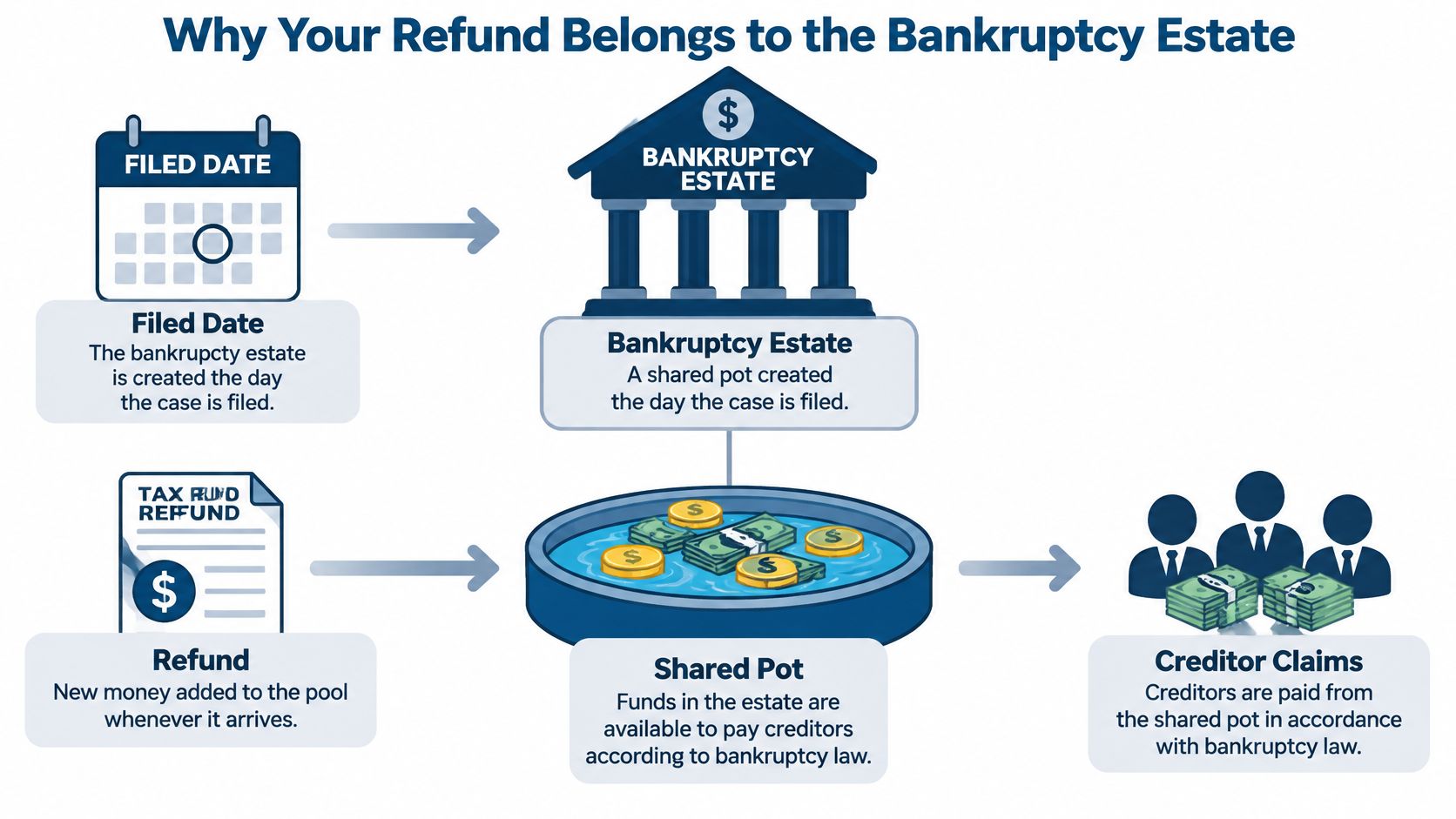
The bankruptcy estate can be understood as a shared pot created when the case is filed. Creditors' rights are addressed through that pot and the repayment plan, and certain property acquired during the case can enter it.
The analogy has limits. Chapter 13 doesn't freeze every bank account or require every incoming dollar to be surrendered. Estate ownership, permission to use money, and the amount payable to creditors are related but distinct questions.
Why the refund's history matters
An Oregon federal bankruptcy decision discusses estate treatment under 11 U.S.C. § 1306(a)(1) in a case involving federal and state refunds totaling $15,569 for tax years 2002 through 2004, recognizing that both prepetition and postpetition refunds can fall within the estate. The important point isn't the amount involved. A refund doesn't become unrestricted cash merely because it arrives after the bankruptcy petition.
The practical analysis requires several pieces of information:
- Confirmed plan language: Does the plan commit refunds to creditor payments or permit retention?
- Local procedure: Must the debtor turn over funds immediately or request permission to retain them?
- Tax-year allocation: Which income and tax period produced the overpayment?
- Documented need: Can the debtor substantiate reasonable expenses supporting a retention request?
A debtor who needs the refund for a necessary vehicle repair should provide an estimate and explain why the vehicle is needed for work. That creates a concrete request for review, rather than an unsupported claim that the household needs extra cash.
Separate present obligations from future goals
A refund intended for a future home purchase still requires the same estate and plan analysis. For longer-term planning, mortgage timing advice from Superior Credit Repair offers a separate resource, but it doesn't establish permission to retain bankruptcy estate funds.
Spending first can leave the debtor facing a turnover demand without the cash to satisfy it. Before treating an expected refund as available, the debtor needs to establish whether the income producing it was earned before or after filing, and which tax year the refund covers.
How Trustees Decide Which Refunds Count as Income
Disposable income broadly means income remaining after the expenses recognized in the bankruptcy calculation, which the plan may direct toward creditors. The official Chapter 13 disposable-income form provides the calculation framework, but a refund still requires attention to its source and the plan's treatment.
The trustee doesn't decide solely from the label on the deposit. Wage withholding, refundable credits, and the tax period behind the payment can raise different questions.
How refund source changes the trustee's treatment
| Refund source | Likely trustee treatment | Key question |
|---|---|---|
| Over-withholding from wages earned after filing | Generally accounted for as disposable income through the plan or turnover | Was the income earned after the petition date? |
| Refund generated by refundable credits, including EITC or ACTC | May count as disposable income unless applicable protections or plan provisions change the result | Does the confirmed plan separately address refundable credits? |
| Refund for a tax year before filing | Potential estate property, with possible tax-debt offsets | What period generated the refund, and what tax debts remain? |
| Refund for a tax year after filing | Postpetition overpayment potentially payable to the trustee | Was the return disclosed, and what does the plan require? |
| Refund arriving after closure or conversion | Requires review of the refund's origin, plan terms, and case status | Has counsel confirmed ownership and any outstanding turnover obligation? |
Under the federal statute defining Chapter 13 estate property, the estate generally includes qualifying property acquired after filing and before the case closes, is dismissed, or is converted. That makes the filing date and case status relevant, but the deposit date alone doesn't resolve ownership.
What the trustee needs to evaluate
The trustee reviews whether the refund reflects excess income, whether documented expenses support retention, and whether the plan's financial assumptions need adjustment. A substantial change may prompt consideration of a plan modification rather than a simple refund transfer.
Tax administration can affect the result before the debtor receives anything. Postpetition overpayments may be applied against other tax debts or sent to the trustee when requested, so the expected refund and the amount deposited may differ.
Understanding Chapter 13 bankruptcy trustee duties helps explain why a trustee requests returns and supporting calculations. The review concerns compliance and creditor distributions, not just whether the monthly payment cleared.
Early disclosure is easier to explain than a refund discovered after spending. Counsel should receive the filed return, the refund breakdown, and any proposed expense documentation while there's still time to address the issue properly.
Exemptions and Local Rules in Minnesota and North Dakota
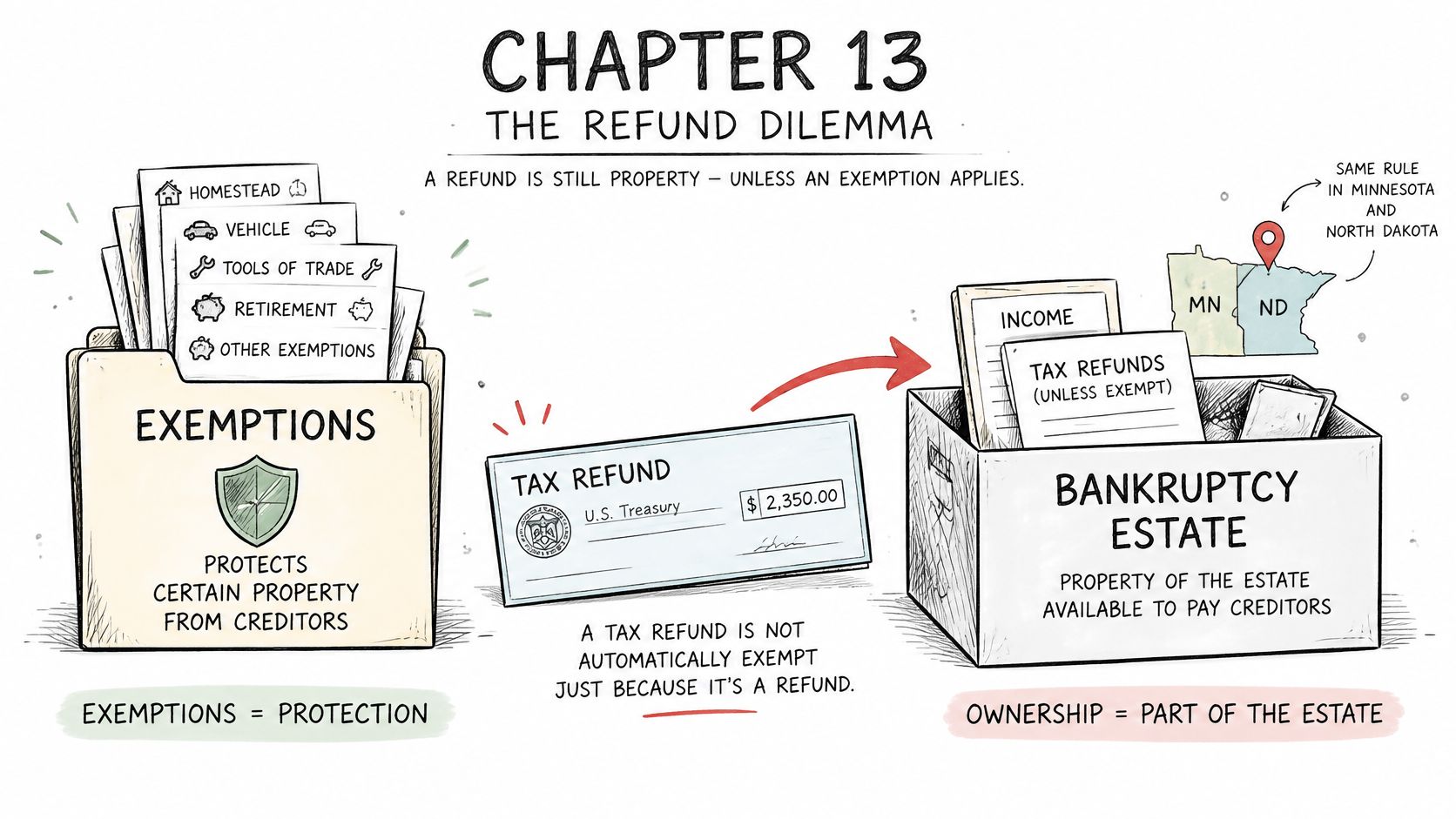
An exemption protects qualifying property from creditor reach under applicable law. It doesn't automatically answer whether a Chapter 13 plan must account for a tax refund as disposable income.
The exemption analysis and the plan-compliance analysis serve different purposes. Exemptions can affect the comparison with what creditors would receive in liquidation, while a request to use a refund for necessary expenses requires its own factual support.
Check the available exemption system first
Federal law provides an exemption list, and state law affects whether that list is available. Minnesota and North Dakota filers shouldn't assume that the same election rules, protected categories, or local refund procedures apply across both states.
Current statutes and any state opt-out provisions need verification before an exemption is claimed. No state-specific dollar allowance should be treated as established from a general consumer explanation.
The firm's guide to bankruptcy exemptions in Minnesota provides context for that discussion. The operative review still requires current law, the debtor's circumstances, and the documents governing the particular case.
North Dakota and Minnesota scenarios
Consider a hypothetical North Dakota filer with a refund attributable to a tax year before filing, a plan silent on refunds, and a trustee's turnover request. Silence isn't permission to spend. Counsel should identify the refund's origin, review any claimed exemption and confirmation language, and request written clarification of the district's procedure.
If the filer needs the money for necessary expenses, the request should include invoices, estimates, or medical bills. A general statement about financial hardship doesn't show which expense requires payment or why the existing budget can't cover it.
A Minnesota filer whose refund includes refundable credits faces a different document task. The filer should separate the credit-generated portion from the remaining refund and determine whether the plan's retention cap includes those credits or protects them separately. Only then can counsel calculate the permitted retention and any amount payable to the trustee.
An exemption claim, a retention allowance, and permission to pay a particular expense aren't interchangeable.
The local verification should cover:
- Current exemption law: Confirm available federal or state elections and any opt-out provision.
- District documents: Read the applicable plan form and local refund procedures.
- Case-specific terms: Check the confirmed plan, modifications, retention language, and notice requirements.
Step-by-Step Refund Protection Before and After Filing
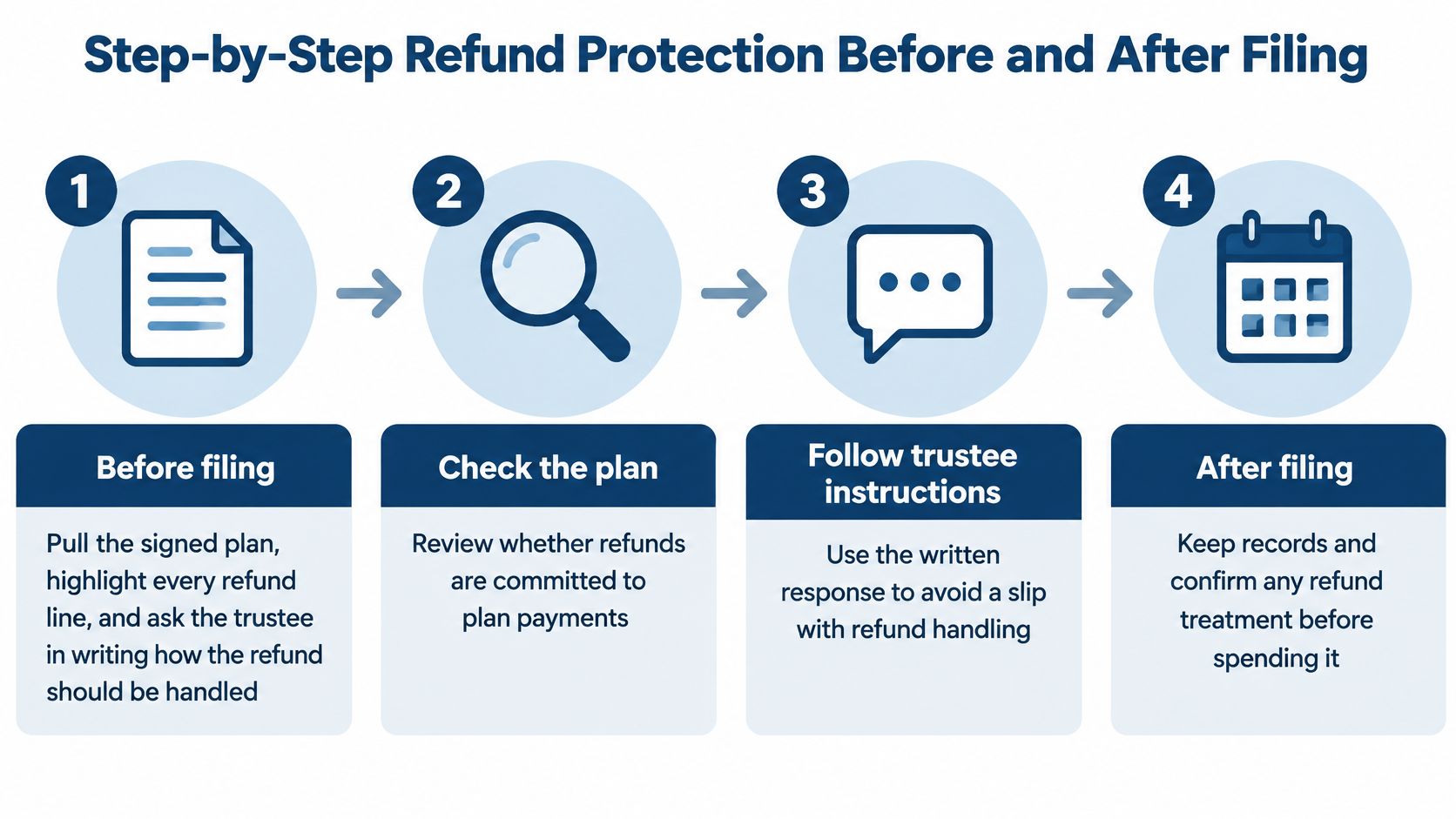
Refund protection depends on completing the required procedure, not finding a reassuring general rule. The useful sequence is to identify the governing documents, disclose the expected payment, obtain any required authority, and preserve proof.
LifeBack Law Firm, P.A. describes its Chapter 13 process in five steps, helps clients with all bankruptcy forms, and pulls their credit report. Refund handling also requires a separate record of the tax payment and the instructions governing it.
Before the return is filed
-
Pull the governing plan documents. Before filing the tax return, highlight every refund provision in the confirmed plan and related orders. Before the bankruptcy itself is filed, counsel should instead review the proposed treatment because no confirmed plan exists yet. The mistake is assuming every plan uses standard language.
-
Prepare a refund breakdown. Identify the tax year, federal and state components, withholding, and refundable credits. This gives counsel a usable calculation rather than a deposit estimate with no explanation. Don't assume that combined refunds receive identical treatment.
-
Send an advance notice through counsel. Provide the expected refund and flag any expense requiring a retention request. An estimate can start the discussion before the final figure is available. Waiting until the money arrives can leave little time to complete a required procedure.
-
File the return when required. Keep the filed copy, relevant schedules, and refund calculation. A tax-preparation summary alone may omit information needed for bankruptcy review. If an extension or amendment is necessary, counsel should address the related bankruptcy reporting requirements.
After filing and before spending
-
Deliver the required tax documents. Follow the recipient, format, and deadline specified by the plan, court, or trustee. Keep proof of submission. Sending documents to a tax preparer doesn't establish that the trustee received them.
-
Submit any required retention request. Counsel should use the applicable notice, motion, or modification procedure and attach evidence supporting the amount requested. A permitted retention category may still require procedural compliance. Filing a request also doesn't necessarily authorize immediate spending.
-
Preserve the money while review is pending. Counsel may recommend a separate account or another clear method of keeping the refund untouched and traceable. The account itself doesn't protect the funds legally. Its practical purpose is to prevent ordinary household spending from consuming money subject to turnover.
-
Use only the authorized amount. Obtain written confirmation of the applicable treatment and any required court approval before paying the proposed expense. Trustee correspondence cannot override the plan or a court order. Keep receipts showing that retained funds were used for the stated purpose.
Recordkeeping safeguard: Keep the return, refund calculation, written instructions, court authorization if required, and expense receipts together.
The file should also identify the exact plan provision governing the refund. That makes a later question about compliance answerable from documents rather than memory.
Tax Return Deadlines and Compliance Mistakes
Chapter 13 debtors remain responsible for required postpetition returns and current tax obligations. Postpetition tax liabilities generally aren't discharged, so a repayment plan isn't a substitute for staying current with taxes.
Tax filing and bankruptcy disclosure are separate duties. A debtor can submit a return to the tax agency yet still fail to deliver documents required by the trustee or court.
Resolve timing and offsets before counting on cash
The Western District of Texas refund rule illustrates why local procedures matter: qualifying refunds may first cure plan delinquency, with the remaining balance remitted to the debtor, and the rule permits offsets against qualifying priority tax debts and associated penalties and interest. Its accompanying local-rule examples include the Northern District of Texas treatment allowing retention of the first $2,000, not a nationwide entitlement.
An offset can reduce or eliminate the payment before the debtor receives it. The file should therefore distinguish the calculated refund, any tax-agency adjustment, and the actual payment.
An extension or amended return also needs attention. Counsel should determine who must receive the extension documentation or amended return, whether an additional refund must be disclosed, and whether an existing retention request needs updating.
A refund arriving after the case ends shouldn't be assumed unrestricted solely because of its arrival date. Counsel should review its origin, the case disposition, and any unresolved plan obligation before the check is cashed or the deposit is spent.
Costly mistakes to prevent
- Missing the filing deadline: An expected refund doesn't excuse an untimely required return.
- Failing to provide the return: Tax-agency acceptance doesn't satisfy a separate trustee disclosure obligation.
- Spending a restricted refund: Current monthly payments don't authorize use of money committed elsewhere by the plan.
- Ignoring an amended return: A corrected return may change the refund and require renewed disclosure or review.
These mistakes can create compliance problems even when the repayment account is current. The explanation of tax refunds and the importance of filing taxes during bankruptcy addresses why tax administration belongs in the ongoing case checklist.
Before the next return is filed, a Minnesota or North Dakota bankruptcy attorney should confirm the refund clause, identify the required submission procedure, and address any proposed use for necessities. That review is more useful before a payment is spent than after a turnover demand arrives.
LifeBack Law Firm, P.A. offers Chapter 13 bankruptcy guidance for Minnesota and North Dakota filers, including help understanding plan requirements and bankruptcy forms. Visit LifeBack Law Firm, P.A. to arrange a phone, video, or in-person consultation, and have the confirmed plan, latest tax return, and any trustee refund notice available for review.